How to Tell if Your AC Contractor is Actually Licensed and Insured


Is Your AC Repair Tech Hiding Their True Credentials?
Are you absolutely certain you know who is working on your expensive cooling system? Knowing exactly how to tell if your AC contractor is actually licensed and insured is the single most important step you can take before approving any repair or replacement estimate. When a cooling system breaks down, the urgency to get the cold air flowing again can cloud your judgment. In our years serving Lancaster homeowners, our team at Affordable Air and Heating has seen firsthand how vulnerable residents become to making rushed hiring decisions during late-summer August heatwaves, prioritizing speed and availability over proper vetting.
Unfortunately, this desperation creates the perfect environment for fly-by-night handymen and unqualified operators to target stressed homeowners. Hiring an unverified worker to handle complex electrical and refrigerant lines exposes you to massive liability risks, potential property damage, and voided equipment warranties. This guide will walk you through the exact steps to verify credentials so you can protect your home and your finances.
If you need professional HVAC services you can trust, our team provides verified, fully insured AC installation and repair to keep your home safe and cool.
The Difference Between a Business License and a California C-20 HVAC License
A pattern we see often in the field is illegal operators claiming they are "licensed" when they only hold a generic local business license. A local business license simply means a company has registered with the city to pay local taxes. It requires zero proof of technical skill, safety training, or trade knowledge. It does not mean they are legally allowed to open up your air conditioner.
In the state of California, any project requiring significant labor and materials must be performed by a contractor holding a valid California C-20 HVAC License. The state mandates this specific classification because heating, ventilation, and air conditioning work involves high-voltage electricity, pressurized refrigerants, and natural gas lines. Improper handling of these elements can lead to catastrophic property damage or severe safety hazards. Illegal operators often use vague "contractor" language to confuse homeowners, hoping you won't know the difference between a tax document and a state-issued trade license.
As a transparent, licensed HVAC company, Affordable Air and Heating proudly displays our C-20 classification on all estimates, contracts, and service vehicles so you never have to guess who is arriving at your door.
What Qualifies a Technician for a C-20 Classification?
Earning a California C-20 HVAC License is not a simple paperwork exercise. The Contractors State License Board (CSLB) requires applicants to prove a minimum of four years of journey-level experience in the HVAC trade before they can even sit for the exams. Candidates must pass a rigorous law and business exam, followed by a comprehensive trade exam that tests their knowledge of HVAC systems, safety protocols, and building codes. Furthermore, the state requires mandatory criminal background checks and fingerprinting, ensuring that the people entering your home have a clean record. Licensed contractors must also maintain a contractor's surety bond to protect consumers.
The Danger of the "Handyman Exemption" Myth
Many unlicensed workers try to hide behind the so-called "handyman exemption." In California, an unlicensed handyman can legally perform minor odd jobs, but only if the total cost of the project (including both labor and materials) stays under a very strict, minimal legal threshold. Because modern air conditioning equipment and specialized refrigerant are expensive, virtually all major AC repairs, compressor replacements, and full system installations far exceed this legal limit. If a handyman offers to replace your AC compressor or install a new condenser, our team strongly recommends walking away—they are almost certainly operating outside the law.
• Local Business License — What It Means: The business pays local city/county taxes. — What It Allows: Basic business operations, retail, or consulting. No trade work.
• Handyman Exemption — What It Means: Unlicensed worker doing minor odd jobs. — What It Allows: Only highly restricted, low-cost cosmetic or minor fixes.
• California C-20 License — What It Means: State-verified HVAC trade expertise and background check. — What It Allows: Full installation, repair, and maintenance of complex HVAC systems.
Step-by-Step: How to Use the CSLB Website for Verification
You should never take a contractor's word for it when they claim to be licensed. Verifying their status takes less than five minutes and provides absolute peace of mind. The State of California provides a free, public database through the Contractors State License Board (CSLB) where you can check the exact status of any contractor.
Recently, our team at Affordable Air and Heating helped a Lancaster homeowner who needed a quote for work on a new house under a serious time crunch as they prepped for the busy back-to-school transition. Even though they needed someone to come out the same day to handle end-of-season cooling issues, they still took a few minutes to verify our CSLB profile before moving forward. Because they verified they were dealing with a legitimate professional, the work was completed quickly and with high quality by our knowledgeable staff, rather than turning into a rushed, unlicensed disaster.
Information You Need Before Searching
Before you log on to verify a contractor, you need to gather a few basic pieces of information from their estimate, business card, or website:
• The exact CSLB license number: This is usually a 6-digit or 7-digit number. California law requires contractors to put this number on all advertisements, vehicles, and contracts.
• The legal business name: If you don't have the license number, you can search by the exact name of the business.
• The personnel name: You can also search by the name of the owner or the qualifying individual listed on the license.
Decoding the CSLB Status Page
Once you have the information, follow these steps to verify their credentials:
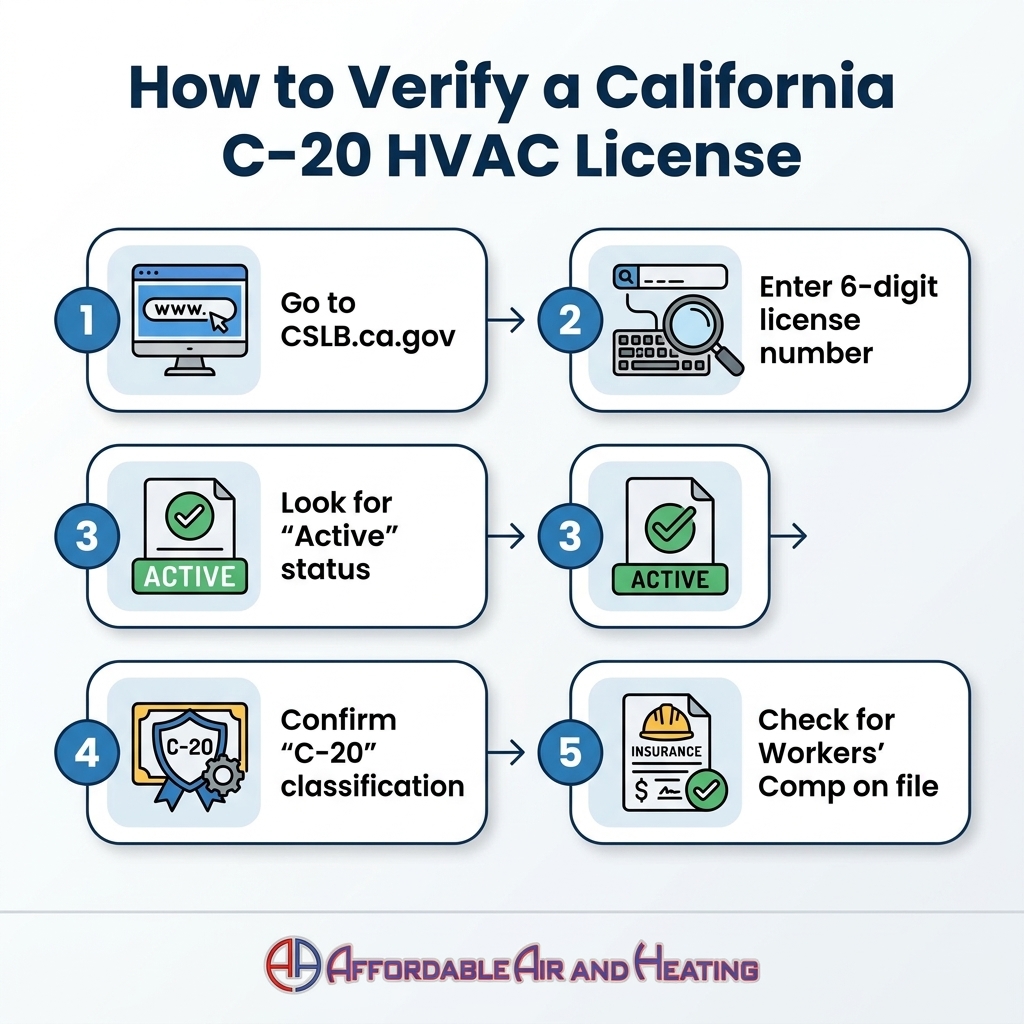
1. Navigate to the official Contractors State License Board website at cslb.ca.gov.
2. Click on the "Check a License" button prominently displayed on the homepage.
3. Enter the 6-digit or 7-digit license number into the search bar and hit submit.
4. Look directly at the "License Status" field. A healthy, legal license will clearly state "Active" in green text. If it says "Inactive," "Suspended," or "Expired," do not allow them to start work.
5. Scroll down to the "Classifications" section and verify that C-20 (Warm-Air Heating, Ventilating and Air-Conditioning) is explicitly listed.
6. Check the bottom of the page for the workers' compensation and bond history to ensure there are no current disciplinary actions against the company.
Why General Liability and Workers' Comp Are Non-Negotiable
A California C-20 HVAC License proves a contractor has the skill to do the job, but insurance proves they have the financial backing to protect you if something goes wrong. Many homeowners confuse different types of insurance or assume that a basic policy covers everything. In reality, a legitimate HVAC contractor must carry two very distinct types of insurance: General Liability and Workers' Compensation. Hiring a contractor who lacks either of these policies puts your home and your personal savings directly in the crosshairs of a lawsuit.
General Liability: Protecting Your Property
General Liability Insurance exists to protect your physical property. HVAC installations involve heavy equipment, water lines, and electrical wiring. If a technician accidentally drops a heavy air handler through your ceiling, or if an improperly welded pipe causes significant water damage to your drywall and flooring, general liability insurance pays for the repairs. If a contractor does not have this insurance, you will be forced to file a claim against your own homeowners insurance, which can increase your premiums or result in a denied claim if the insurance company discovers you hired an unlicensed worker. Verbal assurances that a contractor will "make it right" are never enough; you must always request a formal Certificate of Insurance (COI) directly from their insurance broker.
Workers' Compensation: Protecting Your Finances
While general liability protects your house, Workers' Compensation Insurance protects your bank account. In our experience, this is arguably the most critical insurance an HVAC contractor can carry. If a worker falls off a ladder, suffers a severe electrical shock, or gets injured while lifting a heavy compressor on your property, workers' compensation covers their medical bills and lost wages.
The legal reality in California is frightening for homeowners: if you hire an unlicensed, uninsured contractor and they get hurt on your property, you can be held personally and financially liable for their injuries. Even if the contractor is a sole proprietor operating without employees, hiring them without workers' compensation coverage presents a massive financial risk. Always verify that their workers' compensation policy is active on the CSLB website.
The Hidden Risks of Rushed Hiring Decisions During Heatwaves
When your air conditioning unit suddenly fails during the peak of summer, panic sets in quickly. Lancaster's extreme triple-digit desert heat is unforgiving, and the temperature inside a house without AC can become unbearable within hours. As families deal with the busy back-to-school transition, this intense late-summer climate creates a massive sense of urgency, leading many homeowners to skip the vetting process entirely just to get someone—anyone—out to their house immediately.
Illegal operators actively exploit this desperation. They monitor neighborhood forums and social media during late-summer August heatwaves, offering immediate service and undercutting the estimates of legitimate professionals. What they don't tell you is that their improper repairs can permanently damage your system. Installing an AC unit without pulling the proper vacuum on the refrigerant lines, or failing to size the ductwork correctly, will drastically shorten the lifespan of the equipment. Furthermore, every major HVAC manufacturer requires equipment to be installed by a licensed professional; hiring an unlicensed handyman instantly voids your factory warranty, leaving you completely unprotected when the system fails again. Also, keep in mind that generic energy rebates or federal tax credits may apply to qualifying heat pump installations, but only if the work is completed by a licensed contractor.
You do not have to sacrifice safety for speed. Legitimate companies understand the physical toll of the desert heat and have the infrastructure to provide rapid response without cutting corners on credentials. For example, our technicians recently responded to a local homeowner whose AC went out on a Saturday during peak August heat. Instead of panicking and hiring an unverified handyman, they called our licensed team. We came out on Sunday, secured the needed part, and had the system fully repaired and ready for the rest of the summer by Sunday afternoon. They got fast relief without taking on unnecessary liability.
Red Flags: Warning Signs of an Unlicensed Operator
Even if you know how to tell if your AC contractor is actually licensed and insured, illegal operators can be very persuasive. They often have professional-looking shirts and convincing stories about why their paperwork is "pending." To protect yourself, our team recommends watching out for these undeniable warning signs before you sign a contract or hand over any money.
• Demanding large cash deposits upfront: Legitimate contractors have the credit and capital to purchase materials. If a contractor demands a massive cash payment before any work begins, they are likely operating illegally. California law strictly limits the amount a contractor can request as a down payment.
• Refusing to provide a written estimate: A professional will always provide a detailed, written contract that clearly displays their CSLB license number, the scope of work, and the materials being used. If they only offer a verbal quote or a blank invoice, walk away.
• Arriving in unmarked vehicles: State law requires licensed contractors to display their business name and CSLB number on their commercial vehicles. A plain, unmarked van or personal truck is a major red flag.
• Asking you to pull local permits: A licensed C-20 contractor will always handle the permitting process with the city or county. If they ask you to pull the permit as an "owner-builder," they are trying to bypass the legal system because they do not have the credentials to pull the permit themselves.
Spotting these behaviors early is just as important as knowing the right questions to ask before hiring an HVAC company.
Frequently Asked Questions About HVAC Contractor Credentials
How do I check a contractor's license in California?
You can check a contractor's license by visiting the official Contractors State License Board (CSLB) website at cslb.ca.gov. Use the "Check a License" tool and enter the contractor's 6-digit or 7-digit license number. The database will immediately show you if their license is active, what classifications they hold, and if they have any disciplinary actions on their record.
What happens if I hire an unlicensed HVAC contractor?
Hiring an unlicensed HVAC contractor puts you at massive financial and legal risk. You risk voiding your expensive manufacturer warranties, missing out on potential utility incentive programs, facing severe local code violations, and assuming full liability for any property damage. If the installation is done incorrectly, you will have no legal recourse through the state to force the contractor to fix their mistakes.
What insurance should an AC contractor have?
A legitimate AC contractor must carry both general liability insurance and workers' compensation insurance. General liability covers accidental damage to your home or property during the repair process. Workers' compensation covers the medical expenses and lost wages of the technicians if they are injured while working on your property.
Does an HVAC contractor need a license?
Yes, in California, any project over a minimal financial threshold requires a state-issued C-20 HVAC license. A standard local business license is not enough to legally perform heating and air conditioning work. The C-20 classification ensures the contractor has passed trade exams, background checks, and possesses the necessary journey-level experience.
Can I be sued if an unlicensed contractor gets hurt on my property?
Yes, without workers' compensation coverage, the homeowner can be held directly liable for medical costs and lost wages. If an unlicensed handyman falls off a ladder or suffers an electrical injury at your house, their medical bills could become your financial responsibility. This is why verifying active workers' compensation on the CSLB website is absolutely critical.
Are bonded HVAC contractors better?
A surety bond is legally required for a California contractor's license, so being bonded is a baseline requirement, not an optional bonus. Every active, licensed C-20 contractor must maintain a bond to protect consumers from substandard work or failure to pay suppliers. If a contractor claims being bonded makes them "premium," they are simply stating they meet the minimum legal requirements to operate.
Demand Proof Before You Approve the Estimate
Taking five minutes to verify a CSLB profile and request insurance documents is the easiest way to prevent massive financial headaches down the road. Never let the stress of a broken air conditioner push you into a rushed decision with an unverified handyman. Demand transparency, check the state database, and ensure you are fully protected before anyone touches your cooling system.
When you are ready to work with a team that values your safety and peace of mind as much as your comfort, contact our certified technicians. We provide clear, actionable steps on our credentials and will gladly supply all necessary C-20 license and insurance documentation before any work begins.