Thanksgiving Emergency Heating Calls: The Most Common Culprits We See


When Holiday Hosting Meets Heating System Stress
Thanksgiving in the Lancaster area is only weeks away, and your heating system is about to face its biggest stress test of the year. When our Affordable Air and Heating dispatchers log Thanksgiving Emergency Heating Calls: The Most Common Culprits We See, the story almost always begins with a frustrated host. Your furnace is running constantly, yet the house feels entirely uncomfortable. In our experience, the concrete problem lies in a clash of environments: the intense indoor heat from cooking and a house full of guests, battling against the sharp, sudden temperature drops outside. This unique combination forces your system to work in ways it wasn't designed for, often causing it to short-cycle or trigger a complete safety lockout just as the evening chill hits.
As a host, you face a critical decision point before the first guest even arrives. You must proactively manage your thermostat settings and home airflow to prevent a mechanical failure during dinner. Relying on a solid foundation of professional HVAC services and scheduling proactive heating repair and maintenance with our team in late November ensures your gathering remains memorable for the food and family, rather than a freezing living room.
The Hidden Heat Load of Holiday Gatherings
Over our years of serving Lancaster homeowners, we've found that most severely underestimate how much heat is generated internally during a large late November gathering. Your central heating system is sized based on the square footage of your home and typical daily activities. When you introduce a dozen extra people and run heavy appliances for hours, you completely alter the physics of your home's thermal environment.
Every adult guest generates approximately 300 to 400 BTUs (British Thermal Units) of heat per hour. If you host ten people, that is up to 4,000 extra BTUs of heat radiating through your living spaces. Add active ovens and stovetops to the mix, and the ambient temperature in your kitchen and adjoining dining rooms will rise rapidly. This localized heat creates uneven thermal zones throughout the house, completely confusing your central heating system.
Common Holiday Heat Sources:
• Adult Guests — Estimated Output: 300-400 BTUs/hr per person — Impact on Home Comfort: Raises ambient room temperature quickly in crowded areas.
• Oven (Roasting Turkey) — Estimated Output: High continuous heat — Impact on Home Comfort: Creates a massive micro-climate in the kitchen.
• Stovetop Burners — Estimated Output: Intermittent high heat — Impact on Home Comfort: Pushes warm, humid air into adjoining dining spaces.
• Dishwasher — Estimated Output: Steam and residual heat — Impact on Home Comfort: Adds humidity, making the air feel even warmer.
This massive internal heat generation often gives hosts a false sense of security during the afternoon. The house feels warm, so you assume the furnace is working perfectly. However, our technicians know all too well that this localized heat is actually setting the stage for a system failure when the outdoor environment shifts.
Thermostat Confusion: Why Your Furnace Short-Cycles During Dinner
The Problem: You are sitting down to dinner, and you notice the furnace kicking on, running for two minutes, and immediately shutting off. This mechanical failure is known as short-cycling. Our team sees this constantly: it happens when a heating system turns on and off too rapidly without ever completing a full heating cycle, putting immense wear and tear on the blower motor and heat exchanger.
The Cause of the Confusion
Short-cycling during a holiday gathering almost always traces back to thermostat misreads. As we often explain to our customers, your thermostat only measures the temperature of the air immediately surrounding it. If your thermostat is located in a hallway near the kitchen or a crowded living room, it registers the massive localized heat from the oven and your guests. The thermostat prematurely signals to the furnace that the entire house has reached the target temperature, shutting the system down.
The Yo-Yo Effect
Because the furnace shuts off early, peripheral rooms—like guest bedrooms and bathrooms—never receive warm air. As sudden evening temperature drops begin to chill those outer rooms, guests get cold. Someone inevitably walks over to the thermostat and manually cranks the heat up by five or ten degrees. The furnace fires up, immediately senses the kitchen heat again, and shuts down two minutes later. This constant on-and-off yo-yo effect is a primary cause of motor burnout.
The Solution: Breaking this cycle requires strategic airflow management. By preparing your heating system for holiday guests ahead of time, you can balance the temperatures across the house and keep the thermostat reading accurately.
Surviving the High Desert Evening Chill
The mechanical stress of a holiday gathering is severely amplified by our local climate. As local heating experts, we know firsthand that the Lancaster high desert experiences extreme diurnal temperature variation—meaning the difference between daytime highs and nighttime lows is massive, especially in late fall.
The Daytime Lull
During a typical Thanksgiving afternoon, outdoor temperatures might sit comfortably in the 60s. Combined with the internal heat from cooking and guests, your furnace will likely sit completely idle for six to eight hours. The system falls into a deep lull, requiring zero effort to keep the house warm.
The Nighttime Shock
As soon as the sun sets over the high desert, the lack of atmospheric humidity causes the outdoor temperature to plummet. Within a couple of hours, it can drop into the upper 30s. Suddenly, the internal heat of your guests is no longer enough to fight off the creeping cold seeping through the walls and windows. Your furnace is abruptly called upon to transition from zero activity to maximum heating capacity in a matter of minutes.
This intense, sudden demand placed on the heating system is a massive shock to the components. Bearings that have been sitting cold all day are suddenly forced into high gear. Ignitors are rapidly cycled. This rapid transition from idle to maximum capacity is a primary trigger for the emergency breakdowns our technicians respond to, turning a pleasant evening into a scramble for blankets.
Furnace Safety Lockouts Triggered by Holiday Chaos
A furnace safety lockout is a built-in protective mechanism. When the system's internal sensors detect a dangerous condition—such as a lack of airflow, a failing flame sensor, or an overheating heat exchanger—the control board shuts the entire system down to prevent permanent damage or a fire hazard. During a busy gathering, physical disruptions in the home frequently cause the sudden evening temperature drops to trigger these lockouts. In fact, blocked airflow is one of the most common reasons our dispatch phones ring during holiday dinners.
Here is how the chaos of hosting physically chokes your heating system:
1. The Dining Room Expansion: To make room for extra folding tables and chairs, hosts often push sofas, rugs, and sideboards against the walls. This frequently covers up supply registers and return grilles, completely blocking the airflow the furnace needs to breathe.
2. The Guest Room Quarantine: It is common practice to close the doors to messy bedrooms, home offices, or unused areas before guests arrive. Closing too many interior doors traps air in specific zones and starves the central return vent of the air it needs to circulate, causing the system to overheat.
3. The Coat Pile: Stacking dozens of heavy winter coats on a bed or bench that sits directly over a return vent acts as a thick, suffocating blanket for your HVAC system.
What you can do: Walk through your home before guests arrive and ensure there is at least two feet of clear, unobstructed space around every single supply vent and return grille. Do not attempt to bypass or reset a locked-out furnace repeatedly; if the system locks out, it is protecting your home from a serious mechanical failure.
How Extra Foot Traffic Impacts Filter Life and Air Quality
A house full of guests does more than just generate heat; it dramatically changes the air quality inside your home. Every time the front door opens, wind from the Lancaster high desert blows in extra dust and dirt. Dozens of shoes track in debris. Extra people moving around stir up existing pet dander and carpet fibers that usually sit dormant.
All of this airborne particulate matter gets sucked directly into your HVAC return vents and caught by your air filter. Our maintenance crews frequently pull out completely clogged filters immediately following large holiday gatherings.
A compromised, heavily soiled air filter acts like a brick wall in your ductwork. It forces the blower motor to work twice as hard to pull air through. This extra strain causes the motor to draw more electricity, overheat, and eventually trip a high-limit safety switch, shutting your heat off right in the middle of dessert. Checking and replacing your air filter a few days before hosting a large event is a non-negotiable maintenance step. Furthermore, upgrading your filtration system is one of the most effective indoor air quality solutions our team installs for keeping your home healthy year-round.
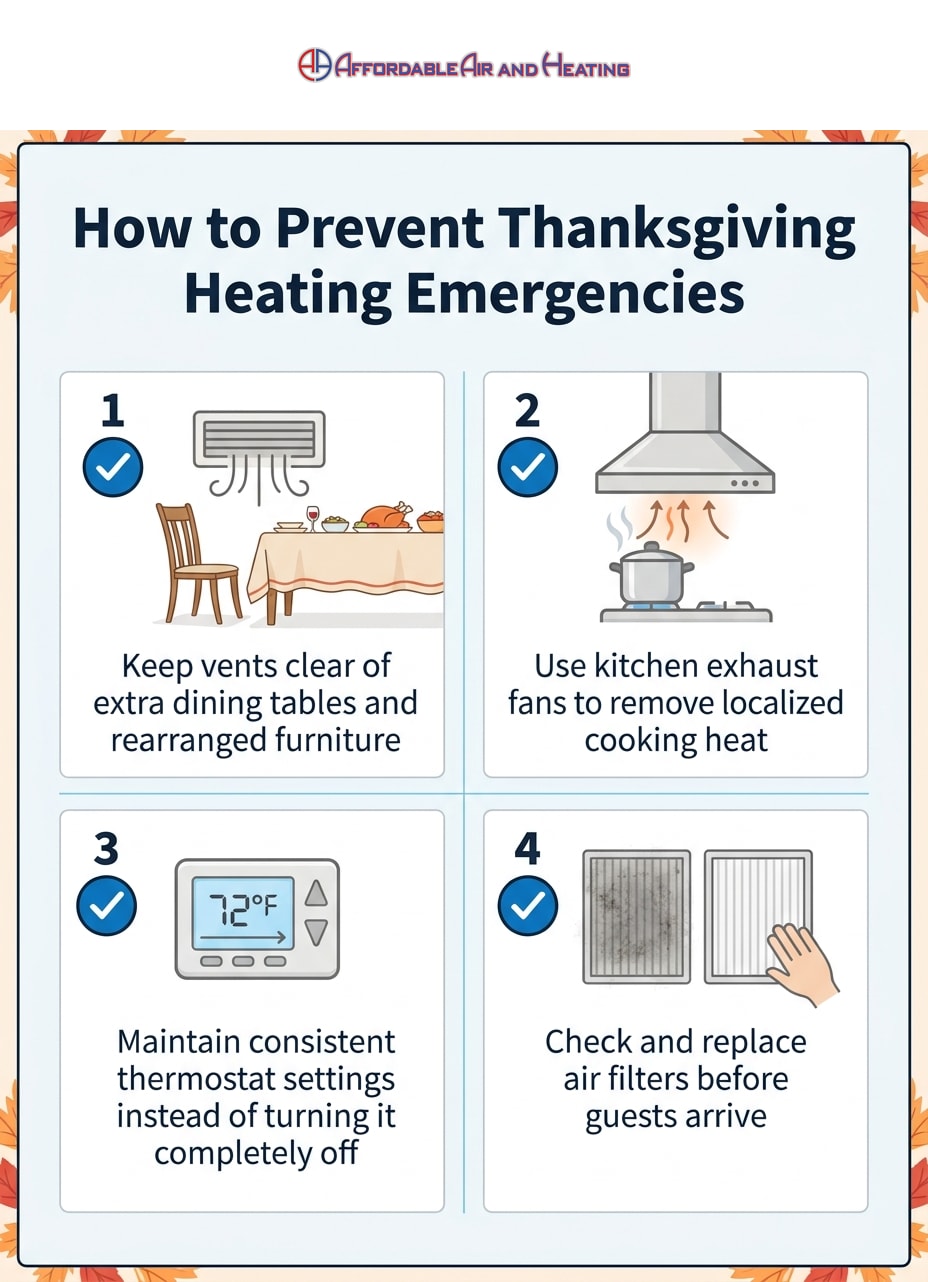
Preventing a Thanksgiving Heating Emergency: A Host's Checklist
Managing the conflicting stresses of Thanksgiving or late November gatherings requires a bit of strategy. The team at Affordable Air and Heating recommends actively managing your home's airflow to prevent thermostat misreads and keep your furnace running smoothly.
• Run your kitchen exhaust fans: Use your vented range hood while cooking to actively pull excess localized heat and humidity out of the kitchen. This prevents the nearby thermostat from getting a false high reading.
• Keep interior doors open: Promote balanced airflow throughout the home by leaving bedroom and hallway doors open. This allows the return vents to pull air evenly from all zones.
• Maintain a consistent temperature: Set the thermostat to a moderate, consistent temperature early in the day. Do not turn the heating system completely off during the afternoon, as this forces the furnace to work exponentially harder to recover when the evening chill hits.
• Schedule a professional tune-up: The best defense against a holiday breakdown is having one of our certified technicians inspect, clean, and calibrate your system in early November before the heavy usage begins.
Frequently Asked Questions About Holiday Heating
Why is my furnace blowing cold air when I have guests?
In our experience, this is often caused by an overheated system hitting a safety limit due to restricted airflow or a dirty filter. When the system overheats, the burners shut off for safety, but the blower motor continues to run to cool the system down. This results in cold air blowing out of your vents even though the thermostat is set to heat. Check your filter and ensure no furniture is blocking your vents.
How should I set my thermostat for a Thanksgiving party?
We advise setting it a few degrees lower than normal before guests arrive, but avoid turning it off completely to prevent a massive workload later. Because bodies and ovens generate so much heat, dropping the baseline temperature slightly keeps the house comfortable during the afternoon. However, keeping the system active ensures it doesn't have to fight a massive temperature deficit when the sun goes down.
What causes a furnace to short-cycle in the winter?
Short-cycling is usually caused by thermostat misreads from nearby heat sources, oversized systems, or restricted airflow causing rapid overheating. During holidays, the intense heat from the kitchen tricks the thermostat into shutting the furnace off prematurely. The system then rapidly turns back on when peripheral rooms get cold, repeating the cycle and wearing out the motor.
How do you keep a house warm with a lot of guests?
Rely on the ambient heat of bodies and cooking, but keep air circulating with ceiling fans to distribute the warmth evenly. Our technicians also recommend running your furnace fan on the "ON" setting rather than "AUTO" to constantly mix the air from the hot kitchen with the cooler air in the bedrooms. This balances the thermal zones and keeps everyone comfortable.
What should I do if my heater fails on a holiday?
Check the filter and your electrical breaker first, then contact a professional with transparent holiday availability. Sudden evening temperature drops can make a failed heater dangerous quickly. Never attempt to open the furnace cabinet or bypass safety switches yourself; always rely on a trained technician to diagnose the mechanical failure safely.
Keep Your Home Warm and Stress-Free This Holiday
Understanding exactly why heating systems fail under the intense stress of holiday hosting is your first and best step toward prevention. By actively managing your thermostat, keeping your vents clear, and changing your air filter before the Lancaster high desert winds pick up, you can protect your equipment from the shock of sudden evening temperature drops.
At Affordable Air and Heating, we highly encourage proactive pre-holiday maintenance checks to ensure your system is ready for the heavy lifting. However, if the unexpected does happen and you find yourself facing a breakdown, you don't have to panic. We provide transparent emergency dispatch and trusted diagnostics, ensuring that holiday and weekend emergency calls are handled professionally, without hidden fees. If you need immediate assistance, our technicians are ready to help across all our emergency dispatch locations. Stay warm, stay safe, and enjoy your holiday season.