Is Your Outdoor Condenser Sounding the Alarm?
Are you suddenly standing in your yard, trying to figure out what went wrong by decoding strange noises from your outdoor AC unit? Hearing an aggressive buzzing, a harsh rattling, or a loud metal-on-metal screech coming from your yard equipment is enough to make any homeowner panic. When you rely on your cooling system to keep your family comfortable, the last thing you want to deal with is a sudden mechanical failure.
During the intense, unrelenting July peak summer heat here in Lancaster, our technicians at Affordable Air and Heating see outdoor condensers working overtime to reject heat from inside your home. Under this heavy load, normal wear and tear can rapidly escalate into a serious mechanical issue. When you hear an abnormal sound, your system is waving a red flag. Ignoring that warning often leads to catastrophic compressor failure, leaving your home sweltering and your wallet significantly lighter. The good news is that understanding what these sounds mean can help you take immediate action to protect your equipment.
Not all sounds are created equal. Some noises indicate a minor nuisance that can wait for a scheduled tune-up, while others require you to cut the power instantly to save your system's most vital components. By learning how to differentiate between these sounds, you can safely troubleshoot the situation from the outside without risking personal injury. If you are ever in doubt about the health of your air conditioning systems, we always recommend prioritizing safety and shutting the unit down as the smartest move.
Is It Safe to Run My AC If It's Making a Noise?
The short answer is almost always no. Continuing to run a noisy AC unit is a massive gamble that frequently results in extensive, irreversible damage to the system. While it might be tempting to let the unit limp along just to keep the house cool for a few more hours, our team often sees that decision turn a relatively straightforward repair into a complete system replacement.
To protect your equipment, you must differentiate between minor environmental nuisance sounds and the sounds of critical mechanical failure. A quiet ticking from a stray leaf brushing against the fan grate is very different from the screeching metal-on-metal vs electrical buzzing that signals a part is actively dying. If you hear heavy metal grinding, aggressive electrical humming, or high-pitched squealing, your immediate reaction should be to walk to your indoor thermostat and switch the system to the "OFF" position.
The Financial Risk of Ignoring the Sound
When a single component begins to fail, it forces the rest of the system to compensate. Your outdoor condenser relies on a delicate balance of electrical current, refrigerant pressure, and mechanical rotation. If a fan motor seizes or a capacitor fails, the compressor—the heart of your cooling system—is suddenly forced to operate under extreme duress.
Ignoring a failing part forces the compressor to draw higher electrical currents and operate at dangerously high temperatures. What starts as a simple component replacement can quickly turn into a full system failure if left running under load. The compressor will repeatedly try to start, overheating its internal windings until they short out or burn up completely.
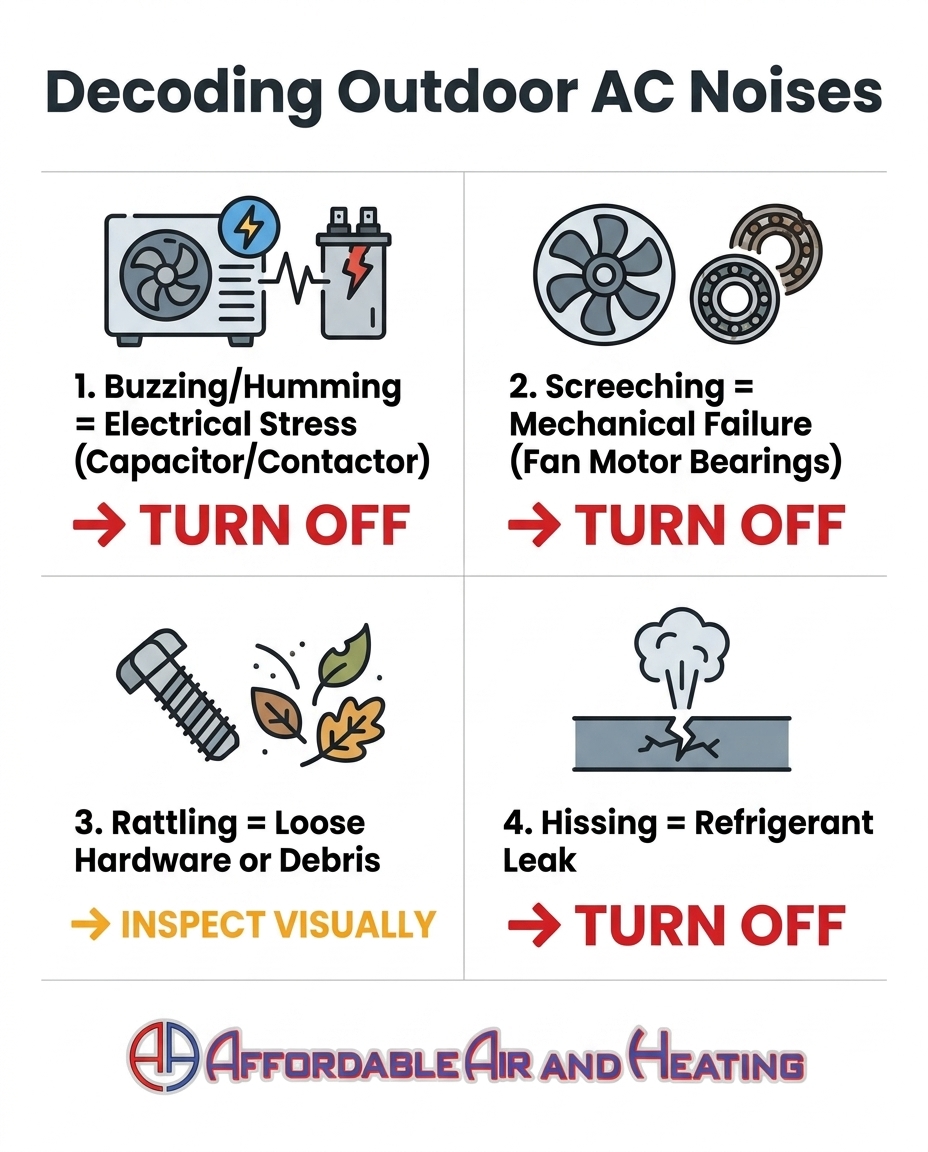
• Light Ticking or Clicking — Likely Cause: Debris (leaves/twigs) touching the fan blade — Immediate Action Required: Visually inspect; turn off to safely remove debris
• Aggressive Buzzing/Humming — Likely Cause: Electrical failure (capacitor or contactor) — Immediate Action Required: Turn thermostat OFF immediately
• Screeching or Squealing — Likely Cause: Failing fan motor bearings — Immediate Action Required: Turn thermostat OFF immediately
• Loud Clanking or Banging — Likely Cause: Loose internal hardware or failing compressor — Immediate Action Required: Turn thermostat OFF immediately
Electrical Buzzing and Humming: Identifying Component Stress
One of the most common and alarming sounds a homeowner can hear is a loud, aggressive buzzing or humming coming from the outdoor condenser. This noise typically occurs when the unit receives the signal from the thermostat to turn on, but the fan blades refuse to spin, and the compressor fails to engage. Instead of the familiar rush of air, the unit just sits there, vibrating with a heavy electrical drone.
This distinct sound almost always points to an issue with the dual run capacitor or the contactor relay. The contactor is a high-voltage switch that pulls closed to send power to the unit, while the capacitor acts like a massive battery, delivering the initial jolt of electricity needed to start the compressor and the fan motor. When a capacitor fails, the motors lose their starting torque. They become stuck in a "locked rotor" state, drawing massive amounts of electricity and humming loudly as they struggle to move.
Continuous operation in extreme ambient temperatures (above 95 degrees) accelerates the risk of capacitors swelling, overheating, and failing. When the high desert sun beats down on the metal cabinet, the internal electrical components face immense thermal stress. Routine HVAC system maintenance is the best way to catch these weakening components before they leave you stranded.
If you hear this electrical buzzing, follow these steps immediately:
1. Do not touch the unit: Never attempt DIY testing of capacitors. They store dangerous, potentially lethal amounts of high voltage even after the power to the house is turned off.
2. Shut off the thermostat: Go inside and switch your thermostat from "COOL" to "OFF."
3. Wait for a professional: Shutting off the system prevents the compressor from overheating and suffering permanent damage while trying to pull locked-rotor amps.
Screeching Metal-on-Metal: Diagnosing Fan Motor Issues
If your outdoor unit sounds like a car with bad brakes, you are likely dealing with a condenser fan motor issue. A piercing screeching or squealing noise often indicates that the bearings inside the fan motor have lost their lubrication or have completely worn down. As the metal components grind against one another at high speeds, they produce a high-pitched wail that is impossible to ignore.
The condenser fan plays a vital role in your cooling system. Its job is to pull outside air through the hot condenser coils, rejecting the heat that the refrigerant absorbed from inside your home. If the fan motor seizes and the blades stop spinning, the compressor cannot reject that heat. The temperature and pressure inside the system will spike rapidly, leading to severe thermal overload and potential compressor death.
Why Modern Motors Require Replacement
In older systems, technicians could sometimes oil or lubricate a squeaking fan motor to extend its life. However, modern high-efficiency HVAC systems utilize sealed motor bearings. Once these sealed bearings begin to fail and screech, the entire motor assembly must be replaced. Ignoring the screeching will only result in the motor burning out entirely, leaving your home without air conditioning when you need it most.
Systems pushed to the brink in the peak summer heat often show warning signs first. A squealing or terrible racket from the outdoor unit can mean a seized motor. If you notice a similar squealing sound, we strongly advise turning off the AC immediately to save the compressor from thermal overload. Taking swift action and having our experts fix loud AC noises is the best way to prevent a total breakdown.
Rattling and Clanking: The Impact of Environmental Debris
Not every terrifying noise means the end of your air conditioner's life. Rattling and clanking sounds can range from something as minor as a loose cabinet panel screw to something as severe as internal compressor damage. Because the outdoor unit vibrates constantly while running, it is entirely normal for hardware to slowly loosen over years of operation.
The environmental factor: In our experience maintaining HVAC systems across the Antelope Valley, we've seen firsthand how the Lancaster high desert climate plays a massive role in how your outdoor unit ages. Lancaster's blowing dust, tumbleweeds, and high desert winds can easily infiltrate outdoor condenser cabinets. Over time, these relentless winds rattle the louvered panels, loosening hardware and forcing twigs, pebbles, and heavy dust through the condenser grates. When debris strikes the spinning metal fan blades, it creates a loud, chaotic clanking noise.
Visual inspection: If you hear rattling, you should visually inspect the exterior of the unit with a flashlight. Look through the top grate to see if a stick or heavy debris has fallen into the fan chamber. Do this without opening any panels or inserting tools into the unit. If you see an obstruction, turn the power off at the thermostat before attempting to remove it safely.
Internal mechanical failure: If the exterior is clear and the panels are tight, but the clanking sounds like it is coming from inside the large, sealed black cylinder at the bottom of the unit (the compressor), you have a major emergency. A clanking compressor usually means internal valves or pistons have broken loose, signifying a severe internal mechanical failure that requires immediate professional intervention.
Hissing or Bubbling Sounds: Recognizing Refrigerant Leaks
While buzzing and screeching are loud and aggressive, a hissing or bubbling sound is often more subtle, yet equally dangerous to your system's health. If you walk past your outdoor condenser and hear a continuous hissing sound—especially one that persists even when the fan is off and the unit is not actively cooling—you are likely dealing with a refrigerant leak.
Your air conditioner operates as a closed-loop system, circulating pressurized chemical refrigerant between the indoor evaporator coil and the outdoor condenser coil. When a breach occurs in the copper lines or the aluminum coils, that highly pressurized refrigerant escapes into the atmosphere, creating a distinct hissing or bubbling noise.
The Consequences of Lost Refrigerant
As the system loses its refrigerant charge, it will soon lose its ability to cool the home. The pressure drop inside the system causes the temperature of the indoor evaporator coil to plummet below freezing. Moisture from the air will condense and freeze on the coil, eventually turning your indoor unit into a solid block of ice. This severely restricts airflow and can send liquid refrigerant flooding back into the outdoor compressor, destroying it.
Handling refrigerant requires specialized EPA certification and is strictly a professional repair. You cannot simply patch a high-pressure line with tape or attempt to recharge the system yourself. If you hear hissing, turn the system off immediately to prevent the compressor from burning out due to a lack of cooling refrigerant, and reach out for professional HVAC services to locate and braze the leak properly.
When to Shut Down Your System to Prevent Catastrophic Failure
Deciphering outdoor AC noises ultimately comes down to one critical decision: knowing exactly when to cut the power. The golden rule of HVAC diagnostics is simple: If you hear screeching, buzzing, or hissing, turn the thermostat to "OFF" immediately. Do not wait to see if the sound goes away on its own, and do not try to force the system to push through the failure to keep your house cool.
How to safely shut down your unit:
1. Walk to your indoor thermostat.
2. Switch the system mode from "COOL" to the "OFF" position.
3. Ensure the fan setting is switched to "AUTO" rather than "ON."
4. Do not attempt to pull the high-voltage disconnect switch outside unless you are trained to do so safely.
Reassure yourself that a timely shutdown often preserves the most expensive components in your system. By stopping the compressor from running under extreme stress, you might turn a massive replacement job into a simple, affordable part swap.
A professional diagnostic visit entails a thorough inspection of the unit's health. A certified technician will check electrical loads, test capacitor microfarads, verify motor health, and inspect the coils for damage. Affordable Air and Heating is committed to honest, cost-effective diagnostics. Our goal is to empower you to make a confident "shut off" decision without fear of being aggressively upsold on unnecessary replacements.
Get Professional Help for Your Noisy Air Conditioner
Your air conditioning system is one of the most vital investments in your home, especially when the summer heat reaches its peak. Don't wait for a strange sound to turn into a total breakdown. The longer a struggling system operates, the higher the risk of permanent, irreversible damage to the compressor.
If your outdoor condenser is buzzing, rattling, or screeching, take control of the situation by shutting the system down at the thermostat. Once the unit is safely powered off, schedule a diagnostic visit to protect your system. Our local team can identify the exact cause of the noise and provide a clear, transparent solution to restore your comfort. Don't let a noisy AC unit ruin your summer—contact us today and let our experts handle the heavy lifting.
Frequently Asked Questions
Why is my outside AC unit making a loud buzzing noise?
A loud buzzing noise usually indicates an electrical failure, most commonly a bad capacitor or a failing contactor relay. When these components fail, the compressor and fan motor cannot start, causing them to hum loudly as they draw excessive electrical current. You should turn the system off immediately at the thermostat to prevent the compressor from overheating and suffering permanent damage.
Is it safe to run my AC if it is making a noise?
It is generally not safe to run your AC if it is making loud, abnormal noises. While a light ticking might just be a twig in the fan grate, heavy grinding, screeching, or buzzing indicates serious mechanical or electrical stress. Continuing to run the system under these conditions forces the compressor to work harder, often turning a minor repair into a catastrophic system failure.
What does a bad AC condenser sound like?
A failing AC condenser can produce several distinct warning sounds depending on the broken component. You might hear a piercing metal-on-metal screech if the fan motor bearings are failing, or a loud electrical buzzing if the starting capacitor is dead. Additionally, a heavy, chaotic clanking from inside the sealed unit usually points to internal compressor damage.
How do I fix a noisy AC compressor?
Fixing a noisy AC compressor requires professional diagnostic tools and EPA certification, as it involves high-voltage electricity and pressurized refrigerant. Homeowners should never attempt to open the condenser cabinet or test electrical components themselves. The best and safest action you can take is to turn the thermostat to the "OFF" position and call a licensed HVAC technician to diagnose the root cause.
Can a dirty condenser coil cause strange noises?
Yes, a severely dirty condenser coil can eventually lead to strange noises by forcing the system to overwork. When dirt and debris block airflow, the system cannot reject heat properly, causing internal pressures and temperatures to spike. This extreme stress can cause the compressor to run louder than normal or cause the fan motor bearings to wear out prematurely and begin screeching.
Why does my AC make a loud screeching sound when it turns on?
A loud screeching sound when the AC turns on is almost always caused by failing bearings inside the condenser fan motor. As the lubrication dries up or the sealed bearings break down, the metal components grind against each other at high speeds. This requires immediate attention, as a seized fan motor will cause the entire system to overheat and shut down.