Why Your Air Conditioner Runs Constantly but Won't Cool the House


Is Your AC Running Nonstop Without Cooling Your Home?
Is your air conditioner running for hours on end, yet the rooms inside still feel warm and sticky? Figuring out why your air conditioner runs constantly but won't cool the house is one of the most frustrating parts of homeownership, especially when you are dealing with intense late August summer heat. You hear the system working, you see the fan spinning, but the relief you expect just never arrives.
In our experience servicing homes across the Lancaster high desert climate, we know firsthand that triple-digit temperatures put extreme thermal stress on your home. When the outdoor heat is that relentless, your cooling system has to work flawlessly just to keep up. If it is struggling as you prep for the back-to-school season, you are left facing a critical decision point: trying to figure out if the issue is a massive duct leak, an undersized unit, or a slow refrigerant leak before you make a frantic service call. The good news is that by simply observing how your system operates, you can often narrow down the root cause. If you are dealing with a system that simply cannot keep up and you need immediate help, reaching out for professional HVAC services or scheduling air conditioning repair and diagnostics is the fastest way to restore your comfort.
Quick Diagnostics: The 3 Primary Causes of Constant Runtimes
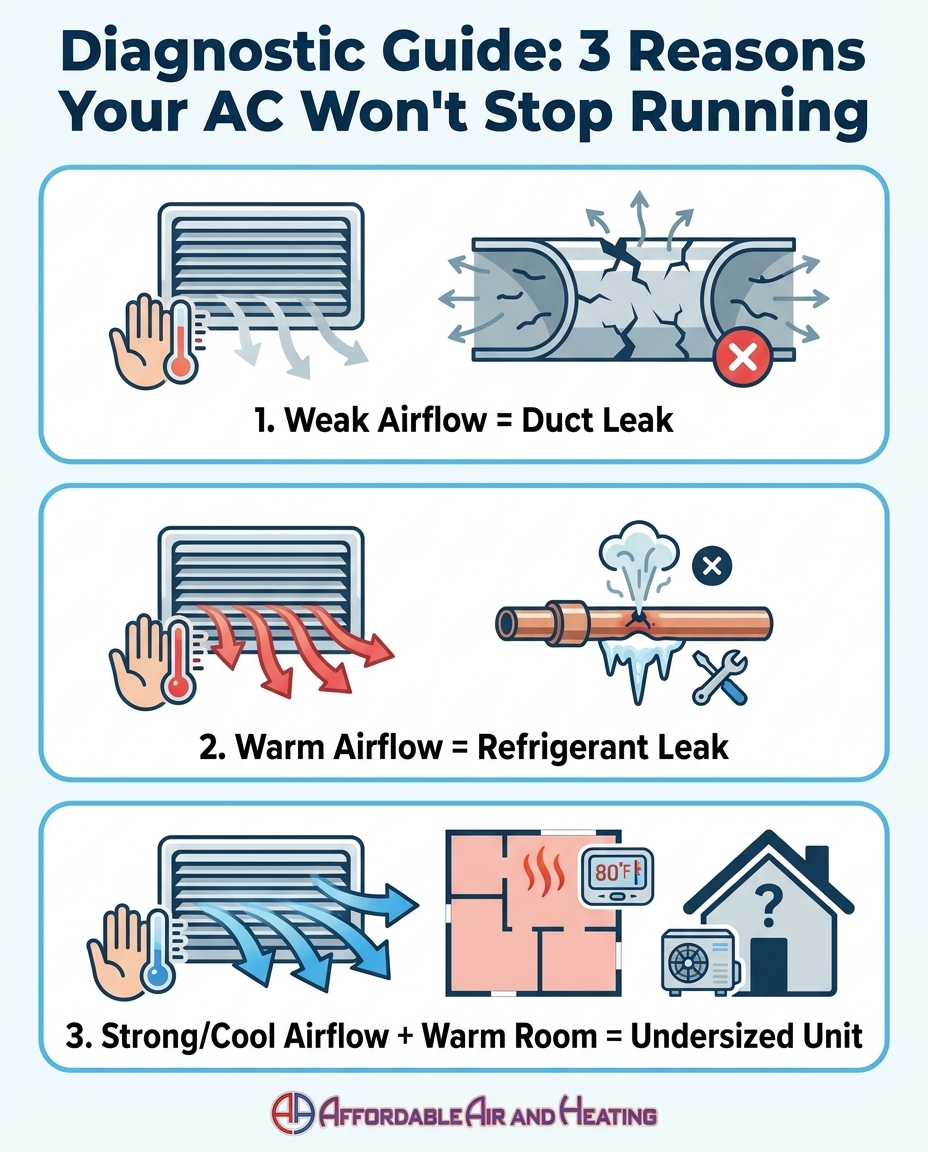
When you have your thermostat set to 72°F but the room is stuck at 78°F, it is easy to assume the entire system is broken. However, continuous runtimes usually boil down to one of three specific mechanical realities. By observing the air coming out of your vents, you can perform a quick diagnostic check to understand what is happening behind the walls.
When our technicians arrive at a home for this issue, we typically find the culprits behind a constantly running AC include:
• Weak airflow at the vents: If the air is cold but barely trickling out of the register, our team usually identifies a severe duct leak, a clogged filter, or a failing blower motor. The system is producing cold air, but that air is never making it into your living space.
• Warm or room-temperature airflow: If the blower is pushing plenty of air into the room but the air feels lukewarm, this almost always points to a refrigerant leak or a failed compressor. The indoor fan is circulating air, but no actual heat transfer is taking place.
• Strong, cool airflow that never reaches the target temperature: If the system is blowing strong, cold air but the house simply will not cool down, you are likely dealing with an undersized unit or an extreme heat load that has surpassed the system's design capacity.
Understanding these three distinct behaviors prevents panic. Instead of just knowing the house is hot, you will know exactly what symptom to report to our dispatch team.
The 15-to-20 Degree Rule: Measuring Your System's Performance
To truly understand why your system is running constantly, you need to know what a healthy air conditioner is actually supposed to do. A properly functioning AC system typically creates a 15 to 20-degree temperature drop between the return air (the warm air being pulled into the system) and the supply air (the cold air blowing out of the vents). At Affordable Air and Heating, our technicians refer to this as the "temperature split," and it is one of the first things we measure during a service call.
How to Observe the Temperature Split
You do not need specialized, expensive tools to observe this basic function. If your home is currently 80°F, the air coming out of your supply vents should be somewhere between 60°F and 65°F. You can test this safely by holding a basic digital thermometer near the return vent for a few minutes to get a baseline reading, and then holding it directly in the airflow of a supply vent.
If the air coming out of the vents is only 5 or 10 degrees cooler than the room, the system will be forced to run continuously because it lacks the cooling power to satisfy the thermostat. This is exactly why you end up with a thermostat set to 72°F but the room stuck at 78°F. The equipment is running, but the mathematical heat removal required to drop the indoor temperature simply is not happening. Recognizing this split helps you confirm that the issue is a mechanical performance problem rather than just a broken thermostat.
Symptom 1: Weak Airflow and the Threat of Massive Duct Leaks
One of the most common reasons we find an air conditioner running non-stop is that the cold air it produces is escaping before it ever reaches you. If you hold your hand up to a vent and feel barely any air moving, your system is likely suffering from a severe airflow restriction or a massive duct leak.
The Hidden Cost of Leaky Ductwork
Ductwork is typically routed through unconditioned spaces like attics or crawlspaces. Over time, the seams in these metal or flexible ducts can separate, or the material can tear. When this happens, your air conditioner works perfectly fine at the indoor coil, but it ends up pumping crisp, cold air directly into your hot attic. Because the conditioned air never reaches the living space, the thermostat never registers a drop in temperature, forcing the unit to run 24/7.
Blower Motor Failures
Beyond duct leaks, weak airflow can also be caused by a failing indoor fan motor that simply cannot push the air hard enough. This is common as families transition into the back-to-school season during late August heat, when systems have been running hard for months. Sometimes the cause is lingering issues from an earlier installation. A technician can diagnose the weak airflow, identify the failing part, and get it replaced. Addressing weak airflow promptly is critical to avoid wasting energy and unnecessarily stressing your equipment.
Symptom 2: Warm Airflow Pointing to a Slow Refrigerant Leak
If you check your vents and find that the airflow is incredibly strong, but the air feels lukewarm or exactly like room temperature, you are facing a different mechanical failure. In our daily service routes, this specific symptom almost always points to a problem with the refrigerant cycle, such as a slow refrigerant leak or a failed compressor.
Understanding the Refrigerant Cycle
Your air conditioner does not actually "create" cold air; it absorbs heat from inside your house and pumps it outside. Refrigerant is the chemical compound that makes this heat transfer possible. If your system has developed a leak and the refrigerant charge drops, the indoor evaporator coil can no longer absorb heat effectively. Counterintuitively, low refrigerant often causes the indoor coil to drop below freezing. Moisture in the air then freezes onto the coil, creating a solid block of ice that completely stops the cooling process.
When this happens, you might wonder why your vents might blow warm air after a power outage or during a normal cooling cycle. The answer is that the indoor fan is just blowing unconditioned air over a frozen or starved coil. We always remind our Lancaster customers that checking refrigerant levels, handling these chemicals, and patching leaks requires a licensed professional. You should never attempt DIY refrigerant handling, as it requires specialized gauges, EPA certification, and precise weighing tools. This specific mechanical failure makes it impossible to cool the house, leaving you frustrated with a thermostat set to 72°F but the room stuck at 78°F until a professional seals the leak and recharges the system.
Symptom 3: Strong, Cool Airflow but an Undersized System
Sometimes, the air conditioner is doing exactly what it was built to do, but the environment is simply too extreme. If your AC blows strong, genuinely cold air, yet the house refuses to cool down, we often discover an undersized system fighting a massive heat load.
The Reality of HVAC Sizing
Residential air conditioners are strictly sized based on regional outdoor design temperatures using a calculation called a Manual J load calculation. This calculation factors in the square footage of your home, the quality of your insulation, the number of windows, and the local climate. However, systems are not sized to handle the absolute hottest day of the decade—they are sized for the average high temperatures.
Fighting the High Desert Heat
Having worked on countless HVAC systems in our region, we know firsthand that Lancaster's triple-digit summer heatwaves can easily push standard residential AC units past their design limits. During intense late August summer heat, the thermal load on the house—the sheer amount of solar radiant heat baking your roof and walls—simply exceeds the system's maximum cooling capacity. The unit is pulling out as much heat as it was designed to, but the house is absorbing heat from the sun faster than the AC can remove it.
In this specific scenario, your air conditioner might not actually be broken. It is just undersized for the extreme weather anomaly you are experiencing. If the system cools the house perfectly fine when it is 90°F outside but runs constantly when it hits 105°F, capacity and thermal load are the likely culprits.
Design Temperature Limits vs. True Mechanical Failure
Synthesizing all this diagnostic information helps you understand the critical difference between a system that is broken and a system that is just fighting extreme weather. As the late summer progresses, the cumulative thermal stress on your home maximizes the cooling load. The walls and attic insulation hold onto heat, making it harder and harder for the AC to keep up at the end of the season.
Based on our years of troubleshooting Antelope Valley AC systems, here is a breakdown of how to tell the difference between a system hitting its limits and a system that has actually failed:
• Airflow Strength — Design Temperature Limit Reached: Strong and consistent in all rooms. — True Mechanical Failure: Weak, barely blowing, or completely stopped.
• Air Temperature — Design Temperature Limit Reached: Crisp and cold (15-20 degrees cooler than the room). — True Mechanical Failure: Lukewarm, room temperature, or slightly warm.
• Time of Day — Design Temperature Limit Reached: Struggles mid-afternoon; catches up at night. — True Mechanical Failure: Struggles 24/7, even after the sun goes down.
• System Behavior — Design Temperature Limit Reached: Runs continuously but sounds normal. — True Mechanical Failure: Makes grinding noises, short-cycles, or trips the breaker.
If your system is just hitting its design limit during a historic heatwave, the best immediate action is to close your blinds, avoid using heat-generating appliances like ovens, and wait for the sun to go down. However, if you are experiencing the signs of true mechanical failure, it is time to call our team for our service areas in the Antelope Valley. Understanding this difference prevents unnecessary panic during severe late August summer heat.
Honest Mechanical Breakdowns over Immediate Replacement Pitches
When you are sweating in your own living room with a thermostat set to 72°F but the room stuck at 78°F, the last thing you want is a high-pressure sales pitch. Unfortunately, some companies use the stress of a broken AC to push immediate, unnecessary system replacements when a simple repair would suffice.
At Affordable Air and Heating, our team provides honest, mechanical breakdowns of AC issues rather than jumping straight to replacement pitches. We believe in transparent, educational troubleshooting. If your system is running constantly because of a blown capacitor, a dirty flame sensor, or a bad fan motor, we will tell you exactly what failed and fix it. Often the problem turns out to be a simple mechanical fault rather than a total system failure.
An accurate diagnosis saves you immense stress and money. Whether you are dealing with a severe refrigerant leak that requires a major repair or a simple electrical fix, knowing the truth about your equipment empowers you to make the right choice. If your system is showing signs of mechanical failure, do not wait until it completely breaks down—schedule an AC inspection so we can get to the root of the problem.
Frequently Asked Questions About Continuous AC Runtimes
Why is my AC running but not cooling the house?
When your AC runs constantly without lowering the indoor temperature, our technicians usually find it points to a lack of capacity (an undersized unit), restricted airflow (a massive duct leak or clogged filter), or a lack of cooling power (a refrigerant leak). The system is mechanically operating, but the heat transfer process is failing. Observing the strength and temperature of the airflow from your vents is the first step in diagnosing the exact cause.
How can I tell if my AC has a refrigerant leak or a duct leak?
You can usually tell the difference by checking the airflow at your supply vents. A duct leak results in very weak airflow because the cold air is escaping into the attic or walls before it reaches the room. Conversely, a refrigerant leak typically results in strong but warm or room-temperature airflow, because the indoor fan is working fine but the system lacks the chemical required to absorb heat.
Does an undersized AC run constantly?
Yes, an undersized unit will run continuously during extreme heat because it can never satisfy the thermostat's set temperature. If the system is too small for the square footage or the thermal load of the home, it will operate 24/7 during late August summer heat without ever reaching the target temperature, simply because the house is absorbing heat faster than the unit can remove it.
Is it bad if my AC runs all day?
While modern air conditioners are designed to run for long, efficient cycles, running 24/7 without ever cycling off causes excessive wear on the compressor, the blower motor, and the electrical components. Continuous operation also drives up your monthly energy usage significantly. If your system never takes a break, we highly recommend scheduling professional maintenance or a mechanical repair.
What are the signs of low refrigerant in an AC?
Signs of low refrigerant include warm air blowing from the vents, a system that runs continuously without cooling the home, and ice buildup on the indoor evaporator coil or the outdoor copper refrigerant lines. You might also hear a faint hissing or bubbling sound near the indoor unit. Because refrigerant is a sealed system, low levels always indicate a physical leak that a licensed technician must locate and repair.
Stop Sweating and Start Troubleshooting: Next Steps for Your Home
Dealing with an air conditioner that refuses to shut off is incredibly stressful, but observing your system's runtime behaviors empowers you to understand exactly what is happening behind the vents. Whether you discover weak airflow pointing to a duct leak, warm air signaling a refrigerant issue, or strong air losing the battle against extreme weather, you now have the diagnostic baseline you need.
Surviving the intense late August summer heat and staying comfortable for the back-to-school transition requires a cooling system that functions efficiently and reliably. If your system is failing to keep up, do not force it to run constantly until the compressor burns out completely. Talk to the experts at Affordable Air and Heating about your specific situation to get a clear, honest diagnostic breakdown. Call our professional HVAC technicians today to inspect your system, resolve the mechanical faults, and restore comfortable, reliable cooling to your home.