Why We Check Your Ductwork Before Installing a New AC



The Hidden Threat to Your Home's Cooling Performance
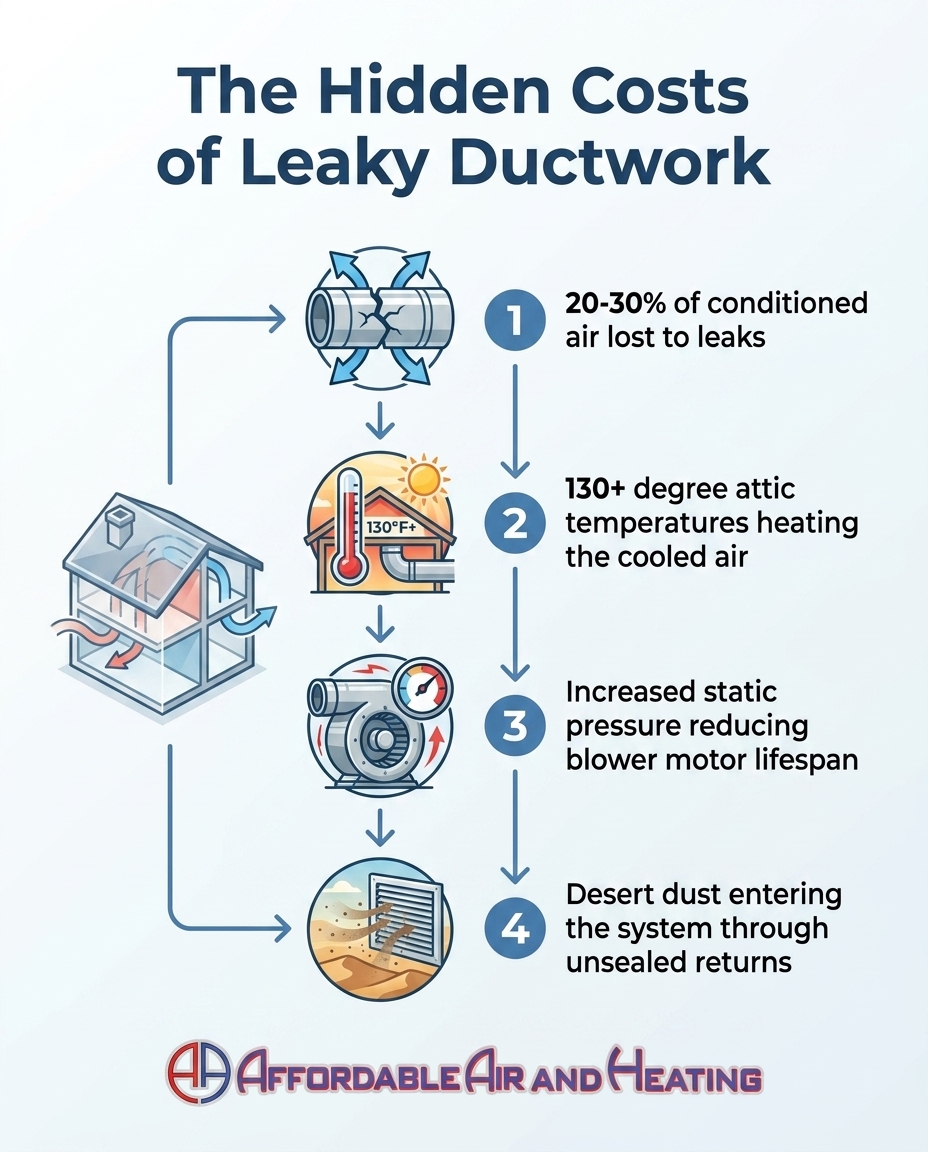
According to the EPA and ENERGY STAR, nearly 20 to 30 percent of the cooled air moving through typical residential duct systems is lost to leaks, holes, and poor connections before it ever reaches the living space. If you are wondering why we check your ductwork before installing a new AC, that staggering energy loss is exactly where the answer begins. In our years serving Lancaster and the surrounding communities, our team at Affordable Air and Heating typically sees that when a homeowner faces a major equipment failure, their immediate instinct is to simply swap out the broken box for a new one. However, the decision point during an AC replacement evaluation is much more complex than just picking a new model number.
You have to decide whether to inspect the aging infrastructure hidden in your walls and ceilings or ignore it and hope for the best. Attaching a brand-new, high-efficiency unit to a compromised delivery system guarantees poor performance, especially when you are fighting brutal August late-summer heat and trying to keep your family comfortable during the busy back-to-school transition. Your HVAC system operates as a complete, interconnected loop. The outdoor condenser and indoor air handler do the heavy lifting of removing heat, but the ductwork is the vital highway that actually delivers the comfort to your rooms.
If that highway is full of potholes, detours, and roadblocks, even the most advanced equipment will fail to cool your home efficiently. That is why a thorough duct assessment is a non-negotiable step when installing a new AC. Skipping this critical diagnostic step means you are paying for premium efficiency but receiving subpar results, forcing your new investment to work twice as hard just to keep you comfortable.
The 'Sports Car Engine in a Golf Cart' Reality
To understand the relationship between a modern air conditioner and the ductwork that supports it, consider a simple analogy: installing a premium, high-efficiency AC onto failing, leaky ducts is like putting a sports car engine into a golf cart. The raw power and advanced engineering are certainly there, but the delivery system simply cannot handle the output. The result is a chaotic, inefficient mess that ultimately damages the very engine you just paid a premium to install.
When an HVAC unit finally dies after a 30-year lifespan, it raises a critical red flag about the surrounding infrastructure. Ductwork degrades at the exact same rate as the mechanical equipment attached to it. If the air conditioner has given out after decades of wear and tear, a pattern often seen is that the original ductwork is suffering from dried-out sealant, disconnected joints, and crushed sections.
The SEER Rating Illusion
When you shop for a new air conditioner, you will see SEER (Seasonal Energy Efficiency Ratio) ratings proudly displayed on every unit. What most homeowners do not realize is that these efficiency scores are calculated in perfect laboratory conditions. In a testing facility, the AC is attached to perfectly sealed, zero-leak ductwork. When that same unit is installed in a real home with compromised ducts, those lab-tested energy savings instantly vanish.
• Perfect Laboratory Ducts — Airflow Delivery: 100% of cooled air reaches rooms — Expected Efficiency: Matches advertised SEER rating — System Lifespan: Maximum expected lifespan
• Aging, Leaky Ducts — Airflow Delivery: Loses 20-30% of air to the attic — Expected Efficiency: Drastically lower than advertised — System Lifespan: Reduced due to overworking
Ignoring the ductwork effectively throws away the energy savings the new AC was supposed to provide. You are paying a premium for advanced technology, only to let the cooled air bleed out into your attic spaces. A comprehensive duct inspection ensures that your new sports car engine actually has the high-performance transmission it needs to drive properly.
Surviving Extreme Attic Temperatures in the Antelope Valley
The condition of your ductwork becomes exponentially more important when you factor in the brutal reality of our local climate. In our experience working across the Antelope Valley, unventilated Palmdale and Lancaster attics transform into absolute ovens during the peak of late summer. With triple-digit outdoor temperatures baking the roof all afternoon, the ambient air inside an attic space routinely exceeds 130 degrees. This hostile environment is exactly where your ductwork lives, and it poses a massive threat to your home's cooling performance.
The Thermodynamics of Leaky Ducts
When you have leaky ducts suspended in a superheated attic, a disastrous thermodynamic exchange occurs. It is not just that the cooled air is escaping into the attic—though that certainly happens. The more severe problem is that unsealed return sections actively draw in superheated, stagnant attic air. This 130-degree air is sucked directly into the duct system, instantly warming the freshly cooled air before it ever reaches your living space.
• Thermal gain: Even if there are no physical holes, degraded insulation around the outside of the ducts allows the intense attic heat to penetrate the thin metal or fiberglass walls.
• Extended run cycles: Because the air arriving at your vents is warmer than it should be, your thermostat never reaches its target temperature.
• Equipment fatigue: The new AC is forced to run significantly longer cycles just to overcome the heat being introduced through the attic.
Proper duct sealing and robust insulation are absolutely mandatory to protect the cooled air as it travels through this hostile environment. Without a verified, airtight delivery system, your brand-new air conditioner is essentially trying to cool down the entire Antelope Valley sun, one attic leak at a time.
Static Pressure: The Silent Killer of Modern AC Systems
Beyond the loss of cooled air, bad ductwork poses a direct mechanical threat to the air conditioner itself. To understand why, we have to look at a concept called static pressure. In simple terms, static pressure is the resistance to airflow within the duct system. Just as high blood pressure forces a human heart to overwork, high static pressure forces your HVAC equipment to strain against invisible resistance.
The Problem: Undersized and Damaged Infrastructure
When our technicians measure static pressure during evaluations, we frequently find older homes built with ductwork sized for smaller, less powerful air conditioners. When a modern, high-capacity unit is installed onto these older, restrictive ducts, the system cannot breathe properly. Imagine trying to run a marathon while breathing through a narrow cocktail straw. The harder you try to pull air in or push it out, the more resistance you face. Undersized ducts, crushed flex-pipe, or severely blocked runs create a massive spike in static pressure.
The Cause: Variable-Speed Motors Meeting Resistance
Modern air conditioners utilize advanced variable-speed blower motors designed to adjust their output based on the home's needs. When these intelligent motors detect airflow resistance, their programming tells them to ramp up their speed to compensate. If the static pressure is too high because the ducts are too small or damaged, the motor will spin faster and faster, desperately trying to push the correct volume of air through a bottleneck.
The Solution: Verifying Capacity Before Installation
The consequences of ignoring static pressure are severe. We recommend a full duct assessment because we have seen too many homeowners experience frozen evaporator coils, burnt-out blower motors, and premature system failure within just a few years of a poor installation. Checking the ductwork ensures the new system has the correct airflow capacity to operate within safe mechanical limits. By measuring the static pressure and evaluating the duct sizing beforehand, we can guarantee that your new AC will breathe easily and last for its full intended lifespan.
Keeping Desert Dust Out of Your New Equipment
Duct integrity is not solely about temperature control and mechanical efficiency; it is also a major factor in protecting your indoor air quality and keeping the internal components of your new equipment pristine. As a local HVAC provider, we see firsthand how heavily laden our desert air is with fine particulate matter.
Leaky return ducts act exactly like a vacuum cleaner hidden in your walls. The return side of your HVAC system is under negative pressure, meaning it is constantly pulling air in to be conditioned. If there are gaps, cracks, or disconnected joints in the return ducts located in the attic, crawlspace, or wall cavities, the system will actively suck unfiltered air directly into the airstream.
The Impact of Desert Dust Infiltration:
• Clogged Evaporator Coils: Heavy desert dust and seasonal wind-blown particulates bypass your home's air filter entirely, coating the wet indoor coil in a thick layer of mud.
• Reduced Heat Transfer: A dirty coil acts like an insulating blanket, preventing the refrigerant from absorbing heat from the air, which severely reduces efficiency.
• System Freezing: When the coil cannot absorb heat due to dust buildup, the temperature drops too low, causing the condensation to freeze into a solid block of ice.
• Poor Air Quality: Whatever dust, insulation fiberglass, and attic debris gets pulled into the return ducts is eventually blown directly into your living room and bedrooms.
By thoroughly checking and sealing the ductwork before a new installation, we protect both the mechanical components of your expensive new AC and the air your family breathes every single day.
Integrity Over Quick Fixes: Our Installation Standard
The difference between a true professional installation and a "blow-and-go" contractor often comes down to what happens before the new unit is ever unboxed. Some contractors are happy to simply swap the metal box in your yard, collect their payment, and drive away, completely ignoring the underlying infrastructure. At Affordable Air and Heating, we refuse to operate that way. Positioning a pre-installation duct assessment as a mandatory step is a mark of our commitment to your long-term comfort and the integrity of our work.
Refusing to cut corners by slapping a premium unit onto a failing delivery system is about protecting your investment. We know that if the ductwork fails, the AC fails. A true professional ensures the equipment will run well and keep the house cold during the most demanding heatwaves. When we insist on checking your ducts, it is never an upsell—it is a mandatory diagnostic step for a successful, reliable installation that you can count on for years to come.
What We Look For During a Pre-Installation Duct Assessment
To demystify the inspection process, it helps to understand exactly what our Lancaster-based technicians are evaluating when they climb into your attic or inspect your crawlspace. We are not just glancing at the pipes; we are conducting a comprehensive physical and mechanical audit of the entire delivery system. Understanding the benefits of having new ductwork installed or properly sealed starts with knowing where the current system falls short.
The Core Ductwork Checklist
• Sizing and Capacity: We verify that the existing trunks and branch lines are physically large enough to handle the cubic feet per minute (CFM) airflow requirements of the new, modern air conditioner.
• Leakage and Disconnections: We trace the lines looking for failed mastic sealant, degraded tape, or entirely disconnected joints where cooled air is freely escaping into the attic or wall cavities.
• Insulation Degradation: We check the thermal barrier around the ducts. If the insulation is crushed, missing, or severely degraded, the ducts will absorb massive amounts of ambient heat.
• Overall Design and Balance: We ensure the layout provides balanced airflow to all rooms in the house, looking for long, restrictive runs or sharp bends that strangle the air supply to distant bedrooms.
• Return Air Adequacy: We measure the return grills to guarantee the system can pull in enough air to match what it is trying to push out.
This evaluation takes time, but it saves homeowners from the frustration of buying a brand-new air conditioner only to find out that the master bedroom is still ten degrees hotter than the rest of the house.
Make Sure Your Next AC Is Set Up for Success
Ultimately, a new air conditioner is only as good as the ductwork delivering its air. Upgrading your outdoor condenser and indoor air handler is a major investment in your family's comfort, but that investment is easily wasted if the delivery system is leaking, undersized, or pulling in extreme attic heat. Addressing duct issues proactively prevents premature breakdowns, eliminates hot and cold spots, and keeps your monthly energy bills exactly where they should be.
When it is time to replace your cooling system, you should always insist on a comprehensive system evaluation, not just a quick equipment quote. A logical, thorough inspection proves that your contractor cares about the final result, not just making a sale. If your current AC is struggling to keep up and you are considering an upgrade, schedule a proper assessment with our Affordable Air and Heating team to ensure your home's infrastructure is fully prepared to deliver the reliable, efficient cooling you deserve.
Frequently Asked Questions
Do I need to replace my ductwork when replacing my AC?
Not always, but we highly recommend having it thoroughly inspected. If your ductwork is over 15 to 20 years old, severely damaged, or incorrectly sized for the new equipment, replacing it will ensure your new AC operates efficiently. In many cases, professional sealing and minor repairs are enough to restore the system's integrity without a full replacement.
Can you put a new AC on old ductwork?
You can, provided the old ductwork is in excellent condition, properly sealed, and correctly sized for the new unit's airflow requirements. However, attaching a modern, high-efficiency AC to deteriorating, leaky ducts will severely reduce the system's lifespan and cooling power. A professional contractor will always measure static pressure and inspect the ducts before approving the installation.
How do you know if your ducts are bad?
Common signs of bad ductwork include uneven temperatures across different rooms, excessive dust buildup around your vents, and unusually high energy bills. You might also notice weak airflow coming from certain registers or hear rattling and whistling noises when the blower motor turns on. If your home never seems to reach the temperature set on the thermostat, leaky ducts are a likely culprit.
How much efficiency is lost through leaky ducts?
According to the EPA, typical residential duct systems lose between 20 and 30 percent of their conditioned air due to leaks, holes, and poor connections. This massive loss forces your air conditioner to run significantly longer cycles to cool your home. Sealing these leaks is one of the most effective ways to restore your system's intended energy efficiency.
What is HVAC static pressure and why does it matter?
Static pressure is the measurement of airflow resistance within your duct system, similar to blood pressure in the human body. If the ducts are undersized, crushed, or clogged, the static pressure spikes, forcing the blower motor to work much harder to circulate air. High static pressure leads to burnt-out motors, frozen coils, and premature equipment failure.
Will a new AC fix uneven cooling in different rooms?
A new AC alone will not fix uneven cooling if the root cause is a poorly designed or leaky duct system. If a specific bedroom is always too hot, it is usually because the duct run to that room is too small, too long, or leaking air into the attic. Balancing the airflow and repairing the ductwork is required to solve room-to-room temperature differences.