The Myth of Closing Vents to Save Money on Cooling


The Dangerous Myth of Shutting Registers to Save Energy
Closing vents in unused rooms doesn't save energy—in fact, the myth of closing vents to save money on cooling is one of the fastest ways to damage your AC. At Affordable Air and Heating, we regularly talk to homeowners tempted to shut the registers in empty guest rooms to lower their late-summer energy bills as the back-to-school season approaches. If you've considered this, you are not alone. The logic seems perfectly sound at first glance: if you stop pumping cold air into a room nobody is using, your system has less space to cool, which should reduce your overall energy costs. Unfortunately, modern cooling equipment simply does not work that way.
Your home's HVAC system is a carefully engineered machine designed to distribute a very specific volume of air throughout your house. When the system was installed, the ductwork was sized to match the exact output of your blower motor. By shutting vents, you are not reducing the system's workload. Instead, you are actively disrupting the engineered balance of the entire setup. The equipment still produces the exact same amount of cold air, but now it has fewer places to push that air.
This restriction leads to severe mechanical stress. During periods of heavy August end-of-season cooling, your equipment is already working harder than usual to maintain a comfortable indoor temperature. Adding unnecessary strain by blocking airflow pushes aging components past their breaking point. What starts as an innocent attempt to save energy on your utility bill quickly cascades into a series of expensive mechanical failures.
Why the "Money-Saving" Logic is Flawed
Most homeowners don't realize that standard residential air conditioners are single-speed systems. They are either on, blowing at full capacity, or they are off. When you close a vent, the system does not magically power down by ten percent to compensate for the closed room. It continues to generate the full volume of cooling, forcing that air against a literal wall inside your ductwork. This sets the stage for a chain reaction of invisible damage that happens right behind your walls and ceilings.
The Invisible Physics of HVAC Static Pressure
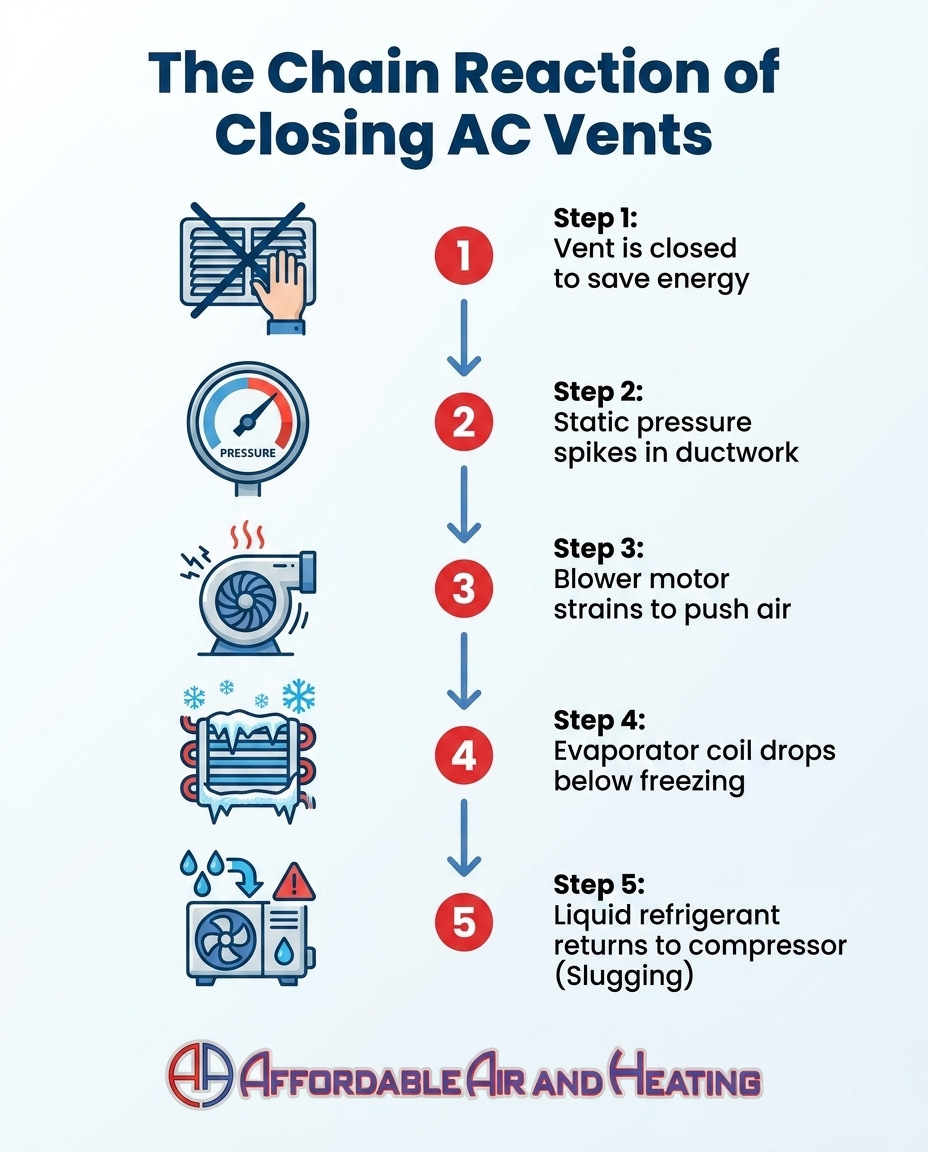
To understand why closing vents is so harmful, you need to understand a foundational concept called static pressure. Static pressure is simply the resistance to airflow within your ductwork. You can think of your air conditioning system as a massive air pump. It expects a specific, balanced amount of warm air to be pulled in through the return vents, and an equal amount of cold air to be pushed out through the supply vents. When this equilibrium is maintained, your system operates smoothly and efficiently.
When you close a supply register, the blower motor continues to push the exact same volume of air into the ducts. However, because there are now fewer escape routes, the air pressure inside the ductwork spikes dramatically. Think of what happens when you pinch a running garden hose. The water doesn't stop flowing from the spigot; instead, pressure builds up intensely behind the pinch, straining the hose and the connection to the house. Your ductwork experiences the exact same phenomenon.
In the Lancaster CA / Antelope Valley region, our team sees systems running at maximum capacity to combat the extreme triple-digit heat. Adding high static pressure to a system that is already fighting the high-desert summer is highly detrimental. If you want to avoid needing emergency air conditioning services, keeping that pressure balanced is absolutely vital.
Why Your System Cannot Simply "Redirect" Cold Air
A common misconception is that closing a vent in the guest bedroom will magically push that exact volume of cold air into the living room, making the main areas cooler. The short answer is: it doesn't work that way. Standard residential HVAC systems are not zoned to dynamically redirect airflow safely. Without specialized bypass dampers and a dedicated zoning control board, the excess air does not smoothly flow to the open vents. Instead, the air crashes into the closed register, backs up into the main trunk line, creates turbulence, and forces the blower motor to fight against a wall of heavy, pressurized air.
Why Closed Vents Cause Evaporator Coils to Freeze
One of the most immediate and frustrating mechanical failures caused by closed vents is a frozen evaporator coil. The evaporator coil is the indoor component of your AC system responsible for absorbing heat from your home's air. It relies on a constant, steady flow of warm indoor air blowing over its metallic fins to function properly.
When you restrict airflow by shutting registers, you slow down the movement of air across this crucial component. Here is exactly how that triggers a system failure:
1. Airflow drops: The spiked static pressure slows down the volume of warm air reaching the indoor unit.
2. Temperatures plummet: Because there is not enough warm air passing over the coil to absorb the cooling energy, the temperature of the coil drops rapidly.
3. Condensation freezes: Air conditioners naturally pull humidity out of the air, creating condensation on the coil. When the coil's temperature drops below freezing, this liquid water turns to solid ice.
4. System blockage: The ice continues to build up, eventually encasing the entire coil in a thick block of frost.
Once the coil freezes, it acts as an insulating barrier. The system can no longer absorb heat, completely stopping the cooling process and leaving your home sweltering. Our technicians at Affordable Air and Heating frequently respond to sudden loss-of-cooling calls during severe heatwaves. Just recently, our team arrived early to diagnose a complete system shutdown, only to find the underlying airflow issue was caused by closed vents. We successfully thawed the coil and fixed the AC so it was blowing cold air again. Often, these sudden shutdowns trace back directly to a frozen coil caused by poor airflow.
During intense August end-of-season cooling, your system needs every bit of airflow it can get to keep the evaporator coil above freezing. Starving the unit of air is a guaranteed way to turn your AC into a block of ice.
Blower Motor Strain and the Cost of Restricted Airflow
Increased static pressure doesn't just freeze coils; it also wreaks havoc on your blower motor. The blower motor is the heavy-duty fan responsible for physically circulating air through your home. How it reacts to closed vents depends largely on the age and technology of your system, but the end result is always damaging.
Older HVAC systems typically use PSC (Permanent Split Capacitor) motors. These motors operate at a fixed speed. When they encounter the high resistance of closed vents, they simply cannot push the air through. The motor bogs down, overheats, and eventually burns out from the strain.
Modern systems, however, use ECM (Electronically Commutated Motor) technology. These "smart" motors are programmed to maintain a specific volume of airflow regardless of the conditions. When an ECM senses the resistance from closed vents, it automatically ramps up its RPMs to force the air through the restriction.
The quick fix: You might think your system is handling the closed vents fine, but behind the scenes, your ECM motor is running at maximum overdrive. This constant overworking drastically reduces the lifespan of the motor. Even worse, the extra electricity consumed by a struggling, ramping ECM motor completely negates any perceived energy savings you hoped to gain by closing the vent in the first place.
Closed vents can also accelerate blower motor failure. A pattern often seen is a bad fan motor that was forced to push against closed vents, sometimes compounded by issues from a previous installer's poor setup, especially in the demanding Lancaster CA / Antelope Valley climate. Opening the vents and having the system properly diagnosed is the safest route.
• PSC Motor (Older) — Reaction to Closed Vents: Slows down due to resistance, struggles to push air. — Long-Term Consequence: Overheats, trips breakers, and suffers premature burnout.
• ECM Motor (Modern) — Reaction to Closed Vents: Ramps up RPMs to forcefully push past the restriction. — Long-Term Consequence: Consumes massive amounts of electricity, negating savings, and drastically shortens motor lifespan.
How Increased Pressure Exacerbates Duct Leakage
There is a hidden consequence to high static pressure that most homeowners never see: duct leakage. The vast majority of residential homes have minor, unsealed seams or small gaps in their ductwork. Under normal operating conditions, these tiny leaks are relatively harmless. But when you close vents and spike the internal pressure, those minor gaps become major problems.
The highly pressurized, cooled air is desperate for an escape route. It will force its way out through every unsealed joint, elbow, and connection in your duct system. This means the expensive, conditioned air you paid to cool is now being blasted into unconditioned spaces like your attic, crawlspace, or inside your walls.
Signs your high pressure is causing duct leakage:
• Uneven cooling: Certain rooms feel perpetually hot despite the AC running constantly.
• Excessive dust: Negative pressure on the return side pulls attic dust and insulation fibers into your living space.
• Spiking utility bills: You are effectively air conditioning the outdoors, causing your system to run longer cycles.
• Whistling noises: High pressure forcing air through tiny gaps often creates a high-pitched whistling sound near your vents.
This process also severely impacts your indoor air quality. If the pressure imbalance causes your return ducts to pull air from dusty, unconditioned spaces, your family ends up breathing in debris, allergens, and insulation particles. During August end-of-season cooling, when dust and allergens are already high, keeping your vents open is essential for keeping your indoor air clean and your cooled air inside the living space.
The Ultimate Consequence: Catastrophic Compressor Failure
If frozen coils and burned-out blower motors weren't bad enough, the chain reaction started by closing vents eventually reaches the heart of your AC system: the compressor. The compressor is the outdoor unit's main engine. It is responsible for circulating refrigerant and is by far the most expensive component to replace if it fails.
When your evaporator coil freezes over due to restricted airflow, the refrigerant inside the coil cannot absorb heat. Normally, the refrigerant enters the indoor coil as a cold liquid and absorbs enough heat to boil into a warm gas before returning to the outdoor compressor. However, when the coil is encased in ice, that heat exchange never happens. The refrigerant remains a cold liquid and travels straight back outside.
This creates a fatal condition known as "liquid slugging." Compressors are specifically designed to compress gas, not liquid. When liquid refrigerant hits the internal valves of the compressor, it acts like a hydraulic hammer. The liquid cannot be compressed, so the internal components of the compressor shatter under the immense pressure.
Lancaster's late-summer heat already pushes compressors to their absolute limits. They run long cycles in brutal outdoor temperatures. Subjecting a stressed compressor to liquid slugging is a guaranteed recipe for catastrophic failure. In our years of serving the Antelope Valley, we've seen this exact scenario ruin perfectly good equipment. We believe in providing transparent, honest advice to our community, and educating homeowners on this myth is meant to save you from unnecessary, devastating repair bills. Leaving your vents open is the easiest way to protect the heart of your system.
Safer Alternatives to Manage High-Desert Cooling Loads
If closing vents is off the table, how can you manage your comfort and energy costs during the hottest parts of the year? Fortunately, there are several safe, effective ways to reduce your energy consumption without destroying your cooling equipment.
Safe Cooling Alternatives Checklist:
• Leave all supply vents fully open: Ensure that at least 100% of your supply and return registers are open and completely unblocked by rugs, heavy curtains, or furniture.
• Utilize ceiling fans: Fans do not lower the temperature of a room, but they create a wind-chill effect on your skin. This allows you to set your thermostat a few degrees higher while feeling just as comfortable in occupied rooms.
• Change your air filters regularly: A severely clogged air filter creates the exact same static pressure problems as closed vents. Swap your filter out every 30 to 90 days, especially during August end-of-season cooling.
• Investigate duct sealing: Having a professional seal the minor leaks in your ductwork ensures that every ounce of cold air reaches your living space, drastically improving efficiency.
• Consider a multi-zone system: If you truly want room-by-room temperature control, a properly designed zoned HVAC system uses bypass dampers to safely manage airflow without harming the equipment.
If you notice hot spots in your home or find vents blowing warm air, do not try to "force" cold air into the room by closing other registers. As HVAC professionals, we know that is a symptom of an underlying issue that needs professional attention, not a DIY airflow hack.
Frequently Asked Questions About AC Vents and Airflow
Is it bad to close AC vents in unused rooms?
Yes, it is highly detrimental to your system. Closing vents increases static pressure within the ductwork, which reduces system efficiency and disrupts the engineered balance of your HVAC setup. Over time, this added strain can lead to major component failures, including frozen coils and burned-out motors.
Does closing vents save money on cooling?
No, it often increases your overall energy consumption. Modern ECM blower motors will automatically consume more electricity to push air past the closed vents. Furthermore, the spiked pressure forces expensive, conditioned air out through tiny leaks in your ductwork, wasting cooling in your attic or crawlspace.
Can closing vents break my AC?
Absolutely. Restricting airflow is one of the leading causes of preventable AC breakdowns. It can freeze the indoor evaporator coil, burn out the blower motor from excessive strain, and ultimately destroy the outdoor compressor through a process called liquid slugging.
Will closing vents redirect air to other rooms?
Not effectively. Without a dedicated, professionally installed zoning system, the excess air simply builds pressure inside the ducts. Instead of smoothly flowing to the open rooms, the air crashes into the closed registers, creates turbulence, and escapes through ductwork leaks before it ever reaches you.
How many vents can I safely close?
HVAC professionals strongly recommend leaving 100% of your supply and return vents fully open for optimal system health. Even closing just one or two vents in the Lancaster CA / Antelope Valley heat can alter the static pressure enough to cause unnecessary wear and tear on your equipment.
Keep Your System Breathing Easy This Late Summer
The short answer is that open vents are absolutely crucial for maintaining the delicate balance of your HVAC system's static pressure. Starving your system of air to save energy is a gamble that almost always ends in catastrophic failure. What you really want is a reliable, efficient system that survives the brutal August end-of-season cooling without expensive, unexpected breakdowns.
By keeping your registers open, changing your filters, and using fans to supplement your comfort, you protect the heart of your air conditioner. If you suspect your system is struggling with airflow, cooling performance, or uneven temperatures, reach out to our team at Affordable Air and Heating to evaluate your ductwork and system balance safely.