Why Your Heating Bills Spike Even When the Thermostat is Low


Are Hidden Mechanical Failures Hijacking Your Thermostat?
Have you kept your thermostat turned down, only to be shocked by unusually high energy usage, wondering exactly why your heating bills spike even when the thermostat is low? You wear extra layers inside, you dial the temperature back to a modest 65 degrees, yet the monthly utility statement still looks like you are running a sauna around the clock. We hear this frustration constantly from our customers across Lancaster. The truth is, while lowering your indoor temperature is a common energy-saving tactic, it simply cannot overcome underlying mechanical failures that bleed energy behind the scenes.
Your thermostat is merely a command center. It tells your equipment when to turn on and off, but it has no control over how much electricity or gas the system consumes while it runs. Three major culprits usually drive this invisible energy waste: severe duct leaks, rapid short-cycling, and failing blower motors pulling excessive power. Because the early fall pre-heating transition is the perfect time to catch these issues, investigating them now can save you from a season of inflated costs. For a comprehensive look at your home's setup, reviewing your HVAC system performance can help you decide when it is time to schedule professional heating diagnostics and repair.
3 Hidden Faults Draining Your Energy (Even on Low Settings)
In our years of servicing HVAC units throughout the Antelope Valley, we have found that many homeowners mistakenly believe a low thermostat setting guarantees low energy consumption. However, the thermostat only dictates the duration of the heating cycle, not the efficiency of the mechanical components doing the heavy lifting. If your equipment is struggling, it will consume significantly more resources to produce the same amount of heat. Before you start looking into broader ways to reduce your monthly utility bills, you need to rule out the mechanical faults that completely negate a low thermostat setting.
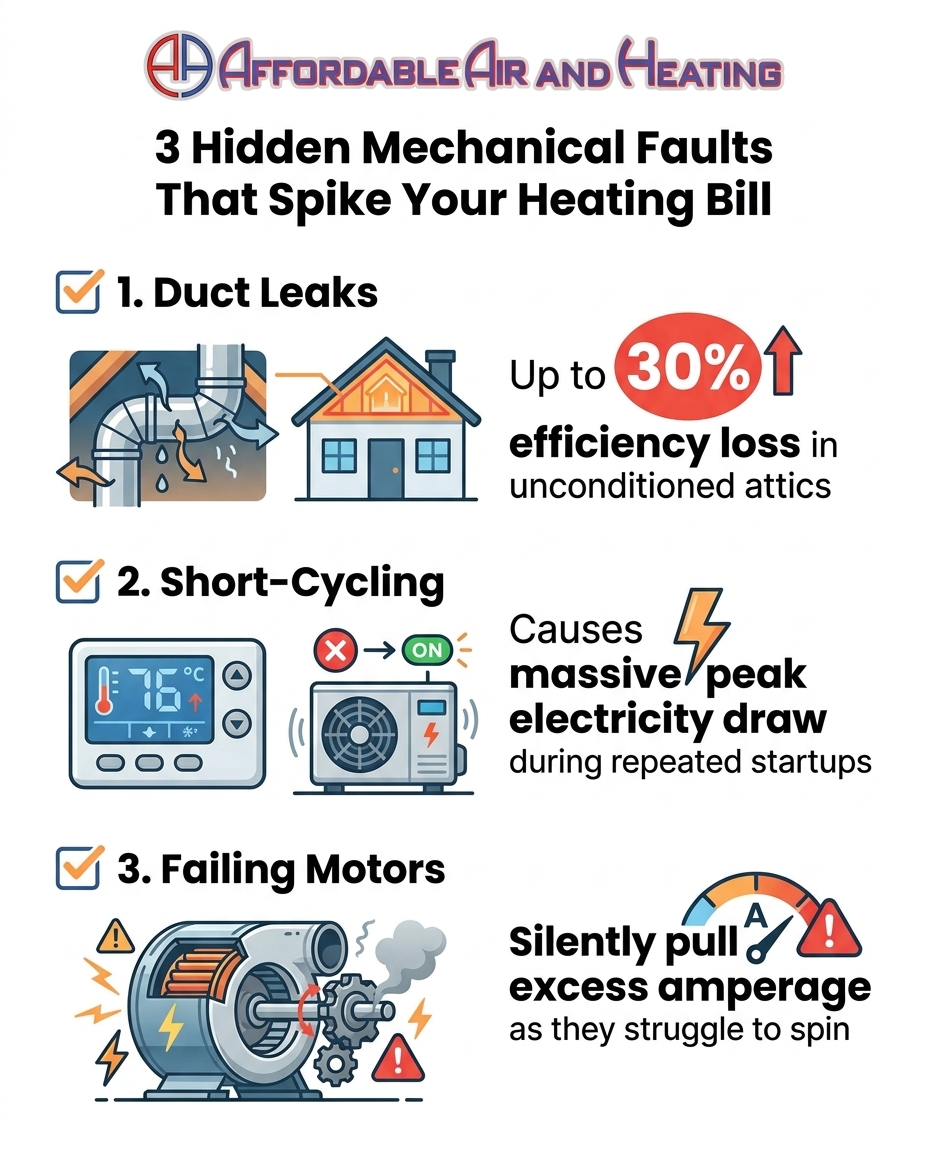
The three primary hidden mechanical faults include:
• Duct leaks in unconditioned attics: Conditioned air escapes into freezing spaces before it ever reaches your living room, forcing the system to run endlessly.
• System short-cycling: The heater turns on and off rapidly, drawing massive amounts of startup electricity without completing a full heating cycle.
• Failing blower motors: Aging or dirty motors struggle to spin, silently pulling excess electrical amperage to force air through the home.
When these faults are present, your system is forced to work twice as hard to satisfy even the lowest temperature demands. In neighborhoods across Lancaster and the Antelope Valley, our technicians frequently see these invisible inefficiencies go unnoticed until the first major utility bill arrives in the mail.
• Thermostat is set to 65°F — What the System is Actually Doing: Losing 30% of heated air into the attic — The Result on Your Bill: Spikes due to continuous running
• Heater sounds like it is turning on often — What the System is Actually Doing: Short-cycling and drawing peak startup power — The Result on Your Bill: Spikes due to electrical inrush current
• Airflow feels slightly weaker than usual — What the System is Actually Doing: Blower motor is over-amping to spin — The Result on Your Bill: Spikes due to excessive electrical draw
The Impact of Severe Duct Leaks in Unconditioned Spaces
Your ductwork is the delivery highway for your home's comfort. Unfortunately, much of this network runs through unconditioned spaces like attics or crawlspaces, making it highly vulnerable to extreme temperature fluctuations. According to the U.S. Department of Energy (Energy.gov), leaky or uninsulated ducts can reduce a heating system's overall efficiency by up to 20 to 30 percent. That means for every unit of energy you spend heating your home, nearly a third could be warming up your attic instead.
The Physics of High-Desert Heat Loss
Our team knows firsthand how Lancaster's high-desert climate features extreme overnight temperature drops. During late fall and winter, an unconditioned attic essentially turns into a freezing zone. If your ductwork has loose joints, degraded tape, or physical tears, the hot air your furnace produces is blown directly into this freezing space. Because the heated air escapes before reaching your vents, your living space never reaches the low temperature you set on the thermostat. Consequently, the heater just keeps running, burning fuel and consuming electricity continuously.
The Secondary Consequence: Indoor Air Quality
Air leaks are a two-way street. While warm air is pushed out into the attic, the system's negative pressure can also pull freezing, dirty attic air into the ductwork. This pulls insulation fibers, dust, and debris directly into the air you breathe. Fixing leaky ducts does not just stop energy waste; we often recommend it as one of the most effective indoor air quality solutions available to homeowners in Lancaster and the Antelope Valley. Sealing these leaks ensures that the air you pay to heat actually stays inside your home, while keeping attic contaminants out.
How System Short-Cycling Multiplies Energy Usage
If you notice your heater turning on, running for just a few minutes, shutting off, and then immediately turning back on, your system is short-cycling. In our experience, this is a severe mechanical dysfunction that consumes massive amounts of energy without effectively heating the home. Short-cycling prevents the system from maintaining steady temperatures, leading to cold spots, uneven heating, and wasted power.
Understanding Startup Energy vs. Running Energy
To understand why short-cycling is so expensive, you have to look at how electric motors operate. HVAC systems draw peak electricity during startup—a phenomenon known as inrush current. It takes significantly more energy to start a heavy blower motor and compressor than it does to keep them running. When a system operates normally, it turns on, runs for 15 to 20 minutes, and shuts off, meaning it only pays that "startup energy tax" two or three times an hour.
When a system short-cycles, it may start up ten or twelve times an hour. You are paying that massive electrical startup tax over and over again, yet the house never actually gets warm. This constant stopping and starting is incredibly damaging to the equipment and is a leading pattern we see causing premature failure.
Common triggers for short-cycling include:
• Oversized equipment: A unit that is too large for the home heats the space too rapidly and shuts down before completing a proper cycle.
• Severely clogged air filters: Restricted airflow causes the heat exchanger to overheat, triggering a safety shutoff switch.
• Faulty flame sensors: If the sensor cannot detect the burner flame, it shuts the system down as a safety precaution.
Proper sizing, airflow management, and regular maintenance are critical for optimal operation, whether you rely on a traditional gas furnace or want to maximize your heat pump efficiency.
Failing Blower Motors and Electrical Overdraw
While gas furnaces use natural gas to create heat, they still rely heavily on electricity to power the blower motor. The blower motor is the workhorse of your system, responsible for pushing the heated air through the ductwork and into every room of your house. As this motor ages, or if it gets bogged down by a lack of maintenance, it begins to struggle.
Why Amp Draw Matters
When dirt builds up on the blower wheel's fins, or when the internal bearings begin to wear out, the motor faces physical resistance. To overcome this resistance and continue spinning at the required speed, the motor pulls significantly more electrical current (amperage) than it was designed to use. This electrical overdraw happens completely silently. You will not hear a difference, and the air coming out of your vents might still feel warm. The only symptom is the shockingly high utility bill that arrives weeks later.
When our team at Affordable Air and Heating gets called out for a high bill complaint, our commitment to thorough mechanical diagnostics means we do not just guess at the problem. We use professional multimeters to test the exact amp draw of your motors, comparing it to the manufacturer's specifications. We inspect the ductwork and measure static pressure to find the root cause of the strain. You cannot fix an over-amping motor by simply swapping out a thermostat; it requires a professional evaluation during the early fall pre-heating transition to prevent complete motor failure.
Why Waiting for Winter to Test Your Heater is a Costly Mistake
Taking a "wait and see" approach with your heating system is a gamble that rarely pays off. Hidden inefficiencies like over-amping motors or short-cycling sequences do not fix themselves. Instead, they turn into complete system breakdowns when pushed to their limits by freezing weather. Addressing these issues during the early fall transition period prevents emergency service calls and ensures the system operates efficiently from the very first day of winter.
We see it happen every year: The Antelope Valley freeze puts sudden and extreme stress on compromised heating equipment. One local homeowner we helped waited until the coldest week in memory—right under a severe freeze warning—before realizing their heater had stopped working entirely. Our technicians assessed the unit in the freezing temperatures, identified a bad relay that had likely been struggling and wasting energy for a while, and ultimately had to recommend a new HVAC unit. Once a new Goodman unit was installed, the heating worked amazingly well, but the emergency breakdown could have been avoided with proactive testing.
The benefits of early intervention:
• Lower utility bills: Catching an electrical overdraw in October saves you months of wasted power.
• Fewer emergency repairs: Parts are replaced before they shatter or burn out under peak winter stress.
• Better scheduling: Early fall pre-heating transition appointments are easier to secure than mid-winter emergency visits.
Frequently Asked Questions About High Heating Bills
Why is my electric bill so high when my heat is on?
When customers ask us this, we often point to a failing blower motor or system short-cycling. Even if you use gas for heat, the blower motor uses electricity to push the air. If the motor is dirty, failing, or starting up too frequently due to short-cycling, it will draw excessive amperage and spike your electric bill.
Can a bad thermostat cause high electric bills?
Yes, if a faulty thermostat is misreading the room temperature, it may cause the system to run constantly or short-cycle. However, we often find that thermostats are unfairly blamed for high bills when the real issue is a hidden mechanical fault like leaking ductwork or a struggling blower motor.
Why is my heater running constantly but not heating?
A heater that runs non-stop without warming the house usually suffers from severe duct leaks in unconditioned spaces, a heavily clogged air filter, or a failing blower motor. If heated air escapes into the attic before reaching your living space, the system will run continuously trying to satisfy the thermostat.
Can leaking ducts cause high heating bills?
Absolutely. In our experience, leaking ducts are one of the leading causes of high heating bills. Losing 20 to 30 percent of your heated air into a freezing attic forces your heating system to run much longer to reach the temperature you set, burning significantly more energy in the process.
How do I know if my HVAC system is short-cycling?
You can identify short-cycling by listening to your system's run patterns. If the system turns on, runs for only a few minutes, shuts off, and immediately turns back on without maintaining the set temperature, it is short-cycling. This requires prompt professional attention to prevent motor burnout.
Stop Guessing and Start Saving Before Winter Arrives
Turning down the dial on your wall is a smart habit, but it is completely useless if your system is bleeding energy through hidden faults. From duct leaks in freezing attics to motors pulling excess amperage, our technicians know these invisible mechanical issues are exactly why your heating bills spike even when the thermostat is low. Making a logical choice to secure a professional inspection now can identify electrical overdraws and duct issues before the severe cold sets in.
Do not wait for an emergency breakdown during the first major freeze of the early fall pre-heating transition. By scheduling professional heating diagnostics and repair with Affordable Air and Heating today, you can stop guessing about your energy usage, secure your family's comfort, and keep your utility costs under control all winter long.