The Summer AC Crisis: When a Freon Leak Strikes
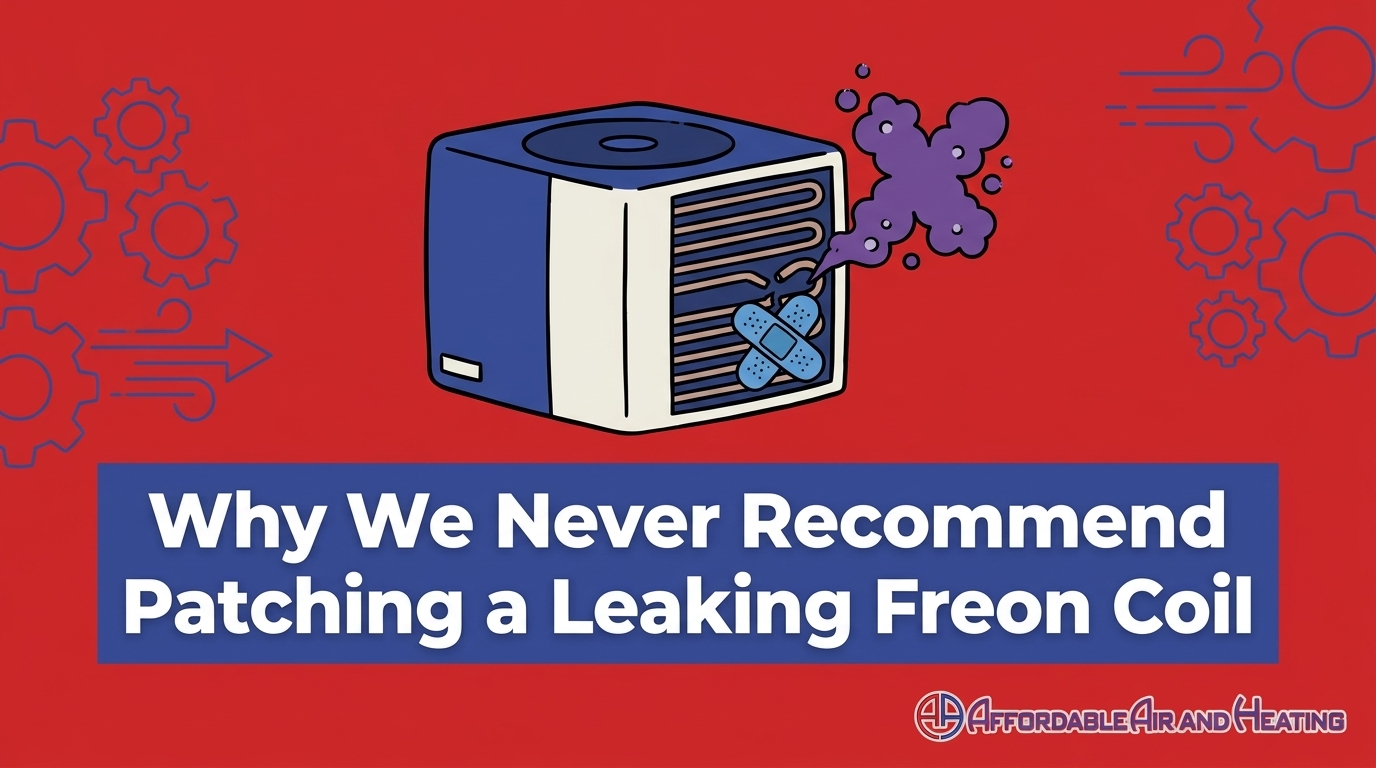
Your air conditioner is running nonstop, but the air coming from the vents feels barely cool, leaving you sweating inside your own home. When a system loses its cooling power, many homeowners start searching for fast answers, which is exactly why our team at Affordable Air and Heating never recommends patching a leaking freon coil. Discovering that your system is low on refrigerant is incredibly stressful, especially when you are facing a brutal July peak-heat cooling load here in Lancaster. You just want cold air flowing again as quickly as possible.
If you find yourself in this frustrating situation, exploring professional HVAC services and proper air conditioning repair and replacement is the only reliable way to protect your home's comfort.
The temptation of a quick fix: When you are desperate for relief from the heat, a chemical sealant—often called "stop-leak"—sounds like a miracle cure. It promises to seal the hole from the inside out without the need for major component replacement. However, our technicians categorically refuse to use these chemical patches on evaporator coils because of the severe damage we've witnessed firsthand in local HVAC systems.
The reality of the repair: An air conditioning system is a highly pressurized, finely tuned mechanical loop. Introducing foreign chemicals into this environment does not just fail to solve the underlying problem; it actively destroys the most expensive components in your equipment. To understand why a simple patch is so dangerous, you have to look at what happens inside the copper lines once that chemical is introduced.
What AC Stop-Leak Is and Why It Sounds Appealing
Chemical sealants are liquid additives injected directly into your air conditioning system's refrigerant lines. They are designed to travel through the system along with the refrigerant and compressor oil. When the liquid sealant finds a leak, it is supposed to react with the outside air, hardening into a scab that plugs the hole.
The initial appeal: It is easy to see why this approach is tempting. Injecting a chemical takes only a few minutes. It provides a false sense of security, allowing the system to temporarily hold enough refrigerant to blow cold air again. For a homeowner looking to avoid an immediate component replacement, it feels like a win. However, this temporary relief masks the hidden costs of cheap AC repair quotes.
Based on the countless service calls our team has handled, here is a breakdown of why the expectation of chemical sealants rarely matches the mechanical reality:
• Provides a permanent seal for the leak. — The Mechanical Reality: Only temporarily plugs microscopic pinholes; fails on larger cracks.
• Saves money by avoiding coil replacement. — The Mechanical Reality: Causes catastrophic damage, leading to full system replacement.
• Restores the AC to factory efficiency. — The Mechanical Reality: Restricts refrigerant flow, forcing the system to work harder.
• Safe for the internal mechanical parts. — The Mechanical Reality: Gums up critical valves and destroys the compressor motor.
The false sense of security: The biggest danger of AC stop-leak is that it actually appears to work for a short window of time. You might get a few days or even a couple of weeks of cold air. But during that time, a hidden reaction is taking place inside your equipment. By introducing a foreign chemical into a closed loop that is only meant to hold pure refrigerant and specialized oil, you are setting the stage for irreversible mechanical failure.
The Chemistry of Failure: How Sealants Create System Sludge
Air conditioning systems are incredibly sensitive to contamination. For your equipment to function properly, the inside of the copper lines must be completely free of air, moisture, and debris. Chemical sealants fundamentally disrupt this pristine environment.
The Moisture Reaction
When an evaporator coil develops a leak, refrigerant escapes under high pressure. But when the system cycles off, the pressure dynamics change, and the system can actually pull ambient air and humidity back inside through that exact same hole. This creates a disastrous chemical reaction.
1. Moisture enters the loop: Ambient humidity is drawn into the copper lines through the leak in the evaporator coil.
2. The chemical catalyst: The stop-leak product is injected into the system. Its entire chemical purpose is to harden when it comes into contact with air and moisture.
3. The internal reaction: Because moisture is already trapped inside the leaking system, the sealant begins to activate and harden inside the refrigerant lines, not just at the site of the leak.
4. Sludge formation: The sealant mixes with the compressor oil and moisture, turning into a thick, sticky, solid polymer—essentially a gooey sludge.
Irreversible Contamination
Once this solid polymer forms inside your air conditioner, the damage is done. The sludge coats the inside of the copper tubing, reducing the space available for refrigerant to flow. When we get called out to diagnose a completely seized compressor, a pattern we see often is the aftermath of this chemical contamination.
The permanent nature of the problem: Unlike dirty coil fins that can be washed, or a bad capacitor that can be swapped out, internal chemical contamination cannot be easily reversed. Standard industry flushing procedures, which use specialized solvents to clean out old oil, are completely ineffective against hardened stop-leak polymer. The sludge clings to the walls of the pipes and travels relentlessly toward the most sensitive mechanical components in your equipment. Once the sealant activates internally, the entire system is compromised.
How Extreme Heat Accelerates Patch Failure
The environment your air conditioner operates in plays a massive role in how quickly a chemical patch will fail. In our years of repairing AC systems across the Antelope Valley, we've learned that the Lancaster high desert climate is notoriously unforgiving on mechanical equipment. When summer temperatures regularly soar into the triple digits, your air conditioner is forced to run continuously just to maintain a basic level of indoor comfort.
The physics of high-pressure cooling: Continuous operation means the pressure inside your refrigerant lines remains at its absolute maximum for hours on end. Refrigerant gas gets incredibly hot as it is compressed, and this extreme heat combined with high pressure puts immense stress on every joint, weld, and bend in the copper.
Zero margin for error: A chemical scab holding a leak together might survive in mild, 75-degree weather where the system only runs for ten minutes at a time. But under the punishing demands of high desert heat, that chemical patch simply cannot withstand the continuous thermal expansion and high-pressure stress. The patch blows out, releasing the remaining refrigerant and leaving you stranded without cooling.
Because these patches fail under stress, they almost always burst on the hottest days of the year—exactly when you need your cooling the most. Whether you live in the heart of the city or in the surrounding Antelope Valley service areas, relying on a chemical patch during a heatwave is a gamble you will inevitably lose.
The Chain Reaction: From a Clogged TXV to Compressor Death
The journey of the chemical sludge does not stop in the copper lines. As the refrigerant pumps through the system, it carries this sticky polymer directly into the heart of your air conditioner. Based on the ruined systems our technicians pull out of homes every summer, the first major casualty is usually the metering device.
Starving the system: Your air conditioner uses a component called a Thermostatic Expansion Valve (TXV) or a piston to regulate exactly how much refrigerant enters the evaporator coil. This valve has an opening no larger than the tip of a ballpoint pen. When the sticky stop-leak sludge reaches this valve, it instantly clogs the tiny opening.
• Restricted flow: The clogged valve prevents refrigerant from moving into the indoor coil, immediately stopping the cooling process.
• Loss of lubrication: The compressor relies on the continuous flow of cool refrigerant and oil to keep its internal motor lubricated and at a safe temperature.
• Extreme overheating: With the TXV blocked, the compressor is starved of this vital cooling flow. It continues to pump frantically against a blocked line, causing its internal temperature to skyrocket.
• Mechanical failure: The internal windings of the compressor burn out, or the mechanical valves shatter under the strain.
The ultimate cost: What started as a small leak in the evaporator coil has now caused the total failure of the compressor—the most critical and expensive component in your entire system. A cheap patch inevitably leads to the most devastating mechanical breakdown possible.

Why We Protect Your System by Refusing to Patch Coils
As a trusted local HVAC provider, we know it would be very easy for a technician to inject a chemical sealant, collect a quick payment, and drive away while your house temporarily cools down. But offering that kind of patch ultimately harms the homeowner, which goes entirely against our core values at Affordable Air and Heating.
An ethical approach to HVAC: We weave our commitment to providing honest, long-term mechanical solutions into every service call, rather than selling cheap, temporary band-aids. True professionals prioritize the lifespan of your equipment over a quick sale. We know that if we put stop-leak into your system today, we will be back in a week or a month to tell you that your compressor is dead and you need an entirely new system.
Protecting your investment: The compressor is the heart of your air conditioner. Everything we do during a repair is designed to protect that specific component. By refusing to introduce contaminating sludge into your refrigerant lines, we are actively protecting your system from premature death. We believe you deserve to know the truth about your equipment: if a coil is leaking, a chemical patch is not a repair—it is a countdown to total system failure.
The Mechanically Sound Solution: Evaporator Coil Replacement
If chemical sealants are off the table, what is the right way to handle a leaking system? The only mechanically sound solution is to physically remove the failing component and replace it. When an evaporator coil develops leaks, the metal has degraded to the point where it can no longer hold pressure.
Restoring true efficiency: Replacing the failing evaporator coil eliminates the leak entirely without introducing foreign chemicals into the system. A new coil restores proper heat transfer, allows the refrigerant to flow freely, and ensures that your compressor receives the cool, lubricating return gas it needs to survive the brutal summer heat.
Real-world reliability: Just recently, our team at Affordable Air and Heating helped a local Lancaster homeowner whose AC unit broke down on a sweltering Thursday afternoon. One of our technicians arrived within hours, properly diagnosed a severely leaking coil, and provided proper replacement options. By the very next day, a new, mechanically sound unit was delivered and installed. Their home was cool again without ever resorting to risky chemical patches that would have jeopardized their long-term comfort.
Addressing the investment: We understand that replacing a coil or upgrading a system is a larger upfront investment than a quick chemical injection. However, the long-term savings of avoiding a catastrophic compressor failure make it the only logical choice. To help ease this transition and restore your comfort quickly, we offer flexible financing options so you can choose the right mechanical fix without unnecessary stress.
Frequently Asked Questions About Freon Leaks and AC Sealants
Is it safe to use AC stop leak?
The short answer is no, it is generally unsafe for the long-term health of your mechanical system. While the chemicals themselves are designed for HVAC use, their reaction with ambient moisture creates a solid sludge inside your copper lines. This sludge coats the internal components, restricts the flow of refrigerant, and forces your compressor to work much harder than it was designed to. Over time, this restriction leads to severe overheating and catastrophic mechanical failure.
Can you patch a hole in an AC coil?
Attempting to patch a hole in an AC coil is highly discouraged because the high operating pressures make patches prone to failure. Evaporator coils are made of thin metal that expands and contracts constantly with temperature changes. A chemical patch or external epoxy cannot withstand this constant thermal movement and the intense pressure of the refrigerant. The patch will inevitably blow out, usually during the hottest part of the day when the system is under the most strain.
How long does freon stop leak last?
Any lifespan you get from a freon stop leak is entirely unpredictable, but it is usually very short under heavy cooling loads. Some homeowners might see a few days of cooling, while others might get a few weeks before the patch fails or the compressor burns out. Because the chemical reaction creates a permanent sludge inside the lines, the "fix" actually initiates a countdown to a much larger, more severe system breakdown.
Will stop leak ruin my AC compressor?
Yes, chemical stop leak is a leading cause of premature compressor death. The sealant travels through the system and clogs the tiny metering device (the TXV) that regulates refrigerant flow. Once this valve is blocked, the compressor is starved of the cool refrigerant it needs to keep its internal motor from overheating. The resulting strain causes the compressor to literally burn itself out, turning a coil problem into a total system failure.
Why do some technicians still offer chemical sealants?
In our experience, chemical sealants are often used as a quick, low-effort fix by those who are not prioritizing the long-term health of your system. It takes only a few minutes to inject a sealant and recharge the system, allowing a technician to move quickly to the next job. However, true professionals refuse to use these products because they know the inevitable damage the sludge will cause to your compressor shortly down the road.
Protect Your AC System with a Proper Diagnosis
Dealing with a warm house and a struggling air conditioner is incredibly frustrating, but choosing the wrong repair can turn a bad afternoon into a massive long-term headache. As we have seen, the mechanical chain reaction caused by chemical sealants proves that these products are a dangerous band-aid, not a cure. They turn a manageable coil leak into a catastrophic compressor failure.
If you suspect your system is losing cooling power, you need a clear, authoritative explanation of what is actually happening inside your equipment from technicians who truly understand Lancaster's extreme summer conditions. We encourage you to seek a professional evaluation to find the true source of the leak. By choosing a mechanically sound repair or replacement, you can restore your home's comfort reliably and permanently. Reach out today to explore proper repair and replacement options that protect your investment for years to come.