The Hidden Threat to Your Cooling Equipment This Summer
Your air conditioner is running nonstop to fight off the intense heat, but if you are wondering why we recommend surge protectors for HVAC systems, the real danger is not just the temperature outside—it is the unpredictable power feeding into your home. The lights flicker for just a second, or the power dips slightly during the hottest part of the afternoon. You might not think much of it, but your cooling equipment certainly feels the impact. The reality of the power grid in Lancaster CA / Southern California during peak summer months is that it is highly unpredictable. As thousands of homes crank up their cooling systems simultaneously, the grid struggles to maintain a consistent flow of electricity.
Protecting your HVAC systems requires more than just changing filters and scheduling tune-ups. Modern cooling equipment is incredibly vulnerable to even minor voltage fluctuations. Every time the power dips or spikes, the sensitive electronic components inside your condenser unit take a hit. Over time, this silent electrical stress degrades vital parts until they suddenly fail on the hottest day of the year.
You face a clear decision: wait for a catastrophic electrical failure that leaves your home sweltering, or install a dedicated protective device to safeguard your equipment. Proactive installation acts as an electrical shield, absorbing the impact of grid instability before it reaches your expensive machinery. Taking action now prevents unexpected breakdowns and extends the lifespan of your entire cooling system.
The 'Outdoor Computer': Understanding Modern Variable-Speed Technology
To understand why power protection is so critical today, you have to look at how cooling technology has evolved. Traditional, single-stage air conditioners were relatively simple machines. They operated on basic mechanical relays and heavy-duty contactors. When the thermostat called for cooling, the system simply slammed on at 100% capacity. While these older units were inefficient and loud, their simple mechanical nature made them somewhat resilient to dirty power.
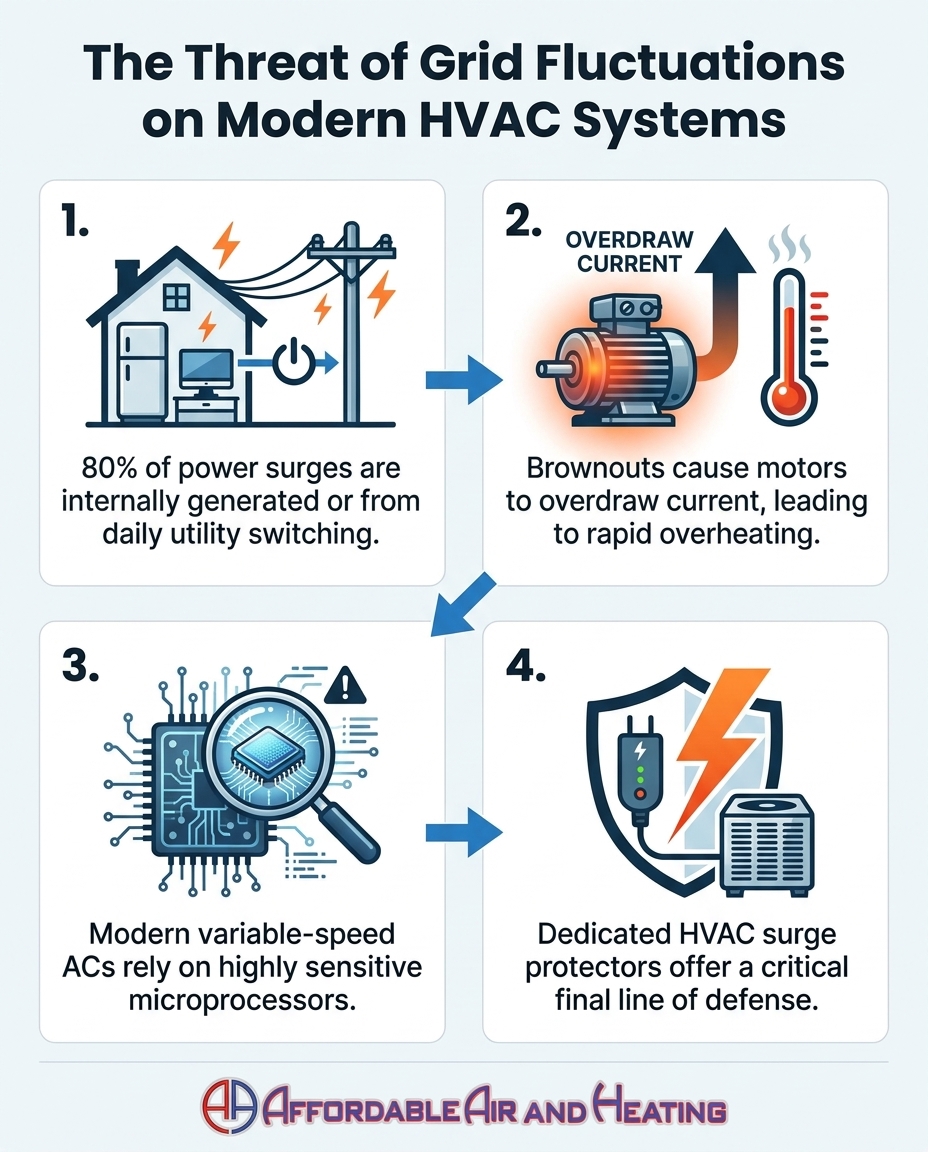
Today's equipment is completely different. Modern variable-speed AC units and heat pump systems do not just turn on and off. They rely on complex microprocessors, inverters, and sensitive control boards to precisely adjust their cooling output. Instead of running at full blast, they ramp up and down in tiny increments to save energy and maintain perfect indoor comfort. Because of this advanced technology, industry experts often refer to modern condensers as "outdoor computers."
Most homeowners would never plug a brand-new desktop computer or a smart television directly into a wall outlet without a surge strip. Yet, many leave their most expensive "computer"—the microprocessors sitting outside in the condenser unit—completely exposed to the harsh realities of the local power grid. These sensitive electronics manage your system's high efficiency, but they require clean, stable power to function correctly.
Why Circuit Boards Are Highly Vulnerable
The control board and the inverter are the brains of a variable-speed system. They convert incoming alternating current (AC) into direct current (DC) to precisely control the compressor's motor speed. This conversion process relies on delicate solid-state components that operate on very low voltages.
When micro-surges travel through your electrical lines, they bypass standard electrical safeguards and hit these delicate components directly. Over time, these tiny, repetitive voltage spikes degrade the solid-state circuitry. It is a cumulative effect—each small surge weakens the board a little more until it finally shorts out. Organizations like the National Electrical Manufacturers Association (NEMA) and the Institute of Electrical and Electronics Engineers (IEEE) have strict standards highlighting the extreme sensitivity of microprocessor-based equipment, confirming that dedicated surge protective devices are an absolute necessity for modern solid-state technology.
How Late-Summer Grid Strain Impacts Your Home's Power Quality
Power quality is not a constant; it fluctuates based on regional demand. As we move into the hottest parts of the year, August late-summer grid strain becomes a daily reality. The triple-digit heat in Lancaster drives localized grid stress to its absolute limit. Every home and business in the region is running their cooling systems at maximum capacity for hours on end, creating massive regional cooling demand.
This immense draw on the utility grid frequently leads to CAISO (California Independent System Operator) Flex Alerts. When demand threatens to outpace supply, the utility grid struggles to maintain the standard 120/240 volts required by your home appliances. The power delivered to your electrical panel becomes unstable.
The impact of dirty power:
• Voltage sags: Brief drops in electrical pressure that starve your heavy appliances of the power they need to operate.
• Rolling blackouts: Intentional power cuts used to balance the grid, which cause massive electrical spikes when the power is suddenly restored.
• Frequency variations: Tiny fluctuations in the alternating current frequency that confuse sensitive solid-state timing circuits.
Dirty power is not just an inconvenience that makes your lights flicker. It is a physical, destructive threat to electrical insulation and solid-state components. When the grid is strained, the electricity entering your home is chaotic, and your cooling equipment bears the brunt of that instability.
The Hidden Danger of Brownouts and Voltage Drops
Most people worry about power surges—massive spikes in electricity that instantly fry electronics. However, the hidden danger during peak summer months is actually the exact opposite: a brownout. A brownout is a significant drop in voltage, and it is often far more damaging to heavy machinery than a traditional power surge.
The physics behind this damage is straightforward. Electric motors, like the ones in your compressor and condenser fan, require a specific amount of total power (wattage) to do their job. Wattage is calculated by multiplying voltage by amperage (current). If the utility grid drops the voltage during a brownout, the motor must draw excessive current (amperage) to maintain its workload.
This excessive current draw generates intense heat inside the motor windings. The rapid overheating melts the protective varnish on the copper wiring, leading to degraded motor insulation. Repeated exposure to these voltage drops drastically shortens the lifespan of compressors and fan motors in modern variable-speed AC units. This is why you might notice your vents blowing warm air after a power outage—the electrical stress may have already compromised a vital component.
Electrical stress can cause a component failure that leaves your air conditioner running but not blowing cool air. A technician can diagnose it, but preventing that electrical stress in the first place is the ultimate goal.
Real-World Consequences for Fan Motors
Faulty fan motors are frequently the first casualty of repeated voltage drops. Because the fan motor is smaller than the compressor, its internal wiring is thinner and more susceptible to melting when forced to draw excessive amperage during a brownout.
When the fan motor struggles or fails, it creates a dangerous cascading effect. The condenser coil can no longer release heat into the outside air. The system's internal pressure skyrockets, forcing the primary compressor to work much harder to pump the refrigerant. If the system does not shut itself down on a high-pressure safety switch, this chain reaction risks total system failure, turning a simple electrical issue into a catastrophic equipment loss.
Lightning vs. Grid Fluctuations: Debunking the Surge Myth
When most homeowners hear the term "surge protector," they immediately picture a massive lightning bolt striking a nearby power pole. While lightning strikes are absolutely catastrophic to home electronics, they are relatively rare in the High Desert. If you are only worrying about lightning, you are missing the most common threat to your equipment.
The reality is that 80% of power surges are internally generated or caused by daily utility grid switching. Every time a large appliance in your home—like a refrigerator, pool pump, or even an older secondary AC unit—cycles on and off, it creates a brief surge of electricity that ripples through your home's wiring. Combined with the daily grid switching performed by the utility company to manage regional loads, your home experiences dozens of minor surges every single day in Lancaster CA / Southern California.
These daily events rarely cause immediate, noticeable damage. Instead, the cumulative damage of small, daily voltage spikes degrades circuit boards silently over time. It is similar to driving a car over a pothole every day; the first few times, the suspension seems fine, but eventually, a critical component snaps. Protecting against these daily, invisible grid fluctuations is the primary reason for installing protective devices on your cooling system. As a trusted High Desert advisor, Affordable Air and Heating actively works to save homeowners from preventable, grid-related equipment failure, prioritizing long-term investment protection over reactive repairs.
Why Whole-Home Protection Isn't Always Enough
Many homeowners upgrade their main electrical panels with whole-home surge protectors and assume their entire property is completely safe. While panel-level protection is an excellent first step, it is not always enough to fully protect sensitive outdoor equipment.
A whole-home surge protector (typically a Type 1 or Type 2 device) is installed at the main breaker box. It does a fantastic job of blocking massive external surges coming from the utility pole before they enter the house. However, as we discussed, many surges originate past the main electrical panel. If a heavy appliance on a different circuit sends a surge through the internal wiring, the whole-home protector at the main panel might not catch it before it reaches your outdoor condenser.
A dedicated HVAC surge protector acts as a final line of defense right at the condenser unit. By layering your protection—using both a panel protector and a dedicated unit at the equipment—you ensure that the microprocessors in modern variable-speed AC units receive the cleanest possible power.
• Installation Location — Whole-Home Surge Protector (Type 1/Type 2): At the main electrical breaker panel or meter. — Dedicated HVAC Surge Protector (Type 3): Directly at the outdoor HVAC condenser disconnect box.
• Primary Function — Whole-Home Surge Protector (Type 1/Type 2): Blocks massive external surges from entering the home's wiring. — Dedicated HVAC Surge Protector (Type 3): Absorbs internal surges and local voltage spikes before they hit the AC circuit board.
• Protection Target — Whole-Home Surge Protector (Type 1/Type 2): General household wiring, standard appliances, and indoor outlets. — Dedicated HVAC Surge Protector (Type 3): Specifically calibrated for the high-voltage demands of compressors and sensitive inverters.
• Response Time — Whole-Home Surge Protector (Type 1/Type 2): Fast, but must travel back to the panel to clamp the surge. — Dedicated HVAC Surge Protector (Type 3): Instantaneous point-of-use protection right at the vulnerable equipment.
The Importance of Professional Assessment and Installation
Adding a surge protector to your cooling system is not a weekend project. Working with 240-volt HVAC circuitry is extremely dangerous and strictly prohibited for DIYers. The electrical current powering your condenser is lethal, and any misstep in wiring can instantly destroy the very circuit board you are trying to protect.
A licensed technician must evaluate your system's current electrical draw, verify the integrity of your home's grounding rod, and ensure breaker compatibility before any device is installed. If your home's electrical ground is weak or corroded, a surge protector has nowhere to dump the excess voltage, rendering it completely useless. A professional assessment ensures that the safety mechanisms will actually function when August late-summer grid strain hits its peak.
Furthermore, professional installation guarantees that the warranties on your expensive variable-speed equipment remain intact. Manufacturers require all electrical modifications to be performed by licensed contractors. When a professional handles your air conditioning protection and service, they properly size the protective device to match your system's maximum amperage, mount it securely in a weatherproof enclosure, and verify that the clamping voltage is correct for your specific model. This level of precision is the only way to ensure your "outdoor computer" survives the unpredictable summer grid.
Frequently Asked Questions
Do I really need a surge protector for my HVAC?
Yes, dedicated protection is highly recommended for newer systems. Modern air conditioners use sensitive solid-state control boards and microprocessors that are easily damaged by minor voltage fluctuations. Installing a surge protector acts as an insurance policy for these expensive electronic components, shielding them from the unpredictable daily fluctuations of the local power grid.
What happens to an AC during a brownout?
During a brownout, the voltage supplied to your home drops significantly. To compensate for the lack of electrical pressure, the motors inside your AC unit draw excessive amperage to keep running. This spike in current generates intense heat, which can quickly melt the internal wiring insulation and lead to premature motor failure.
Can a power surge ruin an air conditioner?
Absolutely, a power surge can destroy an air conditioner instantly or over time. A massive spike can fry the control board, blow the dual capacitor, or short out the compressor windings in a single event. More commonly, small daily surges slowly degrade the internal circuitry until the system fails unexpectedly on a hot afternoon.
Are HVAC surge protectors worth the investment?
They are widely considered one of the smartest investments you can make for your cooling system. The cost of replacing a variable-speed control board or a burnt-out compressor is substantial, not to mention the discomfort of being without air conditioning during a heatwave. A surge protector prevents these specific types of electrical failures, saving you from major unexpected repair bills.
How do I know if a power surge damaged my AC circuit board?
The most common sign is an unresponsive system that refuses to turn on, even when the thermostat is calling for cooling and the breaker is not tripped. You might also notice a faint burning smell near the outdoor unit, or the system might repeatedly try to start and immediately shut down. A licensed technician must perform a diagnostic test to confirm if the board has been compromised by electrical stress.
Will a surge protector prevent my AC from resetting during Flex Alerts?
A surge protector will not stop the utility company from reducing power, nor will it act as a backup battery. Its job is strictly to block the dangerous voltage spikes that occur when the power fluctuates or when the grid comes back online after a rolling blackout. It ensures that when stable power is restored, your system's circuit board is still fully intact and ready to cool your home.
Protecting your investment from regional grid strain does not have to be complicated. By understanding how brownouts and voltage drops physically damage sensitive solid-state components, it becomes clear that a dedicated protective device is a necessary safeguard, not an optional accessory. Taking proactive steps today ensures your cooling equipment stays reliable, efficient, and fully protected, no matter what the summer grid throws your way.