The Importance of Proper Venting for High-Efficiency Furnaces


The Hidden Complexity of Upgrading to a High-Efficiency Furnace
Your older heating system is finally showing signs of failure, and you are ready to upgrade, but the importance of proper venting for high-efficiency furnaces often becomes an unexpected hurdle. Understanding why upgrading to a modern system requires abandoning your home's existing metal chimney flue is a common point of confusion. At Affordable Air and Heating, our technicians frequently see homeowners reach the decision point of approving the necessary scope of work for running new PVC exhaust piping and wonder if it is truly necessary. It can feel like an arbitrary extra step, but making the jump to a 90-plus AFUE system involves a strict mechanical necessity tied directly to how the new unit operates.
For expert guidance on your next system, explore our professional HVAC services or schedule your heating installation and repair today.
When you transition from a standard-efficiency furnace to a high-efficiency model, you are fundamentally changing how your home processes combustion gases. Older furnaces send a significant portion of the heat they generate straight up the metal chimney. Because that exhaust is incredibly hot and dry, standard metal flues handle it perfectly fine. However, modern engineering has changed that dynamic entirely.
Standard vs. High-Efficiency Venting Requirements
• Standard (80% AFUE) — Exhaust Temperature: 350°F - 450°F — Exhaust State: Hot, dry gas — Required Venting Material: Galvanized metal or masonry chimney
• High-Efficiency (90-plus AFUE) — Exhaust Temperature: 100°F - 120°F — Exhaust State: Cool, wet condensation — Required Venting Material: Corrosion-resistant PVC piping
The table above illustrates the drastic difference in exhaust temperatures. A modern furnace is designed to capture the heat that older models waste. By understanding the chemistry and safety requirements behind this crucial installation step, you can feel confident that running new PVC piping is not an upsell, but the foundation of a safe, functional heating upgrade.
How 90-Plus AFUE Systems Extract More Heat (And Create Moisture)
The problem: In our years of replacing aging systems across Lancaster, we see that older standard-efficiency furnaces waste up to 20% of the fuel they consume, sending valuable heat straight out the roof. Homeowners looking to lower their energy consumption naturally turn to high-efficiency models, but they often do not realize that capturing that wasted heat completely changes the physical state of the exhaust leaving the unit.
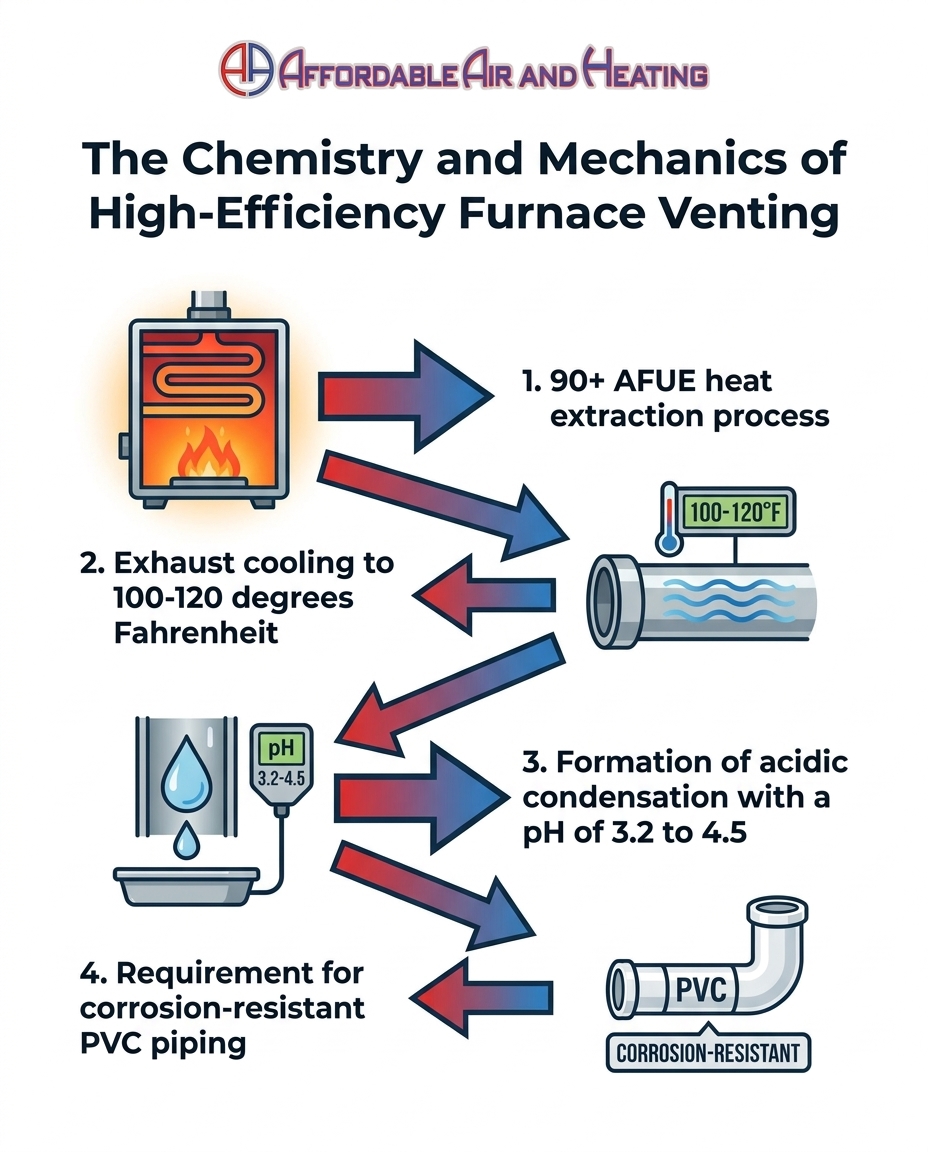
The cause: What makes a furnace high-efficiency is the addition of a secondary heat exchanger. In a 90-plus AFUE system, the combustion gases pass through the primary heat exchanger just like they do in older models. However, instead of venting immediately, those gases are routed into a secondary heat exchanger. The system pulls so much residual heat out of the combustion gases that the exhaust cools significantly. While a standard furnace exhausts gases at around 400 degrees Fahrenheit, a high-efficiency model drops that temperature down to roughly 100 to 120 degrees Fahrenheit.
When you drop the temperature of combustion gas that low, a physical change occurs. The moisture suspended in the gas reaches its dew point and condenses into a liquid. This means your furnace is no longer venting a hot, dry gas; it is now pumping out a cool, wet vapor alongside a steady stream of liquid condensation. If you are Understanding the AFUE Rating on Your Gas Furnace, this secondary heat extraction is exactly where that extra 10% to 16% efficiency comes from.
The solution: Because the exhaust is now wet and relatively cool, it lacks the thermal buoyancy to rise up a traditional vertical chimney. The system requires a specialized, motorized draft inducer to push the exhaust horizontally out of the side of your home, and it requires a venting material that can safely handle constant exposure to moisture.
The Corrosive Reality of Acidic Furnace Condensation
The moisture created by a 90-plus AFUE furnace is not just pure water. The hidden chemistry of combustion reveals a much more destructive reality. When natural gas burns, it produces water vapor and carbon dioxide, along with trace amounts of other byproducts. When that mixture cools and condenses inside the secondary heat exchanger, it forms a mildly acidic liquid.
According to ASHRAE guidelines (the American Society of Heating, Refrigerating and Air-Conditioning Engineers), furnace condensate typically has a pH between 3.2 and 4.5. To put that into perspective, this condensation is roughly as acidic as tomato juice or household vinegar. While that might not sound immediately dangerous to human skin, our installation crews know firsthand that it is absolutely devastating to the materials traditionally used in chimney construction.
What Happens to Improperly Vented Exhaust?
Our team has seen the destructive aftermath of improper venting too many times. If this acidic liquid is allowed to vent into a standard galvanized metal flue or a masonry chimney, the results are rapid and destructive. The continuous exposure to acid eats away at the infrastructure of your home.
• Galvanized metal deterioration: The acid strips the protective zinc coating off metal flues, leading to aggressive rust and eventual pipe collapse.
• Masonry breakdown: Acidic moisture dissolves the mortar joints in brick chimneys, causing structural instability and allowing moisture to seep into drywall and framing.
• Venting blockages: As metal flakes away and mortar crumbles, the debris falls downward, creating blockages that prevent the furnace from venting at all.
This is why upgrading your heating system requires more than just swapping out a metal box in the garage or basement. It requires comprehensive HVAC solutions that address the chemical realities of the equipment. Structural damage is only part of the problem; the real hazard is what happens to the exhaust gases when the flue eventually fails.
Why PVC Piping is the Only Safe, Code-Compliant Venting Solution
With the understanding that high-efficiency condensation destroys metal, the requirement for new venting becomes clear. PVC (polyvinyl chloride) is naturally resistant to the acidic corrosion that destroys standard flues. It can withstand constant exposure to pH levels far lower than what a 90-plus AFUE furnace produces, ensuring the pipe remains structurally sound for the life of the heating system.
Modern high-efficiency installations typically utilize a direct venting method. This involves running two separate PVC pipes to the exterior of the house. One pipe pulls fresh, clean combustion air in from the outside, while the second pipe safely exhausts the cooled, wet, and acidic gases outside. This sealed system is highly efficient because it does not use your home's conditioned indoor air for the combustion process.
The Critical Role of Professional Installation Standards
At Affordable Air and Heating, our installation crews' strict adherence to safety codes and professional installation standards ensures every high-efficiency furnace is vented with the correct PVC piping to prevent carbon monoxide risks. We emphasize to every customer that proper installation is not just about choosing the right material; it is about how that material is assembled.
• Sealed joints: Every joint and elbow in the PVC run must be primed and glued with specialized cement to create an airtight seal. If a joint fails, dangerous carbon monoxide and acidic moisture can leak directly into your living space.
• Precise sloping: The exhaust pipe must be sloped precisely back toward the furnace. Because the exhaust is wet, moisture constantly accumulates inside the pipe. The slope ensures this liquid drains back to the unit, where it is neutralized and directed to a floor drain, rather than pooling inside the pipe.
• Code compliance: Building codes strictly prohibit venting a high-efficiency unit into a standard chimney because of the carbon monoxide hazards created when the acidic moisture inevitably destroys the flue.
Defending Against Freezing Winter Temperatures in the High Desert
The problem: Lancaster's high desert climate presents a unique challenge for high-efficiency heating systems. During the winter, overnight temperatures frequently drop below freezing. If a PVC exhaust pipe or its accompanying condensate drain line is improperly installed, the cold weather can shut down your entire heating system.
The cause: As we discussed, high-efficiency systems constantly produce water. If the PVC exhaust pipe is not sloped correctly, or if it sags in the middle of a long run, that acidic water pools inside the pipe instead of draining. When the freezing winter overnight lows hit the high desert, that pooled water turns to solid ice. This ice creates a blockage in the exhaust pipe. Modern furnaces are equipped with sensitive pressure switches designed to detect blockages. If the system cannot push exhaust gases out, the safety sensors will lock out the furnace entirely to prevent carbon monoxide buildup inside the home.
Our emergency dispatch team sees this pattern every winter. One local homeowner experienced this firsthand when their heating suddenly stopped working during a very cold week under a severe freeze warning. Technicians assessed the unit, identified a bad relay alongside aging components that were failing under the strain of the weather, and recommended a full replacement. A new, efficient HVAC unit was installed, resolving the heating issue and restoring safe, reliable warmth with properly routed venting just in time.
The solution: Professional installers understand how to route and insulate these lines to ensure reliable operation during the coldest weeks. By ensuring the exact required slope (typically a quarter-inch drop per foot of pipe) and utilizing proper insulation where lines pass through unconditioned spaces, our technicians protect your system from freeze-ups. Whether you live in the center of town or in our wider service areas in the Antelope Valley, preparing for the September pre-heating season means ensuring your condensate management is ready for freezing nights.
Planning Your System Upgrade Before Freezing Weather Arrives
As we head into the September pre-heating season, our team strongly recommends using this early fall transition period to evaluate aging standard-efficiency systems. Because upgrading to a high-efficiency system requires additional labor and structural planning for the new PVC runs, it is not a project you want to rush during a mid-winter breakdown.
Routing new PVC pipes often involves finding a clear path through floor joists, basements, or crawlspaces to an exterior wall. This takes careful planning to ensure the pipes maintain their structural integrity and proper slope. Waiting for an emergency breakdown during a freeze warning to discover that a completely new venting system must be routed can leave your family without heat for longer than a standard swap-out would take.
The Benefits of Pre-Season Planning
Tackling this project during the September pre-heating season gives you the time to make informed decisions.
• Thorough assessments: Technicians have the time to properly map out the safest, most aesthetically pleasing route for your new PVC exhaust and intake pipes.
• Financial preparation: Early planning allows time to explore available financing options for high-efficiency furnaces without the pressure of a freezing house.
• Incentive research: You have the opportunity to look into generic energy incentives, federal tax credits, or local utility rebates that often apply to high-efficiency upgrades.
By scheduling your consultation before the cold weather sets in, you guarantee that your new system will be installed, properly vented, and fully tested before you actually need to rely on it.
Common Questions About High-Efficiency Furnace Venting
Why do high efficiency furnaces use PVC pipe?
They extract so much heat that the exhaust cools and condenses. Because a 90-plus AFUE system pulls maximum thermal energy from the combustion gases, the resulting exhaust is roughly 100 to 120 degrees Fahrenheit. At this low temperature, moisture forms. This condensation is acidic and destroys standard metal flues, making corrosion-resistant PVC mandatory for safe operation.
Can you vent a high efficiency furnace into a chimney?
No, venting into a standard masonry or metal chimney violates safety codes. The acidic moisture produced by the furnace will rapidly dissolve the mortar in brick chimneys and rust away galvanized metal pipes. This destruction creates severe structural damage and introduces dangerous carbon monoxide hazards into the living space when the flue eventually fails.
What happens if high efficiency furnace venting is wrong?
Improper venting can lead to toxic carbon monoxide leaking into the home. If the PVC joints are not sealed correctly or the pipe is not sloped properly, acidic moisture can leak out and damage building materials. Furthermore, poorly installed venting often triggers system lockouts, leaving you without heat, and can completely void the manufacturer's equipment warranty.
How does acidic condensation affect metal flues?
The condensation acts as a slow-moving corrosive agent that eats through metal. With a pH level similar to vinegar, the moisture strips the protective zinc coating off galvanized pipes, causing them to rust from the inside out. Over time, the metal becomes brittle, flakes apart, and eventually collapses, blocking the exhaust path entirely.
Why is proper slope critical for furnace exhaust pipes in cold climates?
The slope ensures acidic condensation drains back to the unit rather than pooling in the pipe. In freezing temperatures, pooled water turns to ice, blocking the exhaust path. When the furnace sensors detect this blockage, they shut down the heating system to prevent carbon monoxide buildup, leaving your home freezing until the ice is cleared.
Ensure a Safe, High-Efficiency Heating Upgrade This Fall
Understanding the acidic nature of high-efficiency exhaust makes the requirement for PVC clear and logical. Proper venting is the absolute foundation of a safe, reliable, and corrosion-resistant heating system. As you prepare for the September pre-heating season, consulting with our local professionals will give you a clear, logical explanation of how high-efficiency furnaces produce acidic exhaust condensation, making PVC pipes the only safe, corrosion-resistant, and code-compliant venting solution. Ensure your home is ready for winter by scheduling your heating installation and repair today.