How We Test for Leaky Air Ducts in Older Palmdale Homes



The Hidden Cost of Unseen Attic Leaks in Your Home
According to ENERGY STAR, typical homes lose 20 to 30 percent of conditioned air to leaks, holes, and poorly connected ductwork. When considering exactly how we test for leaky air ducts in older Palmdale homes, that statistic takes on a much heavier weight. At Affordable Air and Heating, our team has spent years inspecting attics throughout Lancaster and the Antelope Valley, and in these older properties, we consistently find this number to be significantly higher, pushing your HVAC system to run continuously just to maintain a baseline level of comfort in your living spaces.
Many homeowners assume that if air is blowing out of the vents, the ductwork is functioning properly. Unfortunately, that is rarely the whole story. Conditioned air—air you have already paid to heat or cool—often escapes into dusty, unconditioned attic spaces before it ever reaches your bedroom or living room. This unseen leakage creates a domino effect: your equipment works harder, your utility bills climb, and your home never quite reaches the temperature set on the thermostat.
The decision to stop guessing about energy loss and authorize a diagnostic test is the first crucial step toward restoring your system's performance. By identifying these hidden leaks with precision, you can vastly improve your air conditioning efficiency and protect your indoor environment from the dust, fiberglass, and allergens lingering in the attic. For older Palmdale properties, taking this proactive approach means the difference between a system that struggles and a system that performs.
How the High Desert Climate Accelerates Duct Degradation
The specific environmental factors in our region play a massive role in how quickly building materials deteriorate. Uninsulated attics in the area experience brutal temperature swings, shifting rapidly from extreme summer heat to freezing winter nights. This High Desert climate acts as a pressure cooker for aging infrastructure, accelerating the breakdown of materials that were never designed to withstand decades of such intense thermal expansion and contraction.
Addressing aging infrastructure is a common challenge across our local HVAC service areas, especially for systems that have been operating for twenty or thirty years. Recently, our Affordable Air and Heating dispatch received a call from a local homeowner needing comprehensive service on their aging HVAC system. Our polite, knowledgeable technicians arrived, assessed the severely degraded ductwork, and performed an outstanding job restoring the system's integrity—leaving the customer very pleased with the meticulous work provided. This type of degradation is a pattern we see constantly in older Palmdale properties.
The Lifespan of Traditional Duct Materials
To understand why leaks happen, you have to look at how ductwork was installed in the past compared to modern standards. Decades ago, contractors relied heavily on basic cloth-backed duct tape to seal joints and seams. While effective in the short term, this material is highly vulnerable to extreme attic temperatures.
• Thermal expansion and contraction: As the attic heats up during the day and cools rapidly at night, the metal ductwork expands and contracts. This constant micro-movement stresses the seams.
• Adhesive breakdown: The extreme heat bakes the adhesive on traditional duct tape, causing it to dry out, turn brittle, and eventually flake away entirely.
• Mastic cracking: Even older mastic sealants can become rigid over time. Once they lose their flexibility, the constant temperature swings cause hairline cracks to form along the joints.
• Structural disconnects: Over decades, what started as a minor seal degradation turns into a massive structural disconnect, allowing huge volumes of air to escape directly into the attic space.
Modern installation requirements use flexible, highly durable mastic sealants and specialized foil tapes designed to withstand these exact temperature extremes, but older Palmdale properties rarely feature these upgraded materials unless they have been recently retrofitted.
Why Visual Attic Inspections Are No Longer Enough
For years, the standard approach to finding duct leaks was simply climbing into the attic with a flashlight and looking around. While this method still has some value, a standard visual inspection can only identify obvious, catastrophic disconnects—like a flexible duct collar that has completely fallen off the main trunk line. It misses the vast majority of the problem.
The limitations of the naked eye: Micro-leaks, degraded seams, and hidden holes beneath layers of blown-in insulation are entirely invisible during a basic walk-through. You might have dozens of tiny gaps along the supply line that collectively equal the size of a basketball, but a visual check will never reveal them. Relying solely on visual checks often leads to incomplete repairs, leaving significant air loss unresolved.
This is where professional methodology changes the game. At Affordable Air and Heating, we don't just guess if your ducts are leaking; we use professional testing to quantify exactly how much air is lost. True diagnostic work requires specialized equipment to remove the guesswork entirely. By relying on precise duct blaster pressurization metrics, we transition from assuming there is a leak to knowing exactly how severe the leakage is, allowing for a much more accurate and effective repair strategy.
• Visual Inspection — What It Detects: Major disconnects, crushed ducts, torn outer insulation. — Limitations: Cannot see under insulation or detect micro-leaks in seams. — Accuracy Level: Low – relies entirely on line-of-sight.
• Smoke Testing — What It Detects: Direction of air movement around exposed joints. — Limitations: Only tests visible areas; does not quantify total air loss. — Accuracy Level: Medium – good for pinpointing, bad for measuring.
• Duct Blaster Testing — What It Detects: Total system leakage, micro-leaks, hidden disconnects. — Limitations: Requires system to be temporarily sealed off. — Accuracy Level: High – provides quantifiable, mathematical data.
The Mechanics: Inside a Professional Duct Blaster Test
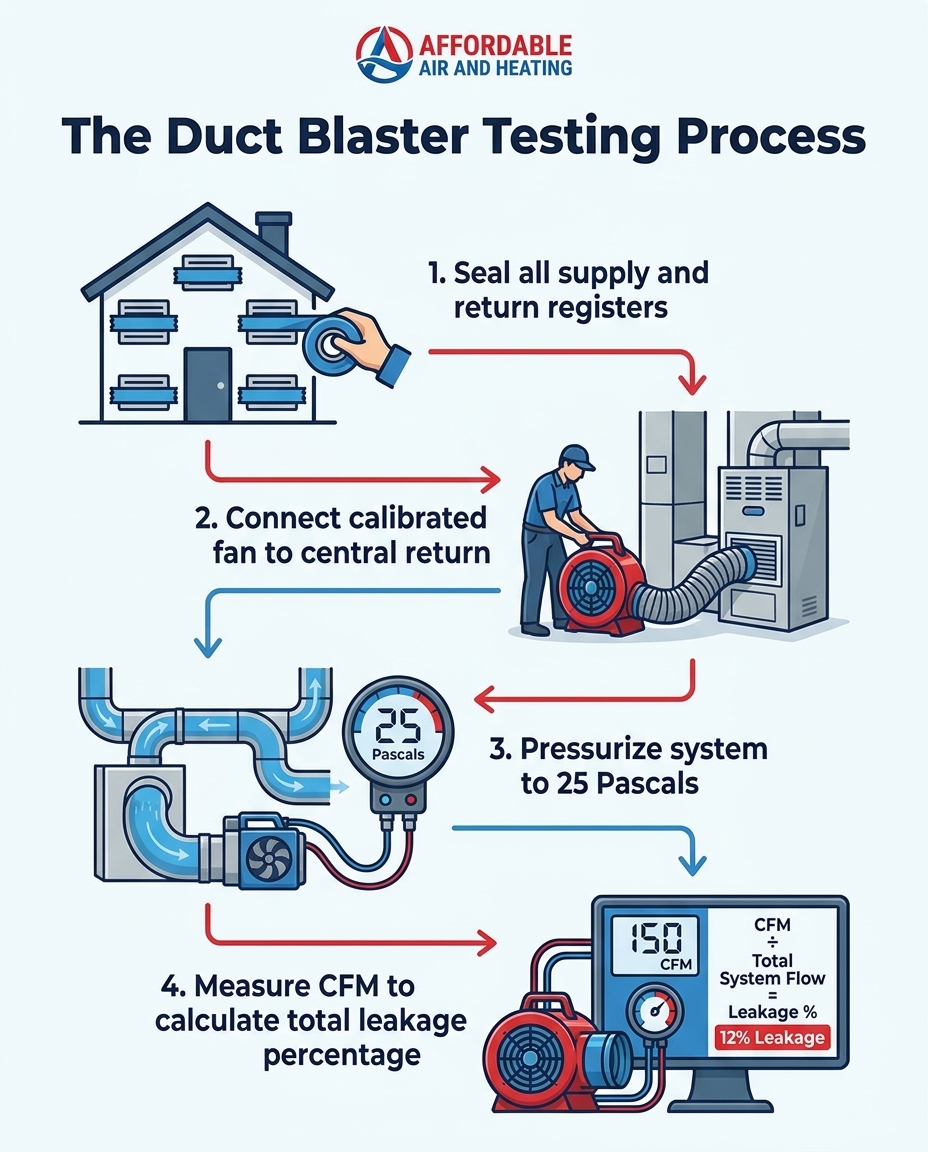
To truly understand the health of your ductwork, you need scientific methodology. A duct blaster test is the industry gold standard for measuring air distribution system leakage, and it is the exact process our technicians use in the field. It involves temporarily sealing the entire duct network and forcing air into it to see exactly how well it holds pressure. Here is how the process unfolds:
1. Sealing the system: Technicians place specialized adhesive masks or foam blocks over every single supply register and return grille inside the home. This creates a completely closed loop.
2. Connecting the equipment: A calibrated diagnostic fan—the "duct blaster"—is attached to the central return opening using a flexible, airtight collar.
3. Pressurizing the ducts: The fan is turned on to pressurize the system to a specific diagnostic metric, typically 25 Pascals. This pressure simulates the normal operating conditions of your HVAC equipment.
4. Measuring the airflow: Digital sensors measure precisely how much air the fan must force into the system to maintain that 25-Pascal pressure. If the ducts are perfectly sealed, the fan hardly has to work. If there are massive leaks, the fan must push a high volume of air to keep the pressure stable.
Setting Up the Diagnostic Equipment
The setup phase is critical for accurate readings. If even one vent is left unsealed, the data will be skewed. Technicians spend considerable time ensuring that the temporary seals are completely airtight. Once the vents are prepped, the digital manometers—highly sensitive pressure gauges—are calibrated to account for the baseline atmospheric pressure in the home before the test begins.
Reading the Pressurization Metrics
The data generated by this test is measured in Pascals (a unit of pressure) and Cubic Feet per Minute (CFM). By analyzing the duct blaster pressurization metrics, we can translate these numbers into actionable data. For example, a specific CFM reading at 25 Pascals directly correlates to the total square inches of leakage across the entire duct network. It tells us exactly how big the "hole" in your ductwork is, even if that hole is made up of a hundred microscopic cracks.
Quantifying Your Air Loss for Targeted Solutions
Data without application is useless. Once the pressurization metrics are recorded, our team calculates the exact percentage of conditioned air escaping the system. We find this to be a powerful moment for homeowners, as it puts a hard number on a problem that previously felt abstract. Knowing that your system is losing 35% of its air to the attic completely changes how you view your monthly utility bills.
Pinpointing the problem areas: This data allows us to isolate the issues. By performing secondary tests, we can determine whether the leakage is concentrated in the supply lines (pushing conditioned air out), the return lines (pulling dusty attic air in), or the central plenum near the indoor unit. Each of these scenarios requires a slightly different approach to repair.
Homeowners receive a quantifiable report, proving the necessity of repairs before any sealing work begins. This transparency ensures you know exactly what you are investing in. Targeted sealing based on these precise duct blaster pressurization metrics directly translates to long-term energy savings and significantly reduced wear-and-tear on your expensive heating and cooling equipment. Furthermore, resolving these efficiency issues may make you eligible for generally applicable energy rebates or federal tax credits; we always advise readers to verify current programs with their utility provider or a tax professional.
Timing Your Diagnostics: The September Pre-Heating Transition
Timing matters when it comes to HVAC diagnostics. In our years of servicing Lancaster and the surrounding High Desert, we always recommend September as a critical transition period—acting as the ideal window for fall-prep. The blistering heat of summer is beginning to wane, but the freezing overnight temperatures of winter have not yet arrived. This brief window is the perfect time to evaluate the health of your ductwork.
Testing and sealing ducts during the September pre-heating transition prevents severe energy waste when freezing winter nights force the furnace to run continuously. If your ducts are leaking heavily, your furnace will struggle to keep the house warm, burning excess fuel and stressing the heat exchanger. Fixing these leaks now protects the furnace from overworking when you need it most.
Furthermore, repairing return-side leaks before the heating season prevents attic dust, old insulation, and fiberglass particles from being pulled into the living space. When the furnace kicks on, you want it circulating clean air, not decades of accumulated attic debris. This diagnostic step is a foundational part of comprehensive indoor air quality solutions for older homes, ensuring your family breathes easier all winter long.
From Diagnostics to Clean, Sealed Ductwork
Testing is only the first half of the equation; resolving the leaks is the ultimate goal. Once the duct blaster test identifies the severity of the air loss, professional mastic and specialized aeroseal techniques can be applied to restore system integrity. Unlike old-fashioned tape, modern mastic is a thick, rubberized paste that is painted over joints and seams. As it cures, it forms a permanent, flexible bond that expands and contracts with the metal, easily handling the High Desert temperature swings.
Sealing the ducts ensures that the system is completely closed off from attic contaminants. However, if your ducts have been leaking for years, they have likely accumulated a significant amount of dust and debris inside the actual lines. Because of this, following a comprehensive seal, homeowners often opt for professional air duct cleaning to remove years of accumulated buildup.
This one-two punch of sealing the perimeter and cleaning the interior maximizes both system efficiency and respiratory comfort. By completing this process during the September pre-heating transition, your home is fully prepared for the seasonal shift, operating with clean lines and zero wasted airflow.
Stop Guessing About Your Home's Efficiency
Older Palmdale properties require modern, data-driven diagnostics to truly resolve stubborn efficiency and comfort issues. Guesswork and visual estimates simply cannot provide the accuracy needed to protect your HVAC investment. A professional duct blaster test provides the exact metrics our technicians need to fix the problem right the first time, ensuring no hidden leaks are left behind.
Don't wait until the deep freeze of winter sets in to find out your furnace is heating the attic instead of your living room. Ensure your system is ready for the upcoming seasonal shift by scheduling a comprehensive evaluation with Affordable Air and Heating. By trusting quantifiable data, you can restore your home's comfort, lower your utility costs, and breathe cleaner air all year round.
Frequently Asked Questions
How do professionals test for duct leaks?
Professionals use a specialized diagnostic tool called a duct blaster to test for leaks. This process involves sealing all the vents in the home and attaching a calibrated fan to the main return. The fan pressurizes the system, and digital gauges measure exactly how much air is escaping through hidden cracks and disconnected joints. This provides a highly accurate, mathematical measurement of total air loss.
What is a duct blaster test?
A duct blaster test is an industry-standard diagnostic procedure used to measure the airtightness of HVAC ductwork. By forcing air into a temporarily sealed duct system, technicians can record pressurization metrics (measured in Pascals and CFM) to determine the exact size and severity of leaks. It removes all the guesswork from duct inspections, revealing micro-leaks that are invisible to the naked eye.
How much air is lost through leaky ducts in older homes?
According to ENERGY STAR, a typical home loses roughly 20 to 30 percent of its conditioned air through duct leaks. However, in older homes with aging materials, this number can easily exceed 40 percent. Factors like degraded mastic, failed cloth tape, and extreme attic temperature swings cause older duct systems to deteriorate faster, resulting in massive energy waste if left unsealed.
Why is my HVAC system losing pressure?
Your HVAC system loses pressure when there are structural disconnects, holes, or degraded seams in the ductwork. Instead of pushing air forcefully out of the vents into your rooms, the system bleeds that pressure into the attic or crawlspace. This lack of pressure forces the blower motor to run longer and harder to distribute air, leading to uneven temperatures and increased wear on the equipment.
Why are visual duct inspections not enough to find leaks?
Visual inspections are limited because they can only identify major, obvious failures, like a completely disconnected pipe. Most duct leaks are microscopic cracks in the seams or holes hidden underneath thick layers of blown-in attic insulation. Without pressurizing the system and measuring the airflow, it is impossible to find or quantify these hidden sources of energy loss.
How long does a professional duct pressurization test take?
A professional duct pressurization test typically takes between one to two hours to complete. The majority of this time is spent carefully prepping the home by securely sealing every single supply register and return grille to ensure accurate readings. The actual pressurization and data collection process takes only a few minutes once the equipment is fully set up and calibrated.