Does a Heat Pump Actually Work When Antelope Valley Summer Hits Triple Digits?
Can a heat pump handle triple digit temperatures in the Antelope Valley? Yes — and with the right equipment and installation, it can do so reliably and efficiently. Here's the short answer:
Quick Answer: Heat Pump Performance in Antelope Valley's Extreme Heat
| Condition | Standard Heat Pump | Modern Variable-Speed Heat Pump |
|---|---|---|
| Up to 100°F | Handles well | Handles well, high efficiency |
| 100°F–110°F | Works but strains | Maintains 90%+ cooling capacity |
| 110°F–115°F | May derate significantly | Designed to operate at full capacity |
| Above 115°F | Risk of shutdown | Premium models maintain 85–90% capacity |
The key factors are equipment type, proper sizing, and regular maintenance.
If you've lived in Palmdale or Lancaster through a July heat wave, you already know what "triple digits" really means — not just hot, but relentlessly, stubbornly hot, day after day, with overnight lows that barely give your home a chance to recover. Many homeowners here wonder whether a heat pump is up to that challenge, or whether it'll buckle under pressure right when you need it most.
The concern is completely fair. Older heat pump technology did struggle in extreme heat. But modern systems — especially variable-speed, inverter-driven units — are a different story. Real-world data from comparable California climates like Bakersfield and the Sacramento Valley show that properly sized, high-efficiency heat pumps can maintain comfortable indoor temperatures even when the thermometer pushes past 110°F.
This guide walks you through exactly what happens to a heat pump in extreme desert heat, what separates a system that thrives from one that fails, and what Antelope Valley homeowners specifically need to know before making a decision.
The High Desert Climate: Why Antelope Valley Demands More from HVAC
Living in the Antelope Valley isn't like living in Los Angeles or even the San Fernando Valley. We are firmly in Title 24 Climate Zone 14, a region defined by its "High Desert" characteristics. This means our HVAC systems face a two-front war.
In the summer, Palmdale and Lancaster frequently see peaks between 105°F and 110°F. Unlike coastal areas, our humidity is incredibly low (often between 10% and 30%). While "dry heat" might feel better on your skin, it creates a massive thermal stress on air conditioning equipment. The greater the difference between the blistering outdoor air and your desired 72°F indoor temperature, the harder the system has to work to "reject" the heat it pulls from your living room.
But the Valley doesn't stop there. Our winter design temperature is a biting 12°F. We experience massive diurnal temperature swings — it can be 80°F in the afternoon and 35°F by midnight. This is why residents in areas like the Antelope Acres CA Location need a system that is as robust in the freezing dark as it is in the scorching noon. Furthermore, our constant winds bring dust and "cottonwood fluff" that can clog a condenser coil faster than you can say "Santa Ana winds," leading to restricted airflow and mechanical strain.
Can a heat pump handle triple digit temperatures in the antelope valley?
The most common myth we hear is that heat pumps are only for "mild" climates. In May 2026, we can confidently say that's a thing of the past. To understand if can a heat pump handle triple digit temperatures in the antelope valley, you have to look at the physics.
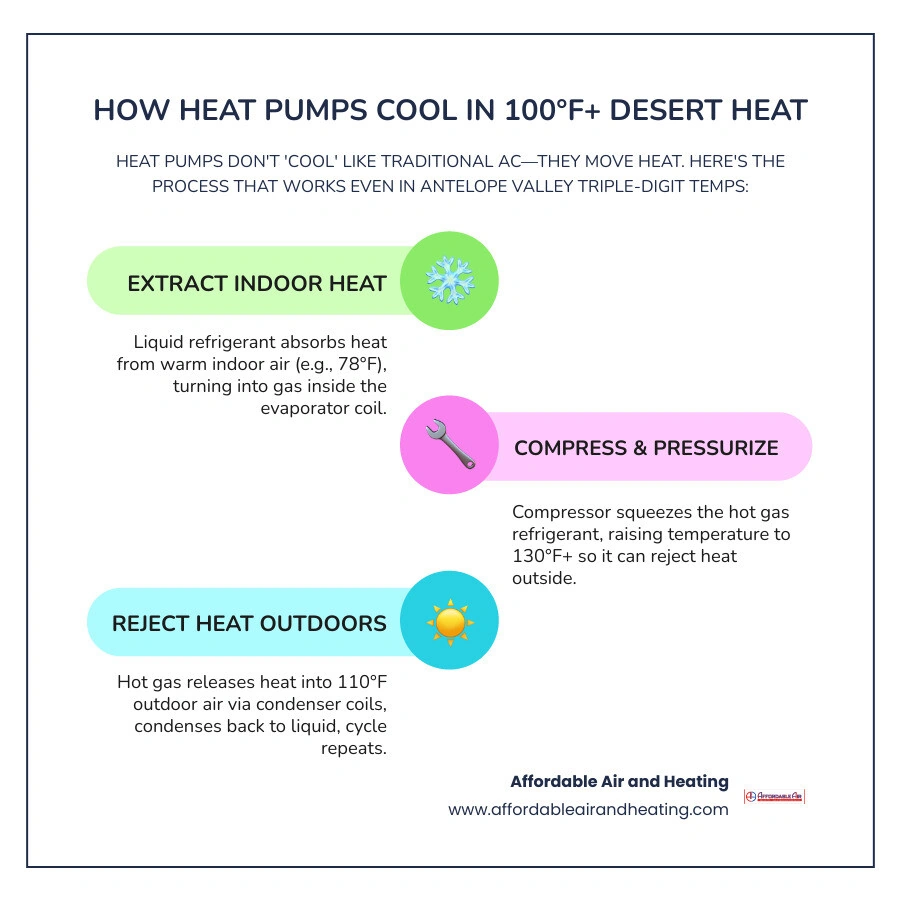
A heat pump doesn't "create" cold; it moves heat. In cooling mode, it works exactly like a traditional air conditioner. It uses a compressor and refrigerant to absorb heat from inside your home and dump it outside. The challenge in 110°F weather is that the outdoor air is already "full" of heat energy, making it harder for the refrigerant to release what it gathered from your kitchen.
However, modern Heat Pumps are engineered for these exact conditions. While a budget, single-stage unit might start to "derate" (lose cooling capacity) once it hits 100°F, a premium variable-capacity system is designed to keep pushing.
| Feature | Single-Stage AC | Variable-Capacity Heat Pump |
|---|---|---|
| Performance at 110°F | Struggles to keep up | Modulates to maintain setpoint |
| Energy Use | High (All or nothing) | Optimized (Uses only what's needed) |
| Humidity Control | Basic | Superior (Longer, lower-speed cycles) |
| Operating Limit | ~105°F-110°F | Up to 115°F-120°F |
Engineering breakthroughs: can a heat pump handle triple digit temperatures in the antelope valley
The secret sauce is inverter technology. Traditional systems are like a light switch — they are either 100% on or 100% off. When it’s 108°F in Palmdale, an old-school system turns on, blasts at full power, gets overwhelmed by the heat, and shuts off (or stays on indefinitely, racking up a massive bill).
Inverter-driven compressors, which we prioritize during a Heat Pump Installation Palmdale CA, act more like a dimmer switch. They can run at 25% capacity or 100% capacity. By running at a steady, lower speed, they maintain consistent airflow and have a larger "effective" heat exchanger surface area relative to the work they are doing. This allows them to manage triple-digit heat without the "heart attack" strain of constant cycling.
Efficiency benchmarks: can a heat pump handle triple digit temperatures in the antelope valley
When we look at Heat Pump Lancaster CA Services, we focus on SEER2 and EER2 ratings. In our dry climate, EER2 (Energy Efficiency Ratio) is actually more important than SEER2 because EER2 measures how the unit performs at a steady 95°F.
Modern high-efficiency units with SEER2 ratings of 16 or higher can maintain 90% of their cooling capacity even when it’s 110°F outside. Systems using R-32 or R-454B refrigerants are also showing better thermal properties in extreme heat than the older R-410A models. This means you aren't just "surviving" the heat wave; you're doing it while saving up to 30% on your annual energy bills compared to an older system.
The Role of Cold Climate Heat Pumps and Proper Sizing
In the Antelope Valley, we often recommend Cold Climate Air Source Heat Pumps (ccASHPs). You might think, "Why do I need a cold-climate unit for 105°F summers?"
The answer lies in our 12°F winters. Standard heat pumps often rely on "strip heat" (electric resistance coils) when the temperature drops below freezing. Strip heat is incredibly inefficient — it’s basically like trying to heat your whole house with a giant toaster. By installing a ccASHP through a Heat Pump Contractor Palmdale CA, you get a system that maintains high efficiency down to 5°F, effectively eliminating the need for those expensive heat strips.
Proper sizing is the other half of the battle. We use Manual J load calculations to ensure your unit isn't too small (which will fail in triple digits) or too large (which will short-cycle and leave your home feeling clammy). Whether it's a Heat Pump Installation Antelope Acres CA or a replacement in Rosamond, we look at your insulation levels, window types, and duct integrity. A "right-sized" unit paired with proper duct sealing ensures that the cool air actually reaches your bedrooms instead of leaking into your 140°F attic.

Maintenance Strategies for Peak Summer Performance
Even the best heat pump will struggle if it's neglected. In the Antelope Valley, maintenance isn't a luxury; it's a necessity.
- Coil Cleaning: Our desert wind is full of fine silt. This dust coats the outdoor condenser coils, acting as an insulating blanket that traps heat inside the unit. Regular Heat Pump Maintenance Lancaster CA includes a professional coil cleaning to ensure the system can "breathe."
- Filter Replacement: We recommend checking your filters every month during the summer. If you have pets or live near open desert, they can clog in as little as 30 days.
- Refrigerant Levels: A tiny leak might not be noticeable when it's 85°F, but it will cause a total system freeze-up during a Heat Pump Repair Palmdale CA emergency when it hits 105°F.
- Pre-Cooling: On days forecasted for triple digits, set your thermostat 2-3 degrees lower at 6:00 AM. This "charges" your home with coolness before the sun hits its peak, allowing your heat pump to maintain the temperature rather than trying to "recover" it during the hottest part of the day.
If you are in the outskirts, our Heat Pump Service Antelope Acres CA team specializes in managing the unique debris and power fluctuation issues common in more rural desert lots.
Signs Your System is Struggling and When to Consider Alternatives
How do you know if your heat pump is losing the war against the sun? Watch for these red flags:
- Short Cycling: The unit turns on and off every few minutes. This usually indicates the compressor is overheating or there is a pressure imbalance.
- Weak Airflow: This could be a clogged filter, a failing blower motor, or duct leaks.
- Warm Air Discharge: If the air coming out of your vents isn't at least 15-20 degrees cooler than the air going in, you likely need a Heat Pump Repair Lancaster CA.
- Unusual Noises: Grinding or squealing from the outdoor unit often means the fan motor or compressor is under extreme mechanical stress.
For some homes, a standard central system isn't enough. If you have a "hot room" that never stays cool, you might look into Heat Pump Repair Antelope Acres CA for your existing unit while adding a ductless mini-split for zoned cooling. In very dry areas, some residents even use evaporative coolers (swamp coolers) to handle the "bulk" of the heat during the day, switching to the heat pump at night for precise comfort.
Frequently Asked Questions about Desert Heat Pumps
What is the maximum temperature a heat pump can handle?
Most modern, high-quality heat pumps are rated to operate at full capacity up to 115°F. Premium inverter models can continue to operate up to 120°F or 125°F, though they may see a 10-15% reduction in total cooling capacity at those extreme peaks.
Do heat pumps work better than traditional AC in dry heat?
In terms of pure cooling, they work identically. However, because most modern heat pumps utilize variable-speed technology more often than standard AC units, they often provide more consistent temperatures and better energy efficiency in the sustained "dry heat" of the Antelope Valley.
How does high desert dust affect heat pump efficiency?
Dust is a significant factor. It can reduce efficiency by up to 20% if it builds up on the coils or clogs the filters. This is why we emphasize seasonal tune-ups for all our neighbors in Lancaster and Palmdale.
Conclusion
So, can a heat pump handle triple digit temperatures in the antelope valley? The evidence is clear: yes, it can. By moving heat rather than fighting it, and by utilizing modern inverter technology, a heat pump is actually one of the smartest ways to stay comfortable in our unique High Desert climate.
At Affordable Air and Heating, we’ve been family-owned since 1996. We understand the specific challenges of living in Climate Zone 14 because we live here too. Whether you are at our Palmdale CA Location or our Lancaster CA Location, our goal is to provide energy-efficient solutions that don't break the bank.
Don't wait for the next 110-degree heat wave to find out if your system is up to the task. From expert Heat Pump Services Palmdale CA to new Heat Pumps installations, we are here to ensure your home remains a sanctuary, no matter what the thermometer says. Give us a call today to schedule your summer readiness check!