What Cracked Heat Exchanger Symptoms Mean for Your Home's Safety
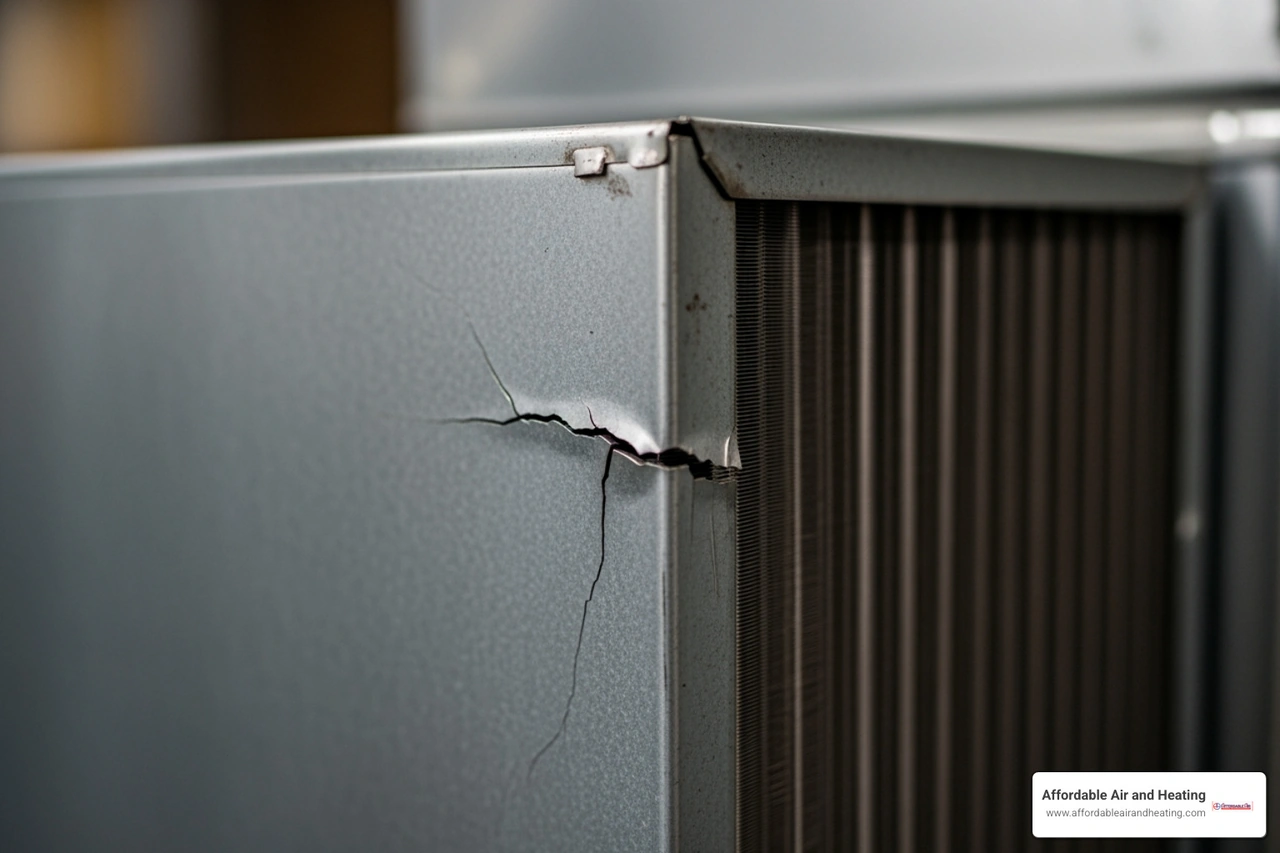
Understanding cracked heat exchanger symptoms and why it is a safety risk could be the difference between a safe, warm home and a life-threatening carbon monoxide emergency. A cracked heat exchanger is one of the most serious problems a gas furnace can develop — and it often goes unnoticed until symptoms are already affecting your family's health.
Here's a quick summary of what to watch for and why it matters:
Common cracked heat exchanger symptoms:
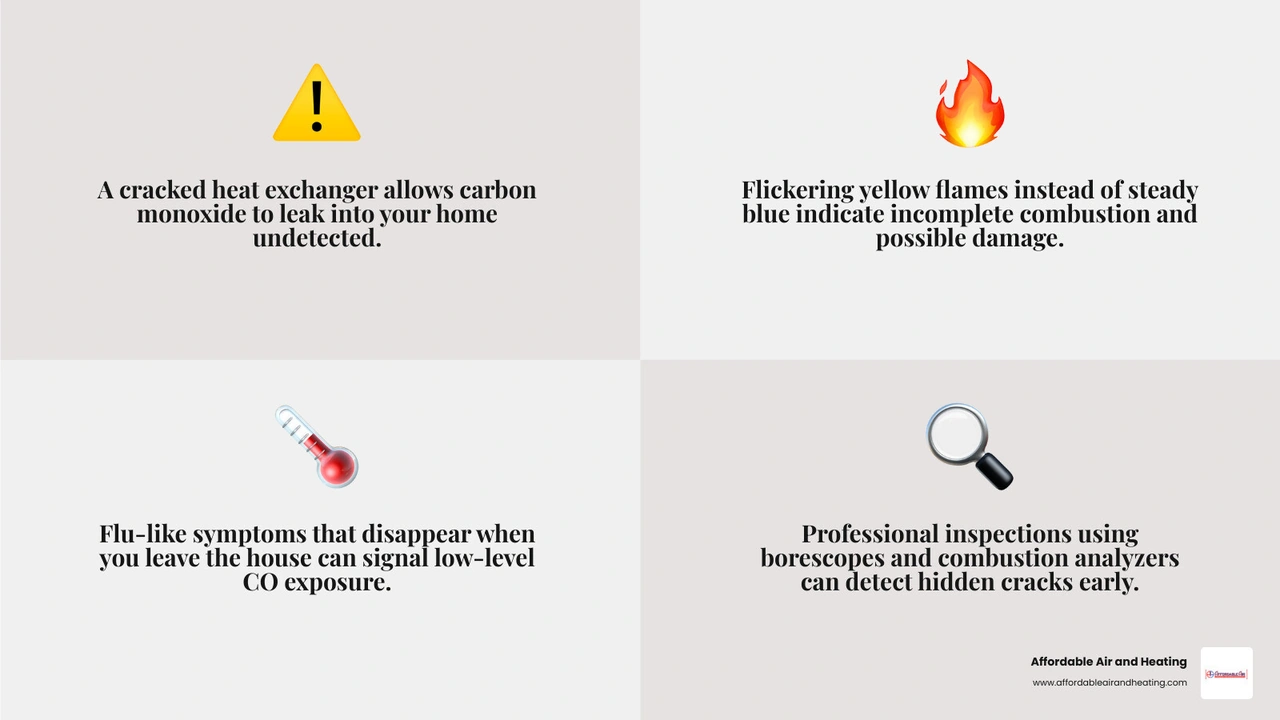
- Yellow or flickering burner flame (should be steady blue)
- Soot or black marks around the furnace
- Unusual chemical or formaldehyde-like smell when the heat runs
- Rattling or banging noises at startup
- Flu-like symptoms (headaches, nausea, dizziness) that improve when you leave home
- Furnace shutting off before reaching the set temperature
- Rust flakes or moisture pooling at the base of the unit
- Carbon monoxide detector alarms
Why it's a safety risk:
- A crack breaks the seal between combustion gases and the air your family breathes
- Carbon monoxide — colorless and odorless — can leak into your living space undetected
- Faulty heating systems cause approximately 400 CO-related deaths and 20,000 emergency room visits in the U.S. every year
- Incomplete combustion from a cracked exchanger can also create fire hazards
- Low-level CO exposure can build gradually, causing chronic health symptoms that are easy to mistake for the flu
If your furnace is more than 15 years old and you're noticing any of these signs, this guide will walk you through everything you need to know — from causes and diagnosis to what steps to take right now.
Understanding the Role of Your Furnace Heat Exchanger
To understand why a crack is so dangerous, we first need to look at what this component actually does. Think of the heat exchanger as the "lungs" of your furnace. It is a set of metal tubes or coils that separates the combustion process from the air that circulates through your home.
When your furnace turns on, the burners ignite gas inside the heat exchanger. This metal gets very hot. Meanwhile, your furnace blower pushes indoor air over the outside of these hot metal tubes. The air picks up the heat and carries it through your vents. Crucially, the "bad" gases created by the fire—like carbon monoxide, nitrogen oxides, and sulfur dioxide—stay trapped inside the tubes and are safely vented out of your chimney or flue pipe.
Because this metal expands when it’s hot and contracts when it cools, it undergoes immense physical stress over thousands of heating cycles. Over time, this leads to metal fatigue. In our experience serving the Antelope Valley since 1996, we’ve seen that furnaces older than 15–20 years are significantly more likely to develop these cracks due to this constant "breathing" of the metal.
If the metal develops even a hairline fracture, that "seal" is broken. Now, those toxic combustion gases can be picked up by the blower fan and pushed directly into your bedrooms and living room. This is why knowing the Signs Your Furnace Needs Repair is so vital for your family's protection. When your system is running correctly, Furnace Repair Boosts Comfort by ensuring only clean, warm air enters your home.
Identifying Cracked Heat Exchanger Symptoms and Why It Is a Safety Risk
Spotting a crack isn't always easy because the heat exchanger is tucked deep inside the furnace cabinet. However, the system will often give you "clues" that something is wrong. We always tell our neighbors in Palmdale and Lancaster to keep an eye on the burner flame. A healthy furnace should have a steady, crisp blue flame. If you see a yellow or orange flickering flame, it usually means oxygen is leaking into the combustion chamber through a crack, disrupting the burn.
Another major red flag is the presence of soot. If you see black carbon buildup inside the furnace or around the burners, it’s a sign of incomplete combustion. You might also notice a strange, pungent odor that smells a bit like formaldehyde. This is caused by aldehydes, a byproduct of incomplete burning. If you smell this, it’s time to learn When Your Furnace Needs Repair and shut the system down immediately.

Don't ignore strange sounds, either. As the metal heat exchanger heats up, a crack can cause the metal to expand unevenly, leading to loud rattling, banging, or popping noises. These sounds often happen right as the furnace starts its cycle. If your unit is making a racket, check out our guide on When You Need Furnace Repair Signs to see if your system matches these dangerous patterns.
Recognizing Cracked Heat Exchanger Symptoms and Why It Is a Safety Risk in Your Daily Health
Perhaps the most frightening aspect of cracked heat exchanger symptoms and why it is a safety risk is how it affects your body. Carbon monoxide (CO) is known as the "silent killer" because you can't see, taste, or smell it.
If you or your family members are experiencing the following, you may have a CO leak:
- Frequent, unexplained headaches
- Nausea or "stomach flu" symptoms that don't go away
- Dizziness or lightheadedness
- Fatigue and sleepiness
- Irritability or confusion
A key sign that these symptoms are related to your furnace is if they improve when you leave the house for a few hours and return when you come back inside. We often see homeowners mistake these for seasonal allergies or a winter cold, but they are actually Furnace Needs Repair Signs that require urgent professional attention.
Visual Indicators of Damage and System Performance Issues
Beyond the flame and your health, there are physical signs on the unit itself. Look for rust flakes or heavy corrosion on the heat exchanger or at the base of the furnace. In high-efficiency "condensing" furnaces, a crack or a secondary heat exchanger blockage can even lead to water pooling on the floor.
You might also notice "short cycling," which is when the furnace turns on and off rapidly without ever really getting the house warm. This happens because the crack messes with the internal pressure or temperature, triggering safety sensors that shut the system down to prevent a fire. If you are Troubleshooting Heater Problems, and your furnace keeps quitting on you, a cracked heat exchanger could be the hidden culprit.
Why a Cracked Heat Exchanger Is a Serious Safety Risk
We cannot stress this enough: a cracked heat exchanger is an emergency. It is one of the leading causes of carbon monoxide leaks in residential heating systems. According to national statistics, heating equipment is involved in about 52,000 home structure fires each year. A crack doesn't just leak gas; it can cause "flame rollout," where the fire literally reaches out of the burner area and ignites nearby components or dust.
Furthermore, the air quality in your home takes a massive hit. Even if CO levels stay below the "lethal" limit, long-term exposure to low levels of combustion byproducts can lead to chronic respiratory issues and weakened immune systems. This is why we often discuss Furnace Replacement for Your Home when a crack is found in an older unit. While Furnace Repair for Home Comfort is our goal, safety always comes first.
Why Ignoring Cracked Heat Exchanger Symptoms and Why It Is a Safety Risk Leads to System Failure
If you ignore the warning signs, the problem will only get worse. Metal expansion ensures that a small hairline crack today will become a gaping hole tomorrow. This leads to total system failure. When the combustion process is compromised, the furnace has to work much harder to produce the same amount of heat, which spikes your energy bills and wears out the blower motor and gas valve.
Eventually, the safety switches (like the flame rollout sensor or the high-limit switch) will permanently disable the furnace to prevent a catastrophe. At that point, you aren't just looking at a repair; it’s likely Time for Furnace Replacement, especially if the unit is in the 15-to-20-year age bracket.
Common Causes and Professional Diagnosis
Why do these cracks happen in the first place? While age is the primary factor, several other issues can accelerate the damage. In our local area, including Santa Clarita and the Antelope Valley, dust and wind are major factors.
| Failure Point | Primary Heat Exchanger | Secondary Heat Exchanger (High-Efficiency) |
|---|---|---|
| Common Cause | Overheating due to restricted airflow | Clogging from acidic condensate/dust |
| Material | Usually aluminized steel | Stainless steel (to resist corrosion) |
| Visual Sign | Cracks/separations at the welds | Plugging or "sludge" buildup |
| Risk Factor | Direct CO leak into air stream | System shutdown and water leaks |
One of the biggest "killers" of heat exchangers is restricted airflow. If you don't change your air filters regularly, the furnace can't "breathe." The heat builds up inside the heat exchanger because there isn't enough air moving over it to carry the heat away. This causes the metal to get much hotter than it was designed for, leading to rapid cracking.
This is why we always emphasize that you can Unlock Savings Regular Furnace Servicing. A simple filter change and a professional cleaning can add years to your furnace's life by preventing this overheating.
How Professionals Detect Hidden Cracks
You should never try to diagnose a cracked heat exchanger yourself. It requires specialized tools and training. When our technicians visit a home in Acton or Santa Clarita, we use several methods:
- Combustion Analysis: We use a digital analyzer to measure the gases in your flue. If we see high levels of CO or fluctuations in oxygen when the blower fan kicks on, it’s a mathematical certainty that there’s a leak.
- Borescope Cameras: We use tiny, high-definition cameras on flexible cables to look deep inside the heat exchanger. This allows us to see cracks that are impossible to spot with the naked eye.
- Visual Inspection: We look for the "tell-tale" signs like soot, rust, and flame disturbance.
- Smoke Tests: In some cases, we use non-toxic smoke to see if it escapes from the exchanger into the air plenum.
Frequently Asked Questions about Furnace Safety
Can a cracked heat exchanger be repaired?
In almost every case, the answer is no. You cannot safely weld or patch a heat exchanger. The metal is thin, and a patch will not expand and contract at the same rate as the surrounding metal, causing it to fail again very quickly. Most manufacturers and safety codes require the entire heat exchanger—or the whole furnace—to be replaced.
How long do heat exchangers typically last?
Most are designed to last 15 to 20 years. However, if the furnace was improperly sized (too big for the house) or if maintenance was neglected, they can fail in as little as 10 years. Modern units using stainless steel or specialized coatings tend to last longer.
Will a carbon monoxide detector always alert me to a crack?
Not necessarily. Standard UL-listed CO detectors are designed to alert you to life-threatening levels of gas. They may not go off if there is a small, chronic leak that is providing "low-level" exposure. This is why professional inspections are mandatory even if your alarm is silent. We recommend replacing your CO detectors every 5 to 7 years to ensure they are sensitive enough to protect you.
Conclusion
A cracked heat exchanger is a serious matter, but it doesn't have to be a disaster if you catch it early. By staying alert to cracked heat exchanger symptoms and why it is a safety risk, you are taking the most important step in protecting your home and your loved ones.
At Affordable Air and Heating, we’ve been a family-owned staple in the Antelope Valley since 1996. We serve neighbors across Palmdale, Lancaster, Santa Clarita, Acton, and the surrounding areas with a commitment to safety and honest diagnostics. Whether your furnace is making a strange noise or you just want the peace of mind that comes with an annual safety check, we are here to help.