Why Your SCE Electric Bill Is Higher Than It Should Be
If you've ever wondered how much can an AC tune-up reduce your SCE electric bill, here's the short answer: a full diagnostic tune-up that includes a refrigerant charge correction, coil cleaning, and airflow adjustment can save a typical 3-ton system roughly 363 kWh per cooling season — which translates to meaningful dollar savings at SCE's current rates.
Quick Answer: Estimated Annual kWh Savings by Tune-Up Action (Per Ton of Cooling Capacity)
| Tune-Up Action | Energy Savings (kWh/ton) | Peak Demand Reduction (kW/ton) |
|---|---|---|
| Refrigerant charge adjustment | 97 kWh | 0.135 kW |
| Evaporator + condenser coil cleaning | 18 kWh | 0.025 kW |
| Airflow adjustment | 6.15 kWh | 0.008 kW |
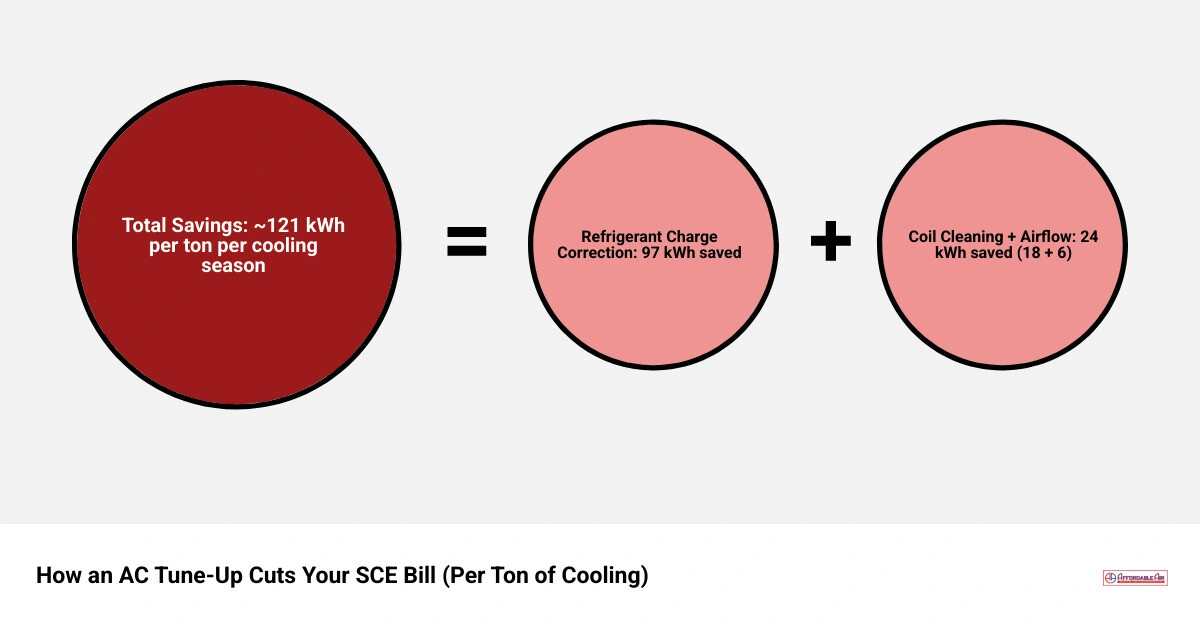
| Total (all three actions) | ~121 kWh | ~0.168 kW |
Multiply by your system's tonnage (e.g., 3 tons) to estimate your total savings. A 3-ton system could save approximately 363 kWh annually from all three actions combined.
For Antelope Valley homeowners running their AC through brutal 100°F-plus summers, that gap between a tuned and an untuned system shows up directly on your Southern California Edison bill — and it adds up faster than most people realize. SCE's residential rates are among the highest in the country, and on a Time-of-Use plan, inefficient cooling during peak hours is especially costly.
The catch? Not every "tune-up" actually delivers those savings. A California utility study of 30 residential tune-up projects found that documented energy savings averaged only 13% of the savings that contractors claimed — largely because most visits skipped the refrigerant charge correction, which alone accounts for the lion's share of real energy reduction.
I'm Vito, and in this guide I'll walk you through exactly what a thorough AC tune-up includes, how each action affects your SCE bill, and how to make sure you're getting the full value from your maintenance visit.
Simple guide to how much can an ac tune-up reduce your sce electric bill terms:
- AC bill spikes in summer
- Why is my electric bill so high in an Antelope Valley summer
- Best thermostat settings to save money during an Antelope Valley summer
How Much Can an AC Tune-Up Reduce Your SCE Electric Bill?

To understand exactly how much can an AC tune-up reduce your SCE electric bill, we have to look closely at Southern California Edison's current rate structure. As of July 2026, SCE residential rates are significantly higher than national averages. With a standard blended rate hovering around 34.5 cents per kilowatt-hour (kWh), every bit of wasted energy counts.
When your air conditioner struggles to overcome dirty coils, low refrigerant, or restricted airflow, it draws more power and runs for longer cycles. This excess consumption directly drives up your monthly bill, pushing you into higher-cost tiers or expensive peak-rate windows. If you are trying to figure out why is my electric bill so high in an Antelope valley summer, an unmaintained cooling system is almost always the primary culprit.
Understanding the Math Behind How Much Can an AC Tune-Up Reduce Your SCE Electric Bill
Let's break down the actual math. If you have a standard 3-ton central air conditioner, a comprehensive tune-up can save you roughly 121 kWh per ton over a cooling season. For a 3-ton unit, that equals about 363 kWh of saved electricity.
Under SCE's standard residential rates of approximately 34.5 cents per kWh, saving 363 kWh translates directly to about $125 in savings over the summer. However, if you are on a Time-of-Use (TOU) plan like TOU-D-4-9PM, where peak rates can soar to 58 cents per kWh, or TOU-D-5-8PM, where summer peak rates can reach 74 cents per kWh, the savings are even greater.
If a significant portion of your cooling occurs during those peak afternoon and evening hours, correcting your system's efficiency can easily save you $150 to over $200 in a single hot season. This makes scheduling professional AC Maintenance Palmdale CA one of the most financially sound decisions you can make before summer peak demand hits.
Real-World Factors That Determine How Much Can an AC Tune-Up Reduce Your SCE Electric Bill
The precise amount you will save depends on several real-world variables:
- System Age and SEER Rating: Older systems (such as those rated 10 to 13 SEER) operate with less inherent efficiency than modern 16+ SEER2 systems. An older, neglected system has much more room for efficiency degradation, meaning a professional tune-up will yield a more dramatic reduction in power consumption.
- Climate Zone Severity: Homeowners in hot, arid regions face much higher cooling demands. If you require AC Maintenance Lancaster CA, your system runs far more hours per day than a system near the coast. The more your system runs, the more those small efficiency gains compound into large dollar savings.
- Duct Integrity: Even a perfectly tuned outdoor unit will struggle if your ductwork is failing. In older homes, leaky ducts can waste 20% to 40% of your conditioned air into the attic, acting as a silent bill killer.
The Science of AC Efficiency: What Happens During a Tune-Up?
A true energy-saving AC tune-up is not a simple visual inspection. It is a highly technical, diagnostic process governed by national industry standards like ACCA Standard 4. This protocol ensures that every vital component of your cooling system is tested, cleaned, and adjusted for peak thermodynamic performance.
To help you visualize where these savings come from, here is a breakdown of how different tune-up actions directly translate to energy and peak demand reductions:
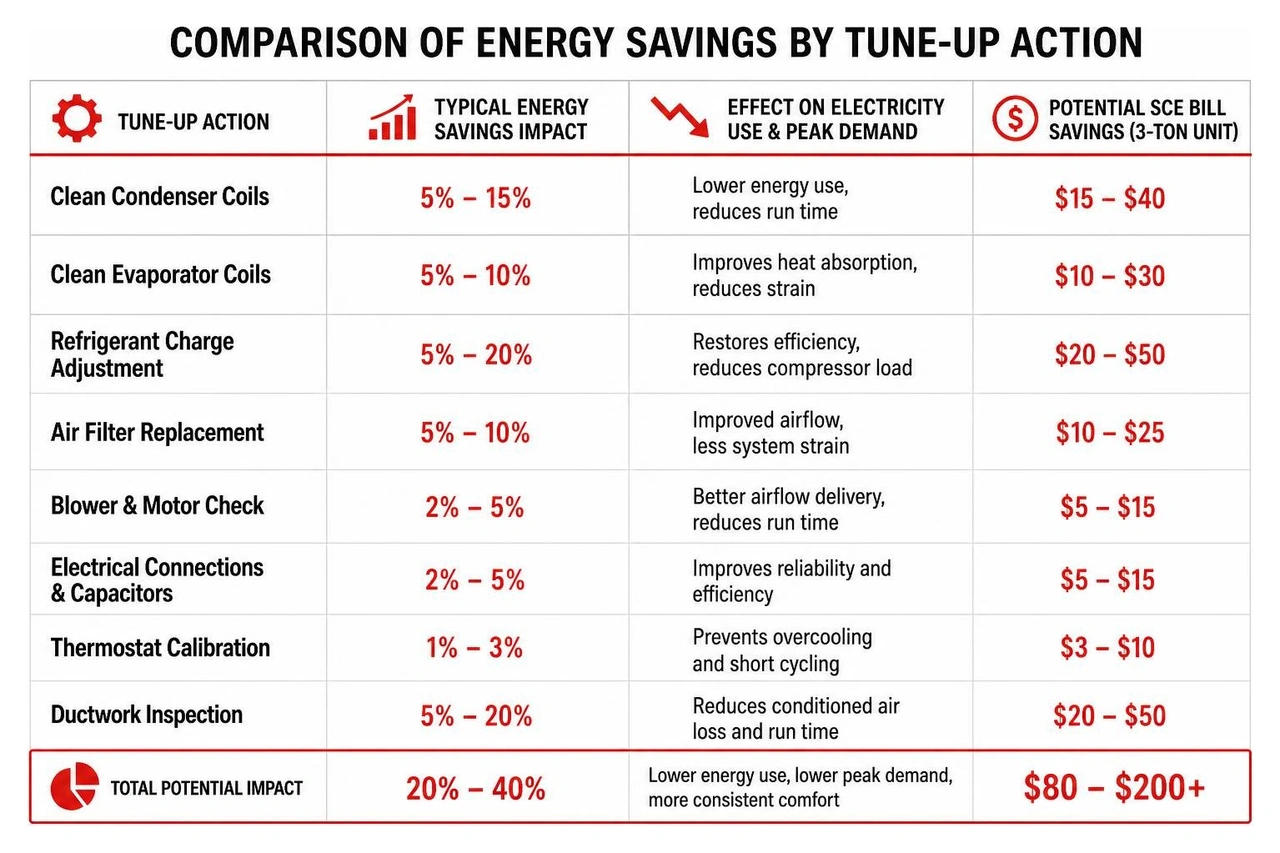
By understanding what is included in a professional AC tune-up, you can easily distinguish between a superficial "quick clean" and a high-yield diagnostic service.
Refrigerant Charge Adjustments and Peak Demand
The single most critical factor in your air conditioner's efficiency is its refrigerant charge. If your system is even slightly undercharged or overcharged, its ability to transfer heat drops dramatically, forcing the compressor to work harder and run longer.
According to California utility studies, correcting an improper refrigerant charge saves an average of 97 kWh per ton of cooling capacity annually. Furthermore, proper charging reduces peak electrical demand by 0.135 kW per ton. For a 3-ton system, this single adjustment can lower peak draw by over 0.4 kW, which significantly reduces the strain on your home's electrical panel and the utility grid during hot summer afternoons.
To achieve these savings, technicians must use precise diagnostic measurements. We use the subcooling method for systems with Thermal Expansion Valves (TXV) and the superheat method for fixed orifice systems. This ensures the refrigerant level is accurate down to the ounce.
Ensuring your refrigerant level is correct is one of the primary benefits of regular AC maintenance, as it protects your expensive compressor from failing prematurely due to liquid slugging or overheating.
Coil Cleaning and Airflow Optimization
Your air conditioner relies on two heat exchangers: the indoor evaporator coil and the outdoor condenser coil.
- The Condenser Coil: Located in your outdoor unit, this coil is exposed to dirt, dust, and wind. A dirty condenser coil acts like a thermal blanket, trapping heat inside the system. Cleaning it saves about 6 kWh per ton.
- The Evaporator Coil: Located indoors, this coil can become coated in fine dust, restricting heat absorption. Cleaning it saves about 12 kWh per ton.
Combined, cleaning both coils saves 18 kWh per ton of capacity and reduces peak demand by 0.025 kW per ton.
Additionally, optimizing the system's airflow saves 6.15 kWh per ton and reduces peak demand by 0.008 kW per ton. Technicians must measure and adjust the airflow to ensure it falls within the optimal range of 350 to 450 Cubic Feet per Minute (CFM) per ton.
Restricted airflow forces the blower motor to draw more current while delivering less cool air to your living spaces. Booking a comprehensive AC Service Palmdale CA ensures that your coils are pristine and your airflow is perfectly balanced for maximum heat transfer.
Navigating SCE Time-of-Use Rates and Summer Spikes
Southern California Edison has shifted most residential customers to Time-of-Use (TOU) rate plans. Under these plans, when you use electricity is just as important as how much you use. Because air conditioning accounts for the vast majority of summer electricity usage, aligning your cooling habits with your TOU plan is key to keeping your bills manageable.
The Impact of TOU-D-4-9PM and TOU-D-5-8PM Plans
Under the popular TOU-D-4-9PM plan, off-peak rates are relatively affordable (around 29 cents per kWh), but they nearly double to approximately 58 cents per kWh during the peak window of 4:00 PM to 9:00 PM.
On the TOU-D-5-8PM plan, the peak window is shorter but even more expensive, with summer peak rates climbing up to 74 cents per kWh.
Because peak hours coincide with the hottest part of the day when your AC has to work its hardest, an inefficient system running constantly during these hours will rapidly inflate your monthly bill. A tuned-up AC system cools your home faster, allowing it to cycle off more frequently during these high-rate windows and saving you from peak-rate billing spikes.
Pre-Cooling Strategies to Maximize Your Savings
You can combine a highly efficient, tuned system with smart thermostat habits to slash your peak-hour SCE costs. One of the most effective methods is pre-cooling.
By lowering your thermostat to 73°F during cheaper off-peak hours (such as 1:00 PM to 4:00 PM), you cool down the thermal mass of your home (the walls, furniture, and floors). When the expensive peak window begins at 4:00 PM, you can raise your thermostat to 78°F or 80°F.
Because your home's structure is already cold, your AC will run minimally—or not at all—during those high-rate hours. To learn how to set up these schedules, read our guide on the best thermostat settings to save money during an Antelope Valley summer. Additionally, you can look into programs like the SCE Summer Discount Plan, which provides bill credits in exchange for letting the utility cycle your AC during grid emergencies.
Frequently Asked Questions About SCE Bill Savings
How often should I get an AC tune-up in a desert climate?
In high-desert climates like the Antelope Valley—including Lancaster, Palmdale, Quartz Hill, Acton, and Rosamond—your air conditioner faces extreme conditions. The combination of intense triple-digit summer heat, heavy winds, and fine desert dust puts incredible stress on your system.
Dust quickly coats outdoor condenser coils and clogs air filters, while the extreme heat forces the system to run for hours at a time. Because of these harsh conditions, you should schedule an AC tune-up at least once a year, ideally in the spring before the summer heat waves arrive. For more details on maintaining systems in our unique local environment, see our guide on how often should you service your air conditioner in a desert climate.
What is the difference between basic maintenance and a diagnostic tune-up?
A basic maintenance visit is often a simple visual inspection, a quick filter change, and a hose-down of the outdoor unit. While helpful, it rarely addresses the hidden thermodynamic issues that waste the most energy.
A professional diagnostic tune-up is a comprehensive performance assessment. It includes:
- Test-In/Test-Out Procedures: Measuring system performance before and after service to document actual efficiency improvements.
- Refrigerant Charge Testing: Using superheat or subcooling calculations to adjust the charge to exact manufacturer specifications.
- Electrical Diagnostics: Checking voltage, tightening electrical terminals, and measuring compressor amp draw.
- Airflow and Duct Inspections: Verifying that CFM per ton is correct and checking for major duct leaks.
For homeowners in Santa Clarita, Stevenson Ranch, Valencia, and surrounding areas, investing in a true diagnostic service is the only way to guarantee real energy savings.
How do dirty air filters affect my monthly SCE bill?
Your air filter is the gatekeeper of your HVAC system's airflow. When it becomes clogged with dust, pet dander, and dirt, it restricts the amount of air entering your system. This restriction forces your blower motor to work harder, increasing its energy consumption.
More importantly, restricted airflow prevents the evaporator coil from absorbing heat efficiently, causing the system to run longer cycles to cool your home. Regularly replacing a dirty air filter with a clean one can reduce your system's overall energy consumption by 5% to 15%. This simple step is one of the easiest ways to keep your monthly SCE bill under control.
Conclusion
When summer temperatures soar across the Antelope Valley and Santa Clarita regions, keeping your home comfortable shouldn't mean draining your bank account. Understanding how much can an AC tune-up reduce your SCE electric bill highlights that preventative maintenance is an investment that pays for itself in lower utility costs, improved system reliability, and a longer equipment lifespan.
At Affordable Air and Heating, we have been family-owned since 1996. We are proud to provide honest, reliable, and energy-efficient cooling solutions to our neighbors throughout Palmdale, Lancaster, Santa Clarita, Acton, Rosamond, Quartz Hill, Stevenson Ranch, Valencia, Canyon Country, Newhall, Saugus, Castaic, Lake Hughes, Ana Verde, and Antelope Acres.
If you want to lower your summer electric bills and ensure your air conditioner is ready for the heat, visit our Affordable Air and Heating page to schedule your comprehensive diagnostic tune-up today. Let us help you keep your home cool and your SCE bills under control!