Why Downstairs Rooms Freeze Before Winter Even Arrives
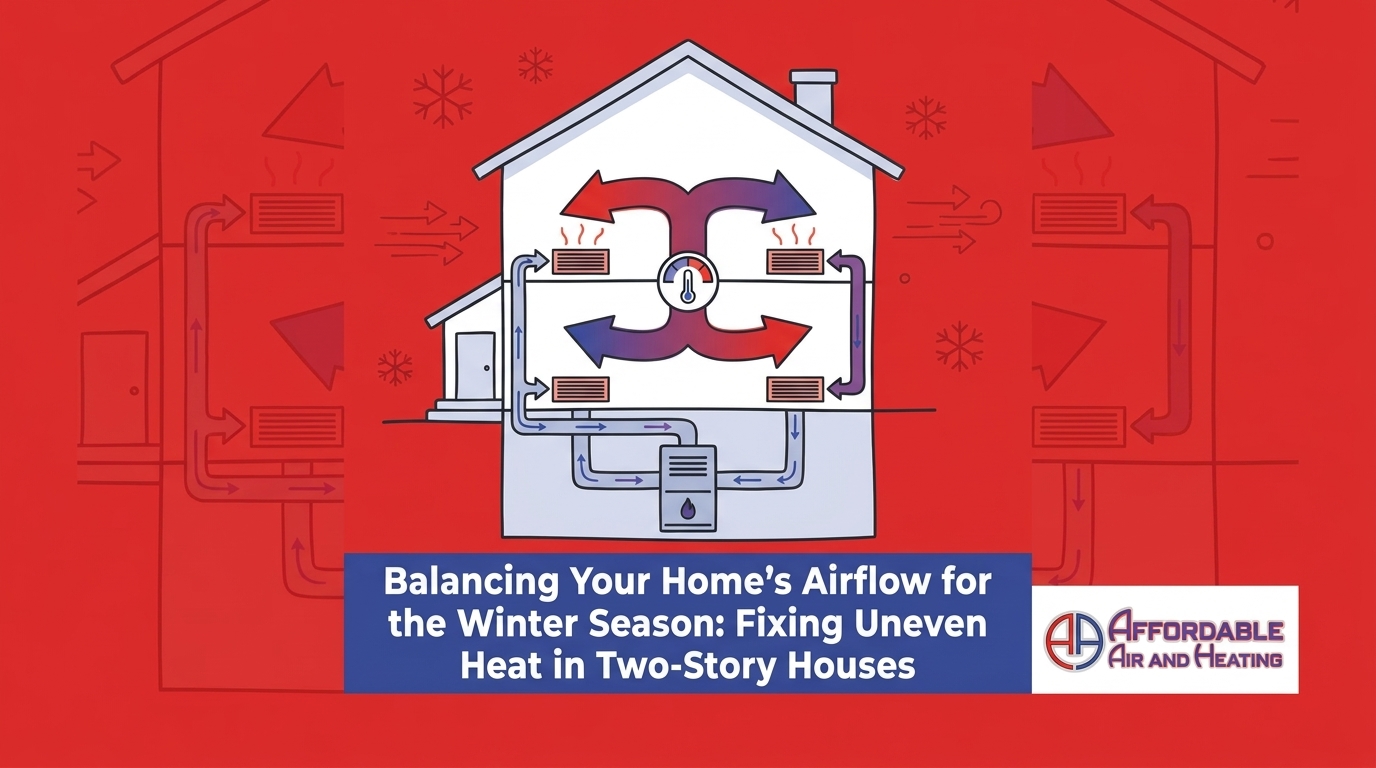
September is finally here, and while the afternoon sun still feels warm, those brisk high desert nights are just around the corner. If you live in a multi-level house, you already know the frustration of running the heater only to find the downstairs living room freezing while the upstairs bedrooms turn into a sauna. Balancing your home's airflow for the winter season is the proactive way to solve this exact problem before the heavy freezing weather hits.
To fix this uneven heating, you need to understand how your HVAC system distributes air throughout the house. Taking the time to make minor, safe adjustments now can prevent a mid-winter emergency. While addressing these early imbalances often requires just a few basic tweaks at the room level, professional heating services are always available to handle more complex, underlying ductwork issues. In our years of servicing Lancaster two-story homes, we've found that a simple seasonal damper adjustment is often all it takes to keep the entire house comfortable.
The Physics of Heat Stratification in High Desert Climates
To effectively correct uneven heating, it helps to understand why it happens in the first place. The scientific reason behind a freezing first floor and a sweltering second floor comes down to basic thermodynamics and regional climate factors.
The problem: Warm air naturally rises due to its lower density. When your furnace kicks on, the heated air is pushed through the ductwork, but its natural physical tendency is to float upward. In multi-level homes, this causes heat to pool on the second floor, a phenomenon known as heat stratification. Meanwhile, radiant heat loss through lower-level windows, sliding glass doors, and concrete slab foundations exacerbates the chill downstairs.
The cause: Our specific regional environment makes this physical reality much more noticeable. As local HVAC experts, we know firsthand that Lancaster sits at a high desert elevation of approximately 2,350 feet. Unlike coastal areas where temperatures remain relatively stable, high elevations experience rapid day-to-night temperature drops. Once the sun goes down, the ambient temperature plummets, stripping heat away from the ground floor much faster than the furnace can push warm air down to replace it.
The solution: Simply turning up the thermostat wastes energy and drastically worsens the upstairs overheating problem. Instead, you have to force the warm air to stay where it is needed most by adjusting how the system breathes.
How Elevation Amplifies Temperature Swings
During the day, your home experiences solar heat gain, absorbing warmth from the sun. But as soon as evening arrives in the high desert, the lack of atmospheric moisture allows that heat to escape quickly. The first floor loses its retained heat far faster than the second floor can distribute it downward. Understanding this rapid shift is why our team typically recommends a specific airflow strategy for Lancaster two-story homes to combat the evening chill.
Using Thermostat Readings to Diagnose Airflow Imbalances
Before you start moving dampers and registers, you need a tangible way to measure your heat stratification problem. The most effective diagnostic tool is calculating the thermostat temperature differential between floors. This gives you a baseline to measure the success of your upcoming airflow adjustments.
1. Gather your tools: You will need the reading from your main floor thermostat and at least one reliable freestanding indoor thermometer or smart home temperature sensor.
2. Place the sensors: Position your secondary thermometer in an upstairs bedroom or hallway, away from direct sunlight, drafty windows, or heat-producing electronics.
3. Time your test: Check these readings during the evening hours when the outside temperature begins to drop rapidly. This is when your heating system works the hardest and stratification is most obvious.
4. Record the differential: Note the exact temperature downstairs versus upstairs while the heating system is actively running.
Understanding your readings is crucial before making adjustments. Use the following table to determine the severity of your airflow imbalance:
• 1°F to 2°F — Diagnosis: Normal variance — Recommended Action: No major adjustments needed; system is well-balanced.
• 3°F to 5°F — Diagnosis: Moderate stratification — Recommended Action: Standard seasonal supply damper adjustments recommended.
• 6°F or more — Diagnosis: Extreme imbalance — Recommended Action: Indicates poor airflow; requires immediate damper adjustment or professional assessment.
Keep these initial numbers handy. After you complete your September pre-heating season prep, you will use this same test to verify that your adjustments actually worked.
Step-by-Step: Adjusting Supply Dampers for the Cold Season
Delivering actionable, safe DIY maintenance is the key to forcing warm air downstairs. The goal here is to restrict the upward flow of heat just enough to redirect it to the lower levels, without suffocating the system.
• Locate the supply registers: Walk through your home and identify all the supply vents (the ones that blow air out) in both the upstairs and downstairs rooms.
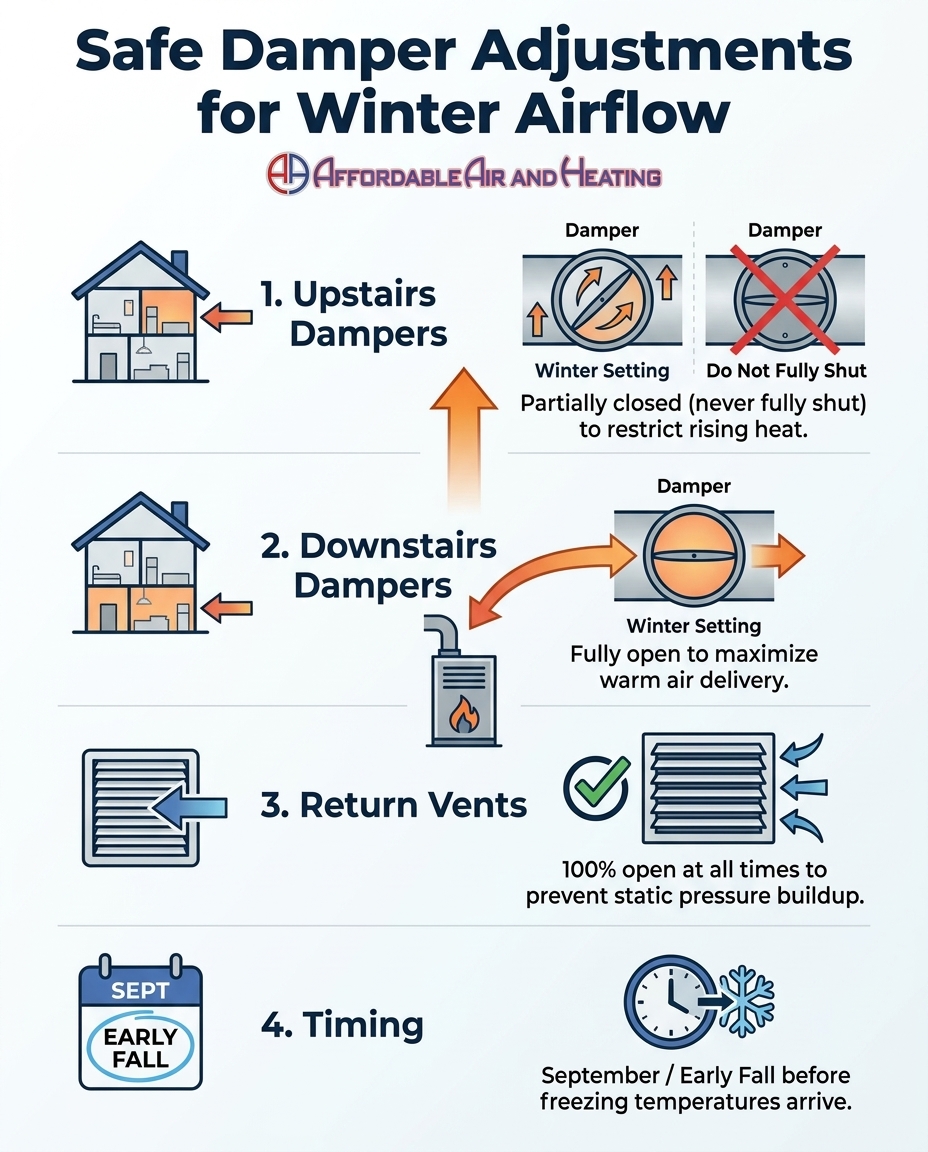
• Adjust the upstairs dampers: Slightly close the supply dampers in the upstairs rooms. Crucial rule: Do not completely shut them. Leave them open about 25% to 30% to allow for necessary pressure release while still restricting the bulk of the rising heat.
• Open the downstairs dampers: Fully open all the supply dampers on the main floor. This encourages maximum warm air delivery to the coldest areas of the house.
• Wait and verify: Leave the system running with these new settings for 24 hours. Re-check the temperature variance between floors using your thermometers to gauge the effectiveness of the change.
Summer vs. Winter Damper Positions
Your HVAC system requires different settings depending on the season. Pushing heat down in the winter requires the exact opposite configuration of pushing air conditioning up in the summer. Emphasizing this transition during your September pre-heating season prep ensures you aren't caught off guard by the first freeze.
• Winter — Upstairs Supply Dampers: Partially Closed (25% open) — Downstairs Supply Dampers: 100% Fully Open — Primary Goal: Force warm air downward against its natural tendency to rise.
• Summer — Upstairs Supply Dampers: 100% Fully Open — Downstairs Supply Dampers: Partially Closed (25% open) — Primary Goal: Force cool air upward against its natural tendency to sink.
The Hidden Danger of Closing Return Vents
While adjusting supply registers is a safe and effective way to manage temperature, you must clearly distinguish between safely adjusting supply dampers and dangerously blocking return vents. Return vents are the large grilles (usually located in hallways or low on walls) that pull air back into your HVAC system to be heated.
The static pressure threat: Closing too many vents—especially return vents—increases static pressure inside the ductwork. Think of your HVAC system like a person trying to breathe through a straw. If you pinch the straw (close the vents), the system has to work exponentially harder to pull in the same amount of air.
Strain on the blower motor: Excess static pressure strains the blower motor, leading to overheating, system short-cycling, or premature mechanical failure. A restricted system will run constantly but fail to heat the house, driving up utility costs while wearing out expensive components.
If basic supply damper adjustments don't work, professional assessment is needed rather than closing more vents. Last fall, a local homeowner reached out to our team at Affordable Air and Heating after struggling to get their house comfortable. Our technicians demonstrated exactly how improper vent closures were affecting the system's static pressure, resolving the issue safely. Working with a trusted local technician ensures that your airflow adjustments don't accidentally strain the blower motor or cause dangerous pressure imbalances behind the walls.
How Proper Airflow Impacts Your Indoor Environment
Balanced airflow does more than just regulate the temperature in your home; it directly impacts your overall health and comfort. When the thermostat temperature differential between floors is too high, it usually indicates that air is not circulating effectively throughout the entire house.
Preventing stagnant air: Proper circulation prevents stagnant air pockets from forming in corners, basements, or isolated downstairs rooms. Moving air is healthy air. When airflow is balanced, your system effectively pulls air from every room, cycles it through the filter, and redistributes it.
Filtering dust and allergens: During the winter months, windows and doors are closed tight to keep the cold out. This traps indoor pollutants inside. Proper circulation helps filter out dust, pet dander, and allergens because the air is constantly moving through the system's filtration media.
Balanced static pressure is also vital to the efficient operation of whole-home air filtration systems. If you restrict the airflow too much, your filters cannot capture particulates effectively. We highly recommend evaluating your overall indoor air quality as part of your comprehensive fall preparation routine.
Troubleshooting Persistent Heating Issues After Adjustments
Sometimes, even the most careful DIY damper adjustments fail to resolve a freezing downstairs. If you have followed the steps above and your Lancaster two-story home is still suffering from extreme heat stratification, the problem likely lies deeper within the system.
Common underlying causes: Adjusting dampers might not be enough if your home suffers from leaky ductwork, undersized heating equipment, or a failing blower motor. Leaky ducts in unconditioned spaces (like an attic or crawlspace) can lose up to 30% of the heated air before it ever reaches your living room.
Lukewarm air symptoms: Pay attention to the temperature of the air coming out of the registers. If your vents are blowing warm air that feels only lukewarm instead of hot when the system is running, your furnace may be struggling with combustion issues, a dirty flame sensor, or restricted airflow causing the limit switch to trip.
When to call a pro: There are strict limitations to external register adjustments. Internal ductwork modifications, installing inline dampers, or resizing duct runs require a licensed professional. During a particularly cold stretch last winter, our team at Affordable Air and Heating responded to a local customer whose HVAC system couldn't keep up with the dropping temperatures. Our knowledgeable technicians quickly diagnosed an underlying mechanical issue and performed the necessary repairs to restore proper heating. Scheduling a pre-season tune-up now can catch these hidden mechanical issues before they leave you freezing in December.
Ensure Your System is Ready for the Cold Months Ahead
Balancing your home's airflow is a simple but vital step for multi-level home comfort. By understanding the physics of rising heat and utilizing your thermostat readings, you can make safe, effective adjustments to your supply dampers.
The key is timing. Completing your September pre-heating season prep ensures you make these adjustments before the heavy freezing weather hits the high desert. If you experience persistent uneven heating, suspect leaky ductwork, or worry about blower motor strain, reach out to our team for professional help. Taking care of your system now guarantees a warm, comfortable home all winter long.
Frequently Asked Questions
Should I close upstairs vents in winter?
You should never completely close your upstairs vents, as this can cause dangerous pressure buildup in your ductwork. Instead, partially close the upstairs supply dampers (leaving them about 25% open) to restrict rising heat without damaging your blower motor. This forces warm air downstairs safely.
How do you push heat downstairs in a two story house?
The most effective method is adjusting your HVAC supply dampers to favor the lower level. Fully open all downstairs supply registers and partially close the upstairs registers. This redirects the airflow to combat the natural tendency of heat to rise to the second floor.
Does closing vents damage your HVAC system?
Yes, completely closing too many vents can severely damage your HVAC system. Closing vents increases static pressure inside the ductwork, which forces the blower motor to work harder, potentially leading to overheating, short-cycling, and premature failure. Always leave vents at least partially open.
How to balance heat in a two story house?
Balancing heat requires a combination of proper damper adjustment and continuous monitoring. Start by checking the temperature differential between your upstairs and downstairs thermostats, then adjust the supply registers to push more air to the colder floor. Wait 24 hours and re-check the temperatures to verify the balance.
What is the ideal temperature difference between upstairs and downstairs?
A well-balanced two-story home should have a temperature differential of no more than 1°F to 2°F between the upper and lower floors. If the variance exceeds 3°F to 5°F, your system is experiencing moderate to severe heat stratification and requires airflow adjustments.
When is the best time of year to adjust HVAC dampers?
The ideal time to adjust your HVAC dampers for winter is in early fall, typically September. Making these seasonal adjustments before the heavy freezing weather arrives allows you to test the system's performance and ensure your downstairs rooms stay warm once the temperatures drop.