Beyond 'AC Running But Not Cooling': A Guide to Mid-Fall Heating Startup


Navigating the Shift to Mid-Fall Heating Startup
You flip the thermostat to "heat" for the first time this season, and instead of cozy warmth, your vents push out a strange burning smell that makes you nervous. If you are searching for reliable home maintenance tips and troubleshooting, navigating your mid-fall heating startup (October) is a critical step for every homeowner. At Affordable Air and Heating, our technicians see this exact scenario play out across Lancaster every fall. You need to know whether that initial odor is just harmless seasonal dust burn-off or a true mechanical issue that demands immediate attention before the winter freezing temperatures arrive.
During the transition from summer cooling to autumn heating, it is completely normal to feel a bit of confusion about how your system should behave. Your furnace has been sitting idle for months, and firing it up for the first time is a stress test for the equipment. Knowing the difference between a normal startup sequence and a potential hazard is the key to keeping your household safe and comfortable. Establishing a neutral, safety-first boundary for testing your system ensures you catch minor issues before they turn into major mid-winter breakdowns. To handle this seasonal transition properly, relying on comprehensive HVAC Services provides the peace of mind that your equipment is ready for the cold months ahead.
Taking a proactive approach in October gives you a comfortable buffer. You have the time to test, observe, and react without the pressure of a freezing house. The goal is to understand exactly what your system is telling you during those first few crucial minutes of operation.
The Antelope Valley Climate: Balancing Late-Season AC and Early Heating
The problem: Living in the high desert means dealing with wild temperature fluctuations that put unique stress on your home's climate control systems. During October, Lancaster and the Antelope Valley experience rapid autumn temperature drops at night, often following hot, sunny days. You might find yourself running the air conditioner at 4 p.m. to combat 95-degree heat, only to need the furnace by 2 a.m. when temperatures plummet into the low 50s or 40s.
The cause: This extreme day-to-night temperature swing forces your equipment to work overtime. Our team frequently fields calls from local homeowners who notice their system struggling during a daytime heatwave, searching for answers to why their unit is running constantly but failing to keep the house cool. Then, just hours later, that same overworked system is asked to switch gears entirely and provide heat. This rapid switching places immense stress on the electrical components, reversing valves, and blower motors that have to alternate functions with very little recovery time.
The solution: Understanding this regional climate challenge helps you set realistic expectations for your equipment. You need to know exactly when to rely on Air Conditioning Services to resolve late-summer cooling fatigue, and when it is time to prep the heating side for the incoming winter. Giving your system a brief rest period between cooling and heating cycles—rather than slamming the thermostat from one extreme to the other—can prevent unnecessary wear and tear.
Why Systems Struggle During Temperature Swings
Rapid weather changes expose underlying vulnerabilities in your HVAC setup. When the ambient temperature drops sharply, you might experience thermostat calibration delays. The sensor inside your thermostat takes time to register the sudden shift, which can cause the system to short-cycle or fail to engage the heat right away. Furthermore, the physical toll of switching from cooling to heating within a 12-hour window means components expand and contract rapidly, increasing the likelihood of loose electrical connections or stressed mechanical parts.
The 15-to-30 Minute Rule: Decoding Dust Burn-Off
In our experience servicing local heating systems, the most common symptom homeowners report during their mid-fall heating startup (October) is a distinct burning smell. Scientifically, this happens because airborne particles, pet dander, and household dust settle on the furnace heat exchanger and electrical components during the idle summer months. When the burners ignite for the first time, this layer of debris instantly incinerates. While the smell can be alarming, it is usually entirely harmless.
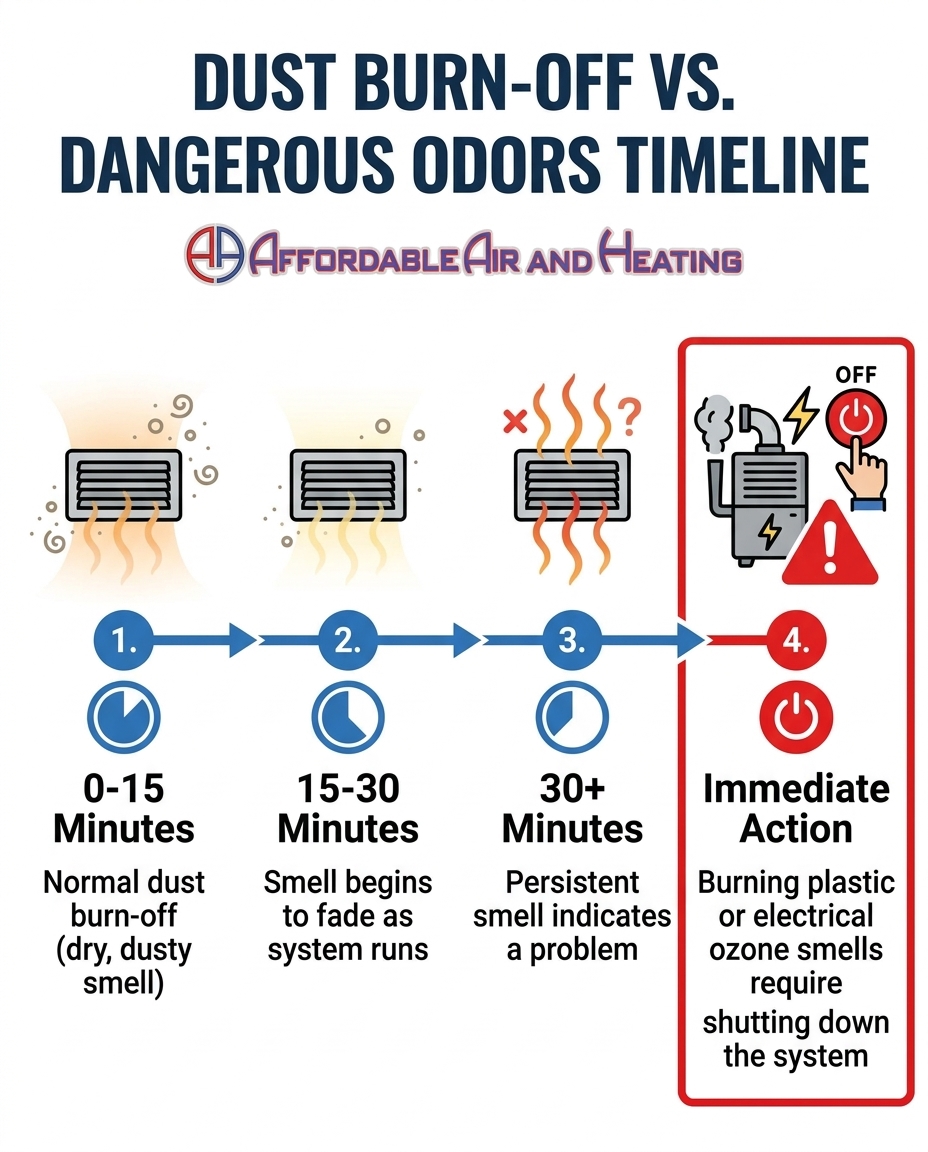
To determine if your system is operating safely, you must follow the strict 15 to 30 minute timeframe for normal dust burn-off smells to dissipate. This is the golden rule of fall furnace testing. Here is exactly how to navigate this process:
1. Clear the area: Remove any boxes, seasonal decorations, or stored items from around your indoor furnace cabinet to ensure proper airflow and safety.
2. Open your windows: Before turning the system on, open a few windows to allow the initial burnt-dust odor to ventilate out of your living space.
3. Set the thermostat: Switch your thermostat to the "Heat" position and bump the temperature two to three degrees above the current room temperature to force the system to kick on.
4. Start the clock: Note the exact time the blower motor engages and the heat begins flowing through the vents.
5. Monitor the smell: The dusty, slightly organic burning smell should peak within the first five minutes and steadily fade.
This establishes a clear safety boundary: if the smell persists beyond 30 minutes of continuous operation, or if it grows stronger and more acrid, it is no longer normal dust burn-off. At that point, you must take further action.
How to Safely Conduct the First Test Run
Safety is the primary focus during this initial test. Monitor the system continuously for the first half-hour. Do not turn the heater on and leave the house to run errands during this initial startup phase. You need to be present to observe how the system sounds, smells, and feels. If the heat exchanger is cracked or a component is failing, the first 30 minutes will usually reveal the problem.
Warning Signs: When a Burning Smell Requires Professional Help
While dust burn-off is a routine part of home ownership, certain odors are immediate red flags. You must be able to differentiate harmless dust from dangerous electrical or mechanical odors. Failing electrical components from a grueling summer cooling season can easily carry over into fall heating issues. A capacitor that barely survived August might finally give out in October, producing a very distinct, toxic smell.
If you detect the sharp scent of burning plastic, electrical ozone (which smells similar to a burnt wire or a hot electrical spark), or melting rubber, this is never normal. These odors indicate that wiring insulation is melting, a motor is overheating, or a critical component is actively failing. If you experience these smells, you must adhere to strict safety boundaries: never attempt a DIY interior cabinet inspection. Opening the furnace cabinet exposes you to high voltage and potential gas leaks. Instead, shut the system down immediately at the breaker panel.
Here is a breakdown of what different smells indicate:
• Dust Burn-Off — Characteristics: Dry, earthy, organic smell that fades quickly. — Likely Cause: Summer dust burning off the heat exchanger. — Required Action: Monitor. Should fade within the 15 to 30 minute timeframe for normal dust burn-off smells.
• Electrical Ozone — Characteristics: Sharp, acrid, metallic, or fishy smell. — Likely Cause: Overheating blower motor, failing capacitor, or melted wiring. — Required Action: Shut down system at the breaker immediately. Call a professional.
• Burning Plastic — Characteristics: Harsh, chemical smell that irritates the nose. — Likely Cause: Melted wire casing or foreign plastic object in the ductwork. — Required Action: Shut down system immediately. Do not run until inspected.
• Sulfur / Rotten Eggs — Characteristics: Distinctive natural gas odor. — Likely Cause: A dangerous gas leak near the furnace or gas valve. — Required Action: Evacuate the home, call the gas company, and request emergency service.
If you encounter any of the dangerous odors listed above, it is time to rely on a licensed professional. Our technicians provide prompt diagnostics across our service areas in Lancaster and the Antelope Valley to ensure your home remains safe.
Electrical Odors vs. Dust
The key difference lies in the longevity and sharpness of the scent. Dust smells organic and dry, similar to turning on a space heater that has been in the closet all year. Electrical smells are sharp, acrid, and often cause immediate irritation to your eyes or throat. Most importantly, electrical odors do not fade over time—they will persist and often intensify the longer the system runs.
Thermostat and Airflow Checks Before Winter Freezes
Before assuming your heating system is broken, it is wise to walk through a few safe, non-invasive troubleshooting steps. Many mid-fall heating startup (October) issues stem from simple airflow restrictions or communication errors rather than catastrophic mechanical failures. Taking a few minutes to verify the basics can save you a tremendous amount of frustration.
• Verify thermostat settings: Ensure the switch is firmly set to "Heat" and the fan setting is on "Auto." If the fan is set to "On," it will blow air continuously, even when the burners are off, which can feel like cold drafts.
• Check and replace air filters: A clogged filter from summer wildfires or heavy household dust can completely choke your system, mimicking a major failure.
• Inspect room vents: Walk through your home and ensure all supply vents and return grilles are unblocked by heavy furniture, rugs, or fall decor.
• Check the circuit breaker: Ensure the breaker dedicated to your furnace was not accidentally tripped during the summer months.
Sometimes, the issue is entirely electronic. Our team at Affordable Air and Heating recently helped a Lancaster homeowner whose thermostat stopped communicating during the first cold snap. Our technician arrived the same day, troubleshot the unit, and had it repaired in about 20 minutes. This same swift resolution applies when your thermostat refuses to communicate with the heating unit entirely during the fall. If the screen is blank or the furnace ignores your temperature adjustments, the thermostat itself may need recalibration or replacement.
The Role of Clean Air Filters in Heating Efficiency
Your air filter is the lungs of your HVAC system. When airflow is restricted by a thick mat of dust, the heat exchanger cannot transfer warmth into the ductwork effectively. This causes the heat exchanger to overheat rapidly. Modern furnaces are equipped with high-limit safety switches that detect this dangerous temperature spike and shut the system down prematurely. If your furnace runs for five minutes and abruptly turns off, a dirty filter is often the primary culprit.
Mechanical Noises to Monitor During Your First Run
Just as smells provide clues to your system's health, noises are excellent indicators of mechanical stability. During a mid-fall heating startup (October), you will hear a variety of sounds. Educating yourself on normal expansion noises versus signs of mechanical failure helps you avoid unnecessary panic while ensuring you don't ignore a genuine problem.
Normal sounds: As hot air rushes through cold metal ductwork for the first time in months, the metal expands. This expansion creates slight popping, pinging, or ticking noises. You might also hear a mild whoosh as the gas burners ignite. These sounds are standard operational noises and should settle down as the house reaches the desired temperature.
Warning sounds: Loud banging, heavy scraping, or high-pitched squealing are never part of a normal startup. A loud boom upon ignition can indicate a delayed gas ignition, which is a serious safety hazard. Scraping metal usually means the blower wheel has come loose from its housing. High-pitched squealing almost always points to a bad fan motor or failing bearings. Another common issue is a failing electrical contactor, which can cause the system to run poorly or emit a loud, continuous buzzing sound. Understanding AC contactor failure symptoms can help you identify if this electrical switch is struggling to bridge the connection to your motors.
Persistent mechanical noises require a licensed technician to diagnose. Ignoring a squealing motor will inevitably lead to a complete motor burnout. For example, our crew frequently responds to early-season breakdowns caused by a bad fan motor that barely survived the summer cooling season. In one recent case, our technician diagnosed the problem over the weekend, ordered the necessary part, and had the system fixed by Monday morning. If you hear a bad motor during your fall startup, the same prompt response is required to protect your equipment.
Diagnosing Blower Motor Issues
The blower motor is responsible for pushing conditioned air through your home. Squealing often indicates a worn belt (in older models) or failing bearings (in newer models). If you hear a loud humming or buzzing sound but feel no airflow coming from the vents, this points directly to an electrical capacitor failure or a seized motor that is trying to start but cannot spin.
Honest Diagnostics and Professional Safety Boundaries
Navigating the shift into cold weather requires knowing when to wait and when to call for backup. The 15 to 30 minute timeframe for normal dust burn-off smells is your most reliable gauge for initial startup odors. However, if your system fails that test, or if it produces grinding noises and electrical smells, professional intervention is non-negotiable.
A proper mid-fall inspection goes far beyond just changing a filter. It focuses heavily on safety, checking for cracked heat exchangers that could introduce carbon monoxide into your living space, verifying proper gas pressure, and ensuring all safety limit switches are functioning correctly. This is where working with a team that provides honest diagnostics from licensed professionals makes all the difference. At Affordable Air and Heating, our reputable technicians will never use a simple, harmless dust burn-off as an excuse to push an unnecessary replacement. Instead, we provide clear, factual assessments of your equipment's true condition.
If you have run your initial test and something feels, sounds, or smells wrong, do not force the system to keep running. Shut it down at the thermostat and contact our team for emergency repairs. Addressing a failing motor or a faulty sensor in October is far less stressful than dealing with a complete breakdown in the middle of a December freeze.
Frequently Asked Questions About Fall System Testing
Is it normal for a heater to smell like burning?
Yes, it is entirely normal for the first 15 to 30 minutes of operation. This happens due to dust and airborne particles accumulating on the heat exchanger over the idle summer months. When the burners ignite, this dust burns off, creating a temporary odor that should fade quickly.
How long does a furnace smell when first turned on?
The smell should completely dissipate within 30 minutes of continuous operation. If you have kept the system running for half an hour and the smell is still strong, or if it suddenly smells like burning plastic or electrical wires, shut the unit down immediately and request an inspection.
Why is my AC running constantly but not cooling during fall days?
In extreme desert climates, intense afternoon heat can overwork the system, causing it to run continuously. However, this symptom may also indicate low refrigerant levels, a failing capacitor, or a dirty evaporator coil that needs professional attention before you transition fully to winter heating.
How to safely test a furnace before winter?
Start by clearing the area around the indoor unit and installing a fresh air filter. Set your thermostat to "Heat," raise the temperature a few degrees, and monitor the system continuously for the first 30 minutes. Listen for unusual noises and ensure any initial dust odors fade within the expected timeframe.
When should I call a professional for furnace noises?
Call a professional immediately if you hear loud banging, heavy scraping, or high-pitched squealing. While slight popping from expanding ductwork is normal, metal-on-metal grinding or loud booms upon ignition indicate mechanical failure or gas ignition issues that require a licensed technician.
Ensure a Safe, Warm Winter With Expert Support
Taking the time to properly test your heating equipment in October provides incredible peace of mind as the seasons change. By trusting your observations regarding the 15-30 minute dust burn-off rule and listening for unusual mechanical sounds, you can confidently evaluate your system's health. If you encounter persistent smells, loud noises, or complete system unresponsiveness, do not hesitate to seek professional assistance. Mastering these home maintenance tips and troubleshooting steps ensures your household remains safe, warm, and comfortable all winter long.