Why We Don't Sell Used or Refurbished HVAC Equipment


The Dangerous Myth of the 'Bargain' Second-Hand System
Many homeowners believe that buying a second-hand unit is a clever way to beat the system, but when you ask why we don't sell used or refurbished HVAC equipment, the answer comes down to hidden risks our technicians see firsthand in the field. Finding a cheap furnace online might seem like a massive win for your budget. The sticker price is incredibly low, the seller promises it "works perfectly," and you think you have solved your home comfort problems for a fraction of the cost. However, in our experience serving Lancaster, the reality of the secondary HVAC market is far more complicated—and significantly more expensive—than a simple cash transaction.
During the early fall transition to heating season, a pattern we see often is the temptation to cut corners reaching its peak. You know the cold weather is coming, and you just want a functioning system before the temperature drops. Unfortunately, buying a used system means buying someone else's discarded problems. You have no way of knowing how hard that equipment was pushed, whether it received regular maintenance, or if it was damaged during removal. If you're looking for reliable HVAC installation and services, our team can show you safe, manageable financing options for new HVAC systems that protect your home and budget without the massive risks of second-hand gear.
The true cost of ownership:
• Initial purchase: The only time a used system looks cheap is on the day you buy it.
• Installation hurdles: Our professional contractors, along with most reputable companies, refuse to install equipment with an unknown history, meaning you may struggle to find a qualified technician.
• Ongoing repairs: Without a warranty, every failing part comes directly out of your pocket.
Understanding the total cost of ownership is the first step in making a smart decision for your home. When our crew factors in the inevitable breakdowns, the lost energy efficiency, and the complete lack of manufacturer support, we consistently see that "bargain" system ending up costing exponentially more over its shortened lifespan than a brand-new, entry-level unit.
Redefining True Affordability in Home Comfort
As a company named Affordable Air and Heating, we built our entire reputation on providing cost-effective solutions for our community. That commitment to true affordability is exactly why we outright reject used equipment. In our daily operations, we prove that true affordability does not mean finding the absolute cheapest piece of metal on the internet. It means securing long-term value, enjoying predictable energy bills month after month, and experiencing zero emergency breakdowns when you need your system the most.
Living in Lancaster and the High Desert requires equipment you can trust implicitly. When our team is called out to a home where a used system has broken down, the cycle of constant repairs begins. First, it might be a worn-out capacitor. Next month, the blower motor seizes up. Before long, homeowners are paying for emergency service calls that add up to more than the cost of a new system. We watch this cycle transform a "cheap" purchase into a severe financial burden all too often.
What true affordability looks like:
• Predictability: Knowing exactly what your heating and cooling costs will be, without sudden spikes from failing, inefficient parts.
• Reliability: Having the peace of mind that your system will turn on and stay on during extreme weather events.
• Protection: Knowing that if a rare manufacturer defect does occur, you are fully covered by a comprehensive warranty.
Our professional contractors refuse to install used units because we cannot guarantee the safety, origin, or internal condition of the equipment. We refuse to put our name on a system that is destined to fail. Protecting your budget means protecting you from the unpredictable, high-cost breakdowns inherently associated with second-hand machinery.
The Warranty Trap: Why Used Systems Leave You Unprotected
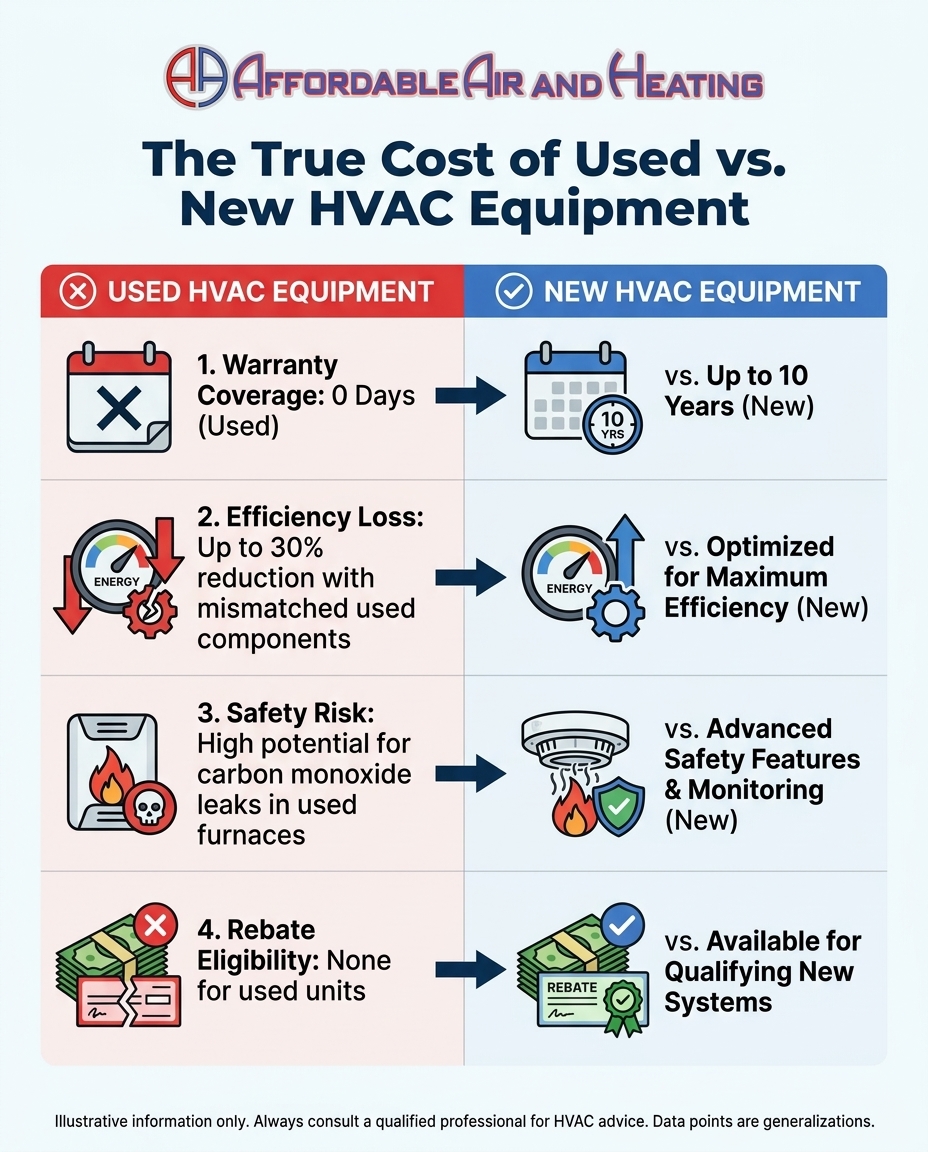
One of the most devastating financial surprises we have to explain to homeowners buying second-hand equipment is the reality of HVAC warranties. When a homeowner purchases a new system, the manufacturer provides a robust warranty covering major components for up to a decade. However, these agreements contain strict legal clauses: most major HVAC manufacturer warranties are strictly non-transferable to secondary owners, or they immediately revert to a drastically reduced term if the equipment changes addresses.
The term "refurbished" is often used loosely by online sellers to make a unit sound reliable. In the HVAC industry, a refurbished unit usually just means it was wiped down and spray-washed. There are no factory-backed guarantees on the internal components. If the compressor dies two weeks after you install it, you have a zero-day guarantee. You are entirely on your own.
If you find yourself troubleshooting vents blowing warm air on a used unit, you will quickly realize the massive liability shift that has occurred. If a new unit fails, the manufacturer covers the expensive parts. If a used unit fails, the homeowner bears 100% of the parts and labor burden.
• Parts Warranty — New HVAC System: Up to 10 years (registered) — Used / Refurbished System: 0 days (voided upon removal)
• Compressor Coverage — New HVAC System: Up to 10 years or Lifetime — Used / Refurbished System: None
• Financial Liability — New HVAC System: Manufacturer covers defective parts — Used / Refurbished System: Homeowner pays 100% of all costs
• Operational History — New HVAC System: Flawless, factory-tested — Used / Refurbished System: Unknown, potential hidden damage
Entering the early fall transition to heating season without a warranty is a massive gamble. The peace of mind that comes with a decade of manufacturer protection is a core part of what you pay for when investing in a new system. Stripping that protection away leaves your household finances incredibly vulnerable.
Hidden Safety Hazards Lurking Inside Used Furnaces
While a failed air conditioner is uncomfortable, a failed furnace can be downright dangerous. The severe physical dangers of installing used heating equipment are the primary reason our technicians at Affordable Air and Heating refuse to handle them. The most critical component inside any gas furnace is the heat exchanger. This metal chamber contains the toxic combustion gases while transferring heat to the air circulating through your home.
The Problem: Over years of expanding and contracting, heat exchangers undergo immense thermal stress. This constant movement can cause microscopic cracks to develop in the metal. When a used furnace is uninstalled, bounced around in the back of a truck, and reinstalled, that fragile, aging metal is subjected to forces it was never designed to handle.
The Cause: These micro-cracks are often entirely invisible to the naked eye. If you install a used furnace with a compromised heat exchanger, those cracks open up as the metal heats. This creates a severe risk of carbon monoxide leaking directly into your home's ductwork. Furthermore, improper removal and transport frequently damage sensitive gas valves and safety switches, compromising the unit's built-in fail-safes.
The Solution: Professional verification and brand-new equipment. Entering the freezing winter nights of the High Desert requires absolute certainty that a furnace will operate safely under heavy loads. One homeowner in our area reached out to our dispatch during a freezing winter week when their heat stopped working under a freeze warning. Our technicians assessed the unit, diagnosed a bad relay on an aging second-hand system, and ultimately recommended a new HVAC unit because repairing the unsafe system wasn't worth the risk. Our crew installed a new unit, and the heat now works amazingly well, providing total safety and peace of mind. We will not risk a family's safety on second-hand gear in Lancaster and the High Desert.
Mismatched Components and the Efficiency Drain
HVAC systems are not a collection of random parts; they are engineered ecosystems. In our time troubleshooting local homes, providing a technical deep-dive into how these systems operate reveals exactly why piecing together used components destroys efficiency. If you try to pair a used outdoor unit with your existing indoor equipment, you are almost certainly creating a severe mismatch.
1. The Coil Relationship: Your outdoor condenser coil and your indoor evaporator coil must be perfectly matched in terms of size, capacity, and refrigerant flow. If they are mismatched, the system cannot absorb and release heat effectively.
2. Massive Efficiency Loss: According to Department of Energy data, mismatched components can reduce system efficiency by up to 30%. You might think you are saving money, but we see homeowners pay for that mismatch every single month on their utility bills.
3. Compressor Strain: An inefficient, mismatched system forces the outdoor compressor to overwork constantly. It runs longer cycles, runs hotter, and inevitably suffers premature failure.
If you are considering upgrading, we recommend investing in new air conditioning systems to ensure that all components are factory-matched for peak performance.
The Danger of Refrigerant Phase-Outs
Beyond mismatched coils, refrigerant compatibility is a massive hurdle in the secondary market. Our technicians frequently encounter used units that utilize phased-out refrigerants like R-22, which is no longer manufactured or imported in the United States.
If you buy a used R-22 unit and it develops a leak, recharging it can be prohibitively expensive—if you can even find a technician legally willing to do it. Even older R-410A systems are currently facing industry transitions. Modern systems are designed for current environmental standards, utilizing modern refrigerants that offer optimal efficiency and full regulatory compliance. Trying to save money by installing obsolete technology is a fast track to a regulatory and financial dead end in Lancaster and the High Desert.
How Extreme Weather Accelerates Wear and Tear
Not all used HVAC units are created equal, and location plays a massive role in how much life a system has left. Contextualizing the mechanical stress on HVAC units specifically within the local climate proves exactly why we tell our customers that buying a used unit here is a terrible idea. Lancaster's High Desert climate features extreme triple-digit summers and freezing winter nights. This specific environment degrades equipment significantly faster than milder regions.
Understanding thermal stress:
• Metal fatigue: The constant, drastic temperature fluctuations cause the metal components within the system to expand and contract aggressively, leading to accelerated fatigue.
• High operational hours: A system in the High Desert runs for hundreds of hours more per year than a system on the coast. This invisible wear degrades blower motors, bakes capacitors, and wears down contactors.
• Dust and debris: Desert winds push fine particulate matter into the condenser coils, causing the system to work harder and run hotter if not meticulously maintained.
A 5-year-old unit pulled from a home in a mild coastal climate has significantly less wear than a 5-year-old unit subjected to our local extremes. Buying a used unit locally means buying equipment that has already been pushed to its absolute limits. If you want equipment that will actually survive the environment, you need reliable heating equipment that starts its lifespan at zero hours, fully prepared to handle Lancaster and the High Desert.
Smart Alternatives: Making New Systems Accessible
Replacing an aging or dead unit doesn't require resorting to the secondary market. There are highly effective, financially sound alternatives that make brand-new, safe equipment accessible to homeowners on a budget.
Another local family recently experienced this firsthand when they called us. They returned from vacation to find their HVAC unit had died after more than 30 years of service. Rather than hunting for used parts or dealing with sketchy online sellers, they called our team for professional help. We provided a quote the same day and professionally installed a brand-new unit the next day. The house was comfortable immediately, and they bypassed all the stress and delays of the secondary market.
Accessible paths to new equipment:
• Energy Rebates and Incentives: Generic utility incentives and local energy rebates frequently apply to high-efficiency new installations, helping to offset the initial purchase cost significantly.
• Federal Tax Credits: Upgrading to qualifying modern technology, like high-efficiency heat pumps, can often make you eligible for federal tax credits, keeping more money in your pocket during tax season.
• Flexible Financing: Modern financing options allow homeowners to break the cost of a reliable, warrantied system into manageable monthly terms, transforming a large upfront expense into a predictable utility-style payment.
• Speed and Peace of Mind: A professional installation by our team happens quickly and correctly. You avoid the endless delays of sourcing missing parts for a used unit and gain immediate, reliable comfort.
During the early fall transition to heating season, taking advantage of these smart alternatives ensures your home is protected before the extreme temperatures arrive.
Frequently Asked Questions: Why We Don't Sell Used or Refurbished HVAC Equipment
Why won't HVAC companies install used equipment?
Contractors cannot guarantee the safety or operational history of a used unit. Installing unknown equipment poses severe liability risks for our business and potential safety hazards for the homeowner. Our professional technicians refuse to put our reputation—and your family's safety—on the line for equipment that could fail catastrophically at any moment.
Does a used HVAC system have a warranty?
In almost all cases, no. Manufacturer warranties typically apply only to the original purchaser at the original installation address. Once a unit is uninstalled and moved, the factory warranty is immediately voided, leaving the secondary buyer 100% responsible for all future repair costs.
Is it safe to buy a refurbished furnace?
It is highly risky and generally not recommended. Micro-cracks in the heat exchanger can cause carbon monoxide leaks, which are incredibly difficult to detect until the unit is installed and running. What looks like a "clean" refurbished furnace on the outside can be a literal hazard on the inside.
How long does a refurbished AC unit last?
Lifespans are entirely unpredictable due to unknown previous maintenance, mismatched parts, and prior environmental stress. A refurbished unit might last a few years, or the compressor could seize up within the first month of operation. There is no reliable way to gauge its remaining life.
Can I get energy rebates on a used HVAC system?
No, used systems do not qualify for incentives. Federal tax credits and local utility rebates strictly require the installation of new, certified high-efficiency equipment. Buying used means you forfeit all access to these financial relief programs.
Invest in Long-Term Comfort and Safety
The short answer to why we don't sell used or refurbished HVAC equipment is that, in our extensive field experience, the risks simply outweigh the rewards. The threat of voided warranties, severe safety hazards, and inevitable breakdowns means that a second-hand unit is never a true bargain. True affordability requires investing in safe, warrantied equipment that will operate reliably for years to come. As we move through the early fall transition to heating season, now is the time to secure your home's comfort. We encourage you to reach out to our team at Affordable Air and Heating to explore professional installation and flexible financing options to ensure your family stays safe and comfortable before the extreme High Desert temperatures arrive.