The Myth of the 'Cheaper' Fix for Aging Heating Systems
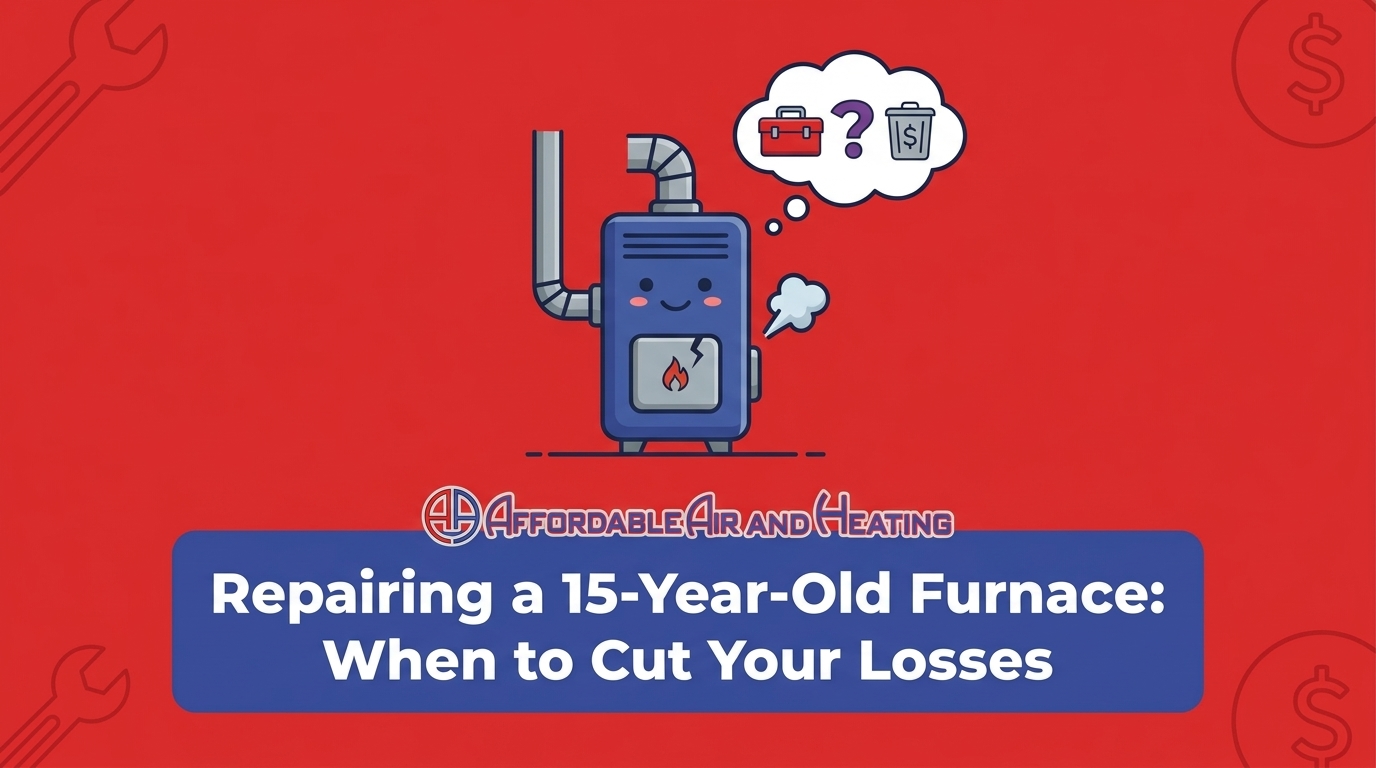
When faced with a sudden breakdown during early fall, Repairing a 15-Year-Old Furnace: When to Cut Your Losses is the first question you must ask to avoid wasting money on obsolete equipment. A common misconception among homeowners is that patching up a broken part is always the most cost-effective way to keep a house warm. You schedule your September pre-heating season tune-up, expecting a clean bill of health. Instead, the technician discovers a failed inducer motor on your aging gas furnace. Suddenly, you face a critical decision: authorize a major repair or invest in a full system replacement. While a quick fix feels easier to manage right now, it often sets a costly trap before the cold weather settles in.
In our years serving the Lancaster high desert at Affordable Air and Heating, our team frequently sees the frustration this causes. If you are weighing your options, our comprehensive heating services can help you determine the safest, most reliable path forward.
The instinct to repair rather than replace is natural. We are conditioned to fix things when they break. However, heating systems operate under immense thermal stress, and they have a finite mechanical lifespan. At 15 years old, a gas furnace has already pushed past the average life expectancy for its internal components. When a major part fails at this stage, it is rarely an isolated incident. It is usually the first warning sign that the system has reached the end of its functional life. Understanding when to stop sinking funds into obsolete equipment is the key to maintaining a comfortable, safe home without facing repeated emergency breakdowns.
Evaluating the Tipping Point: The Inducer Motor Failure
To understand why a single part can condemn an entire heating system, you have to look at how a gas furnace actually operates. The sequence of operations dictates that before the gas valve can open and the burners can ignite, the furnace must prove it can safely vent dangerous combustion gases out of your home. This is where the inducer motor comes in.
The inducer motor is a small, specialized fan that pulls a draft through the heat exchanger. It ensures that hazardous byproducts, like carbon monoxide, are pushed safely up the flue and out of the house. If the inducer motor fails, a safety mechanism called the pressure switch detects the lack of draft and completely locks out the furnace. The system will not fire, and your home will not heat.
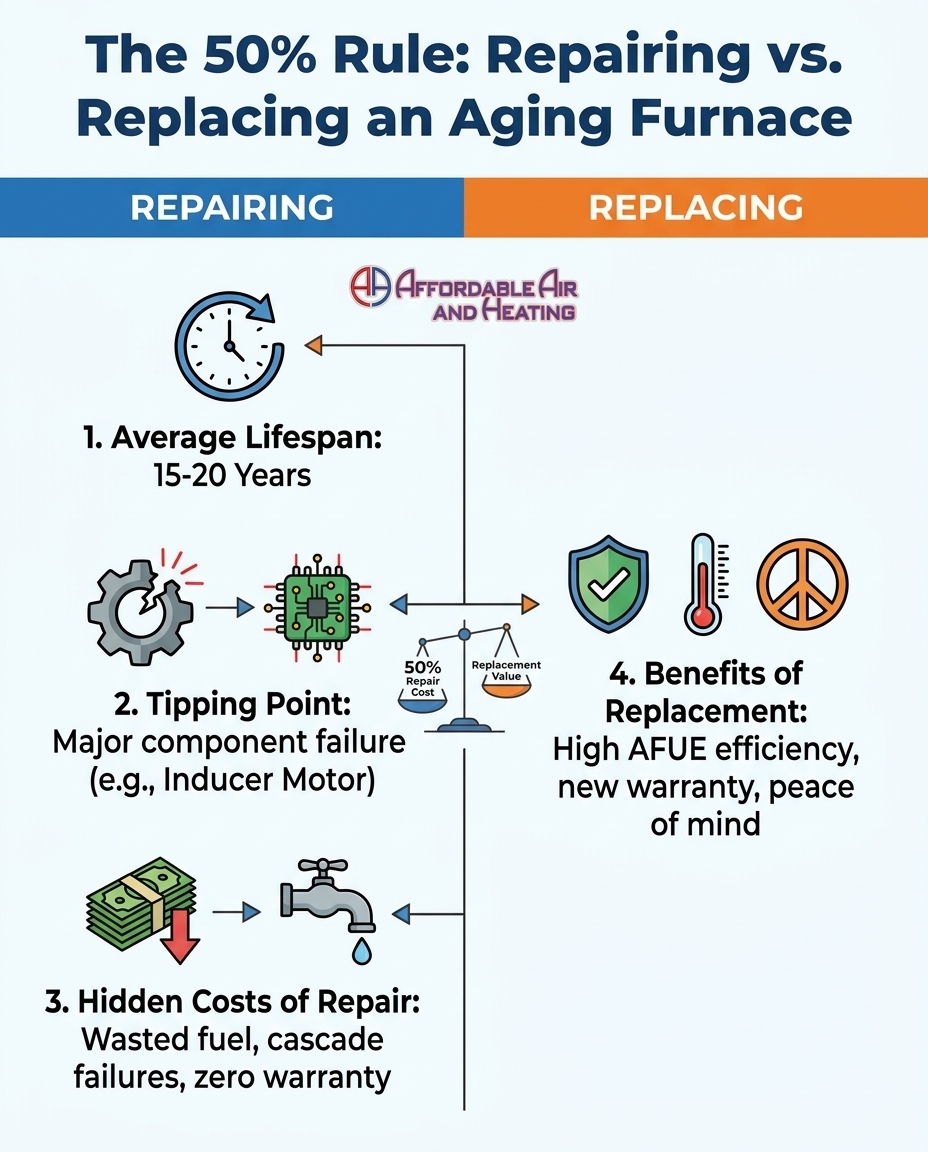
When an inducer motor fails on a 15-year-old gas furnace, industry professionals look to the 50% Rule. This rule states that if the cost of a repair approaches half the remaining value of the system, the repair is a poor investment. Because a 15-year-old furnace has essentially zero remaining financial value and no warranty coverage, any major repair easily violates this rule.
Furthermore, sinking significant funds into aging equipment introduces the problem of parts availability. Manufacturers phase out parts for older units as they shift production to modern, high-efficiency systems. Sourcing an obsolete inducer motor often requires special orders, leading to extended delays. When you combine the high proportional cost of the repair with the logistical difficulty of finding the right parts, the inducer motor failure clearly emerges as the mechanical and financial tipping point.
The Mechanical Cascade Effect in Older Furnaces
The Problem: When homeowners choose to replace a major component on an aging system, they often expect the furnace to run smoothly for several more years. Unfortunately, the reality of thermal fatigue and mechanical wear tells a different story. Fixing one part on a 15-year-old gas furnace does not reset the clock on the rest of the unit.
The Cause: Heating systems suffer from the mechanical cascade effect. Over a decade and a half of operation, the metal components inside your furnace have expanded and contracted thousands of times. Bearings wear down, electrical relays degrade, and the heat exchanger experiences severe thermal stress. When an inducer motor begins to fail, it often pulls an inadequate draft for weeks or months before it stops completely. This causes the furnace to run hotter than it was designed to, putting immense strain on the heat exchanger. Even after you install a brand-new inducer motor, the damage to the surrounding components has already been done.
The Solution: The only way to stop the cascade effect is to recognize it before you waste resources on a doomed system. A failing inducer motor is frequently a precursor to a cracked heat exchanger, which carries severe safety risks, including carbon monoxide exposure. Our technicians recently helped a local homeowner who experienced this exact type of mechanical cascade during the coldest week of the winter. Faced with a freeze warning and a shivering household, we assessed their aging unit, identified a bad relay that was part of a larger system failure, and recommended a full replacement. The homeowners opted for a new unit, and their heating now works amazingly well, completely bypassing the cycle of endless repairs. Upgrading through a complete HVAC system replacement stops the cascade effect entirely, providing a fresh start with modern safety tolerances.
Why High Desert Winters Demand Uncompromising Reliability
The decision to repair or replace cannot be made in a vacuum; it must be grounded in the specific environmental realities of your region. As a local team serving the Lancaster high desert, we know firsthand that our climate is defined by extreme diurnal temperature variations. It is not uncommon for daytime temperatures to feel mild and comfortable, only to plummet rapidly as soon as the sun goes down.
This rapid nighttime temperature drop makes an unreliable 15-year-old furnace a distinct safety risk rather than just a minor inconvenience. At lower elevations, a home might retain its heat for several hours after a furnace failure. In the high desert, the lack of atmospheric moisture means the ambient heat escapes into the atmosphere almost immediately after sunset. If your aging furnace decides to quit at 8:00 PM, the interior of your home will be freezing by midnight.
The structural integrity of heating equipment is tested most severely during these sudden, deep freezes. An older system has to run longer and harder to overcome the rapid heat loss of a high desert night. A patchwork repair might hold up during a mild afternoon, but it is highly likely to fail under the sustained load of a freezing night. Investing in a new system provides the peace of mind that comes from knowing your equipment can handle the unique, aggressive temperature swings of the Lancaster high desert without faltering when you need it most.
Long-Term Affordability vs. Sunk Repair Costs
When evaluating affordability, you have to shift your perspective from the immediate cost of a band-aid fix to long-term financial wisdom. True affordability is about making strategic decisions that lower your overall cost of ownership over the next decade. This is the core of the Affordable Air and Heating ethos: providing honest guidance that prevents homeowners from sinking money into doomed equipment.
A 15-year-old gas furnace typically operates at a much lower Annual Fuel Utilization Efficiency (AFUE) rating than modern systems. An older unit might only convert 70 to 80 percent of the fuel it consumes into usable heat, sending the rest out the exhaust pipe. Modern, high-efficiency systems can achieve AFUE ratings of 95 percent or higher. The wasted fuel from an aging unit acts as a hidden, ongoing cost that inflates your utility bills month after month.
Additionally, upgrading to a high-efficiency system often opens the door to financial incentives. Generic federal tax credits and local utility rebates may apply to qualifying high-efficiency installations, helping to offset the initial investment. When you compare the two paths side-by-side, the financial reality becomes clear.
• Immediate Result — Repairing the Old 15-Year-Old Unit: Provides a temporary, partial fix to get the system running. — Upgrading to a New Heating System: Completely resets the lifespan clock on your home comfort.
• Future Reliability — Repairing the Old 15-Year-Old Unit: High risk of subsequent breakdowns due to the mechanical cascade effect. — Upgrading to a New Heating System: Highly reliable, tested to handle severe high desert temperature drops.
• Energy Consumption — Repairing the Old 15-Year-Old Unit: Continued high energy consumption due to outdated AFUE ratings. — Upgrading to a New Heating System: Dramatically improved AFUE efficiency, reducing wasted fuel.
• Warranty Protection — Repairing the Old 15-Year-Old Unit: Zero warranty on the rest of the aging system; you pay out of pocket for the next failure. — Upgrading to a New Heating System: Protected by comprehensive new manufacturer warranties for peace of mind.
The Strategic Advantage of Early Fall Preparation
Timing plays a crucial role in how stressful a major HVAC decision becomes. September is the critical pre-heating season window in the high desert. Making the decision to replace an aging system during early fall gives you a massive strategic advantage over waiting for the system to fail in the dead of winter.
During the early fall, you have the logistical advantage of scheduling a replacement on your own terms. Once the first major cold snap hits, industry-wide delays become common as emergency calls flood in. By acting early, you ensure your home is protected before the extreme weather arrives. If you notice unusual symptoms during the seasonal transition—such as strange noises, poor airflow, or vents blowing warm air when they shouldn't—it is time to take action.
If your September pre-heating season tune-up reveals a major component failure, follow this checklist to manage the situation effectively:
• Request a full system assessment: Do not just look at the broken part. Ask the technician to inspect the heat exchanger, blower motor, and control board for signs of impending failure.
• Calculate the true cost: Weigh the quoted repair against the 50% Rule, keeping in mind that your 15-year-old system has no remaining warranty.
• Review your energy bills: Compare last winter's utility costs to historical averages to see how much efficiency the old unit has already lost.
• Explore your options: Ask for a replacement estimate alongside the repair quote so you can make a fully informed, side-by-side comparison.
• Act before the freeze: Schedule the replacement while the daytime weather is still mild, avoiding the discomfort of a freezing house during the installation process.
Frequently Asked Questions About Aging Furnaces
Should I replace my 15-year-old furnace?
In most cases, replacing a 15-year-old furnace is the smartest financial decision. At this age, the system has reached the end of its designed lifespan and will begin suffering from frequent mechanical failures. Upgrading to a new unit provides better energy efficiency, restores manufacturer warranty protection, and eliminates the safety risks associated with aging heat exchangers.
Is it worth fixing a furnace inducer motor on an older unit?
Fixing an inducer motor on a unit older than 12 to 15 years is generally not recommended. The inducer motor is a major safety component, and its failure is often the tipping point that precedes a cascade of other expensive breakdowns. Investing heavily in a repair for a system that is already obsolete violates the 50% Rule of HVAC maintenance.
At what age should you replace a gas furnace?
You should strongly consider replacing a gas furnace when it reaches 15 years of age, especially if it requires a significant repair. While some units can technically run longer, their efficiency drops drastically, and the risk of carbon monoxide leaks increases. Proactive replacement at the 15-year mark prevents emergency breakdowns during peak winter weather.
How long does a gas furnace usually last?
The average lifespan of a standard residential gas furnace is between 15 and 20 years. This lifespan depends heavily on how well the system was maintained, the quality of the original installation, and the severity of the local climate. In regions with harsh temperature drops, the constant thermal cycling can push a furnace toward the lower end of that life expectancy.
What is the mechanical cascade effect in heating systems?
The mechanical cascade effect occurs when one failing part adds excessive stress to the rest of the heating system, leading to a chain reaction of breakdowns. For example, a weak inducer motor can cause poor drafting, which overheats and eventually cracks the heat exchanger. Fixing the initial part does not reverse the stress placed on the rest of the aging components.
How do I know if my older furnace is losing efficiency?
The clearest sign of lost efficiency is a steady increase in your winter utility bills despite using your thermostat the same way. You might also notice that the furnace runs for longer cycles to reach the desired temperature, or that some rooms feel noticeably colder than others. An annual tune-up can measure the system's actual AFUE output to confirm how much fuel is being wasted.
Make the Smart Choice for Your Home's Winter Comfort
Deciding whether to repair or replace a major appliance is never easy, but the data clearly shows that cutting your losses on a 15-year-old system is often the most financially sound decision. The combination of the mechanical cascade effect, the lack of warranty coverage, and the extreme demands of the Lancaster high desert makes nursing an old unit a risky gamble. You deserve a clear, objective framework to evaluate your options without the pressure of a mid-winter emergency.
Our team is here to provide the expert guidance you need to confidently transition into the heating season. We encourage you to book a comprehensive assessment to weigh your specific options. If a replacement is the safest route, we offer flexible financing options to ease the transition to a reliable, high-efficiency new system. Make the smart choice today, and enjoy the peace of mind that comes with dependable winter comfort.