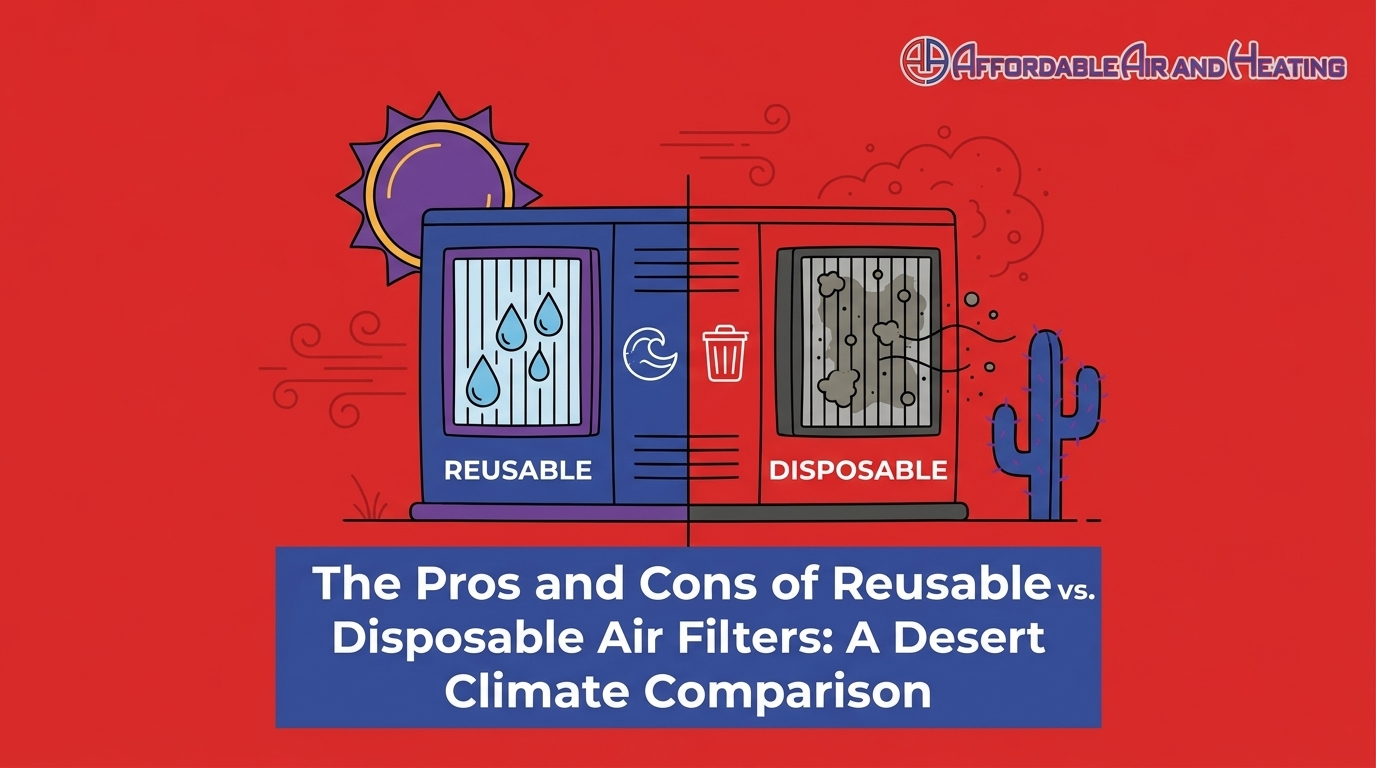
The Pros and Cons of Reusable vs. Disposable Air Filters


Myth vs. Reality: Are Eco-Friendly Filters Always the Best Choice?
Upgrading to a washable filter is often touted as the ultimate eco-friendly home hack, but understanding the pros and cons of reusable vs. disposable air filters reveals a much more complicated reality. A common myth circulating online suggests that buying one permanent filter will solve all your indoor air quality problems while eliminating household waste. However, this generic advice rarely accounts for the specific environmental challenges homeowners face in extreme climates.
As the September pre-heating season transition approaches, fall winds begin kicking up massive amounts of fine dust and debris. At Affordable Air and Heating, our team sees firsthand how this seasonal shift forces your heating and cooling equipment to work overtime just to push air through your home. The decision you make at the filter rack isn't just about reducing landfill waste—it is fundamentally about protecting your expensive HVAC equipment and ensuring the air your family breathes remains clean. Choosing between an electrostatic washable vs. pleated disposable filter requires looking past the marketing claims and evaluating how these materials actually perform under heavy particulate loads.
If you are struggling with persistent dust and want to improve your home's indoor air quality, exploring dedicated air purification systems is often the most effective next step.
Understanding the Contenders: Electrostatic Washable vs. Pleated Disposable
Before making a decision for your home, you need to understand exactly how these two distinct technologies capture airborne contaminants. They approach the problem of dirty air using completely different physical mechanics, which directly impacts their effectiveness, their maintenance requirements, and their overall lifespan.
The Mechanics of Electrostatic Washable Filters
Washable filters are typically made from multiple layers of woven synthetic materials, such as polypropylene or specialized plastics. As air flows through these layers, the friction generates a mild static charge. This electrostatic charge acts like a magnet, attracting and holding onto dust particles, lint, and larger debris until the filter is removed and washed. Because they rely on this static charge rather than dense physical barriers, the weave of a washable filter is generally quite open. This open design allows for excellent airflow when the filter is perfectly clean, but it also means that ultra-fine particles can easily slip right through the gaps.
The Mechanics of Pleated Disposable Filters
Pleated disposable filters take a brute-force physical approach to air cleaning. They are constructed from dense synthetic cotton or polyester fibers that are folded into an accordion-like shape. These folds, or pleats, dramatically increase the total surface area of the filter without requiring a larger frame. Instead of relying on a static charge, pleated filters physically trap airborne contaminants within a microscopic web of fibers. As the filter collects dirt, the spaces between the fibers shrink, which actually increases the filter's ability to catch even smaller particles—though this eventually restricts airflow if left unchanged.
Comparing Performance Metrics
The standard measurement for filter efficiency is the Minimum Efficiency Reporting Value (MERV). This rating scale dictates what size particles a filter can successfully capture. Understanding this scale is crucial, as is understanding how thick your AC filter should be to accommodate higher ratings.
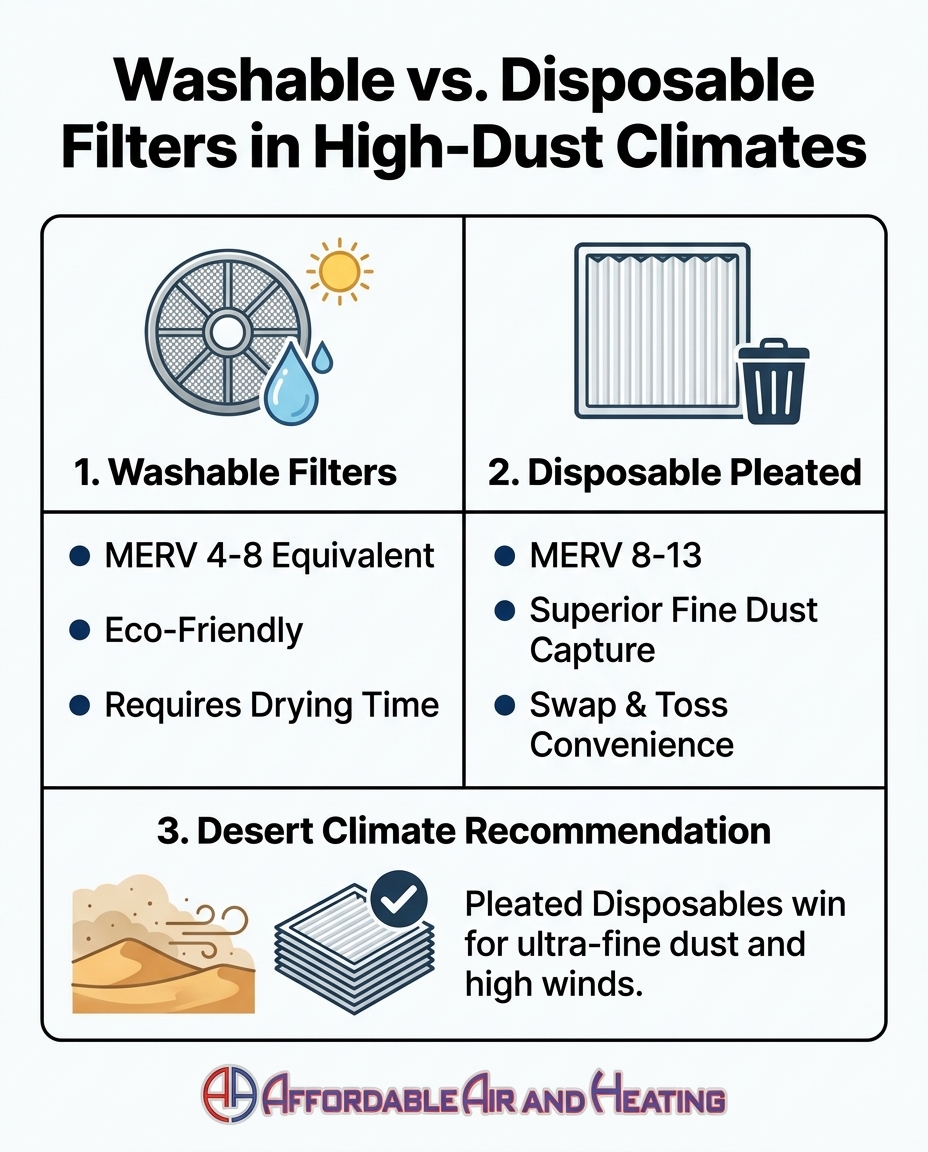
• MERV Rating — Electrostatic Washable: Typically MERV 4 to 8 equivalent — Pleated Disposable: Easily achieves MERV 8 to 13
• Capture Method — Electrostatic Washable: Friction-generated static charge — Pleated Disposable: Dense physical fiber web
• Airflow Impact — Electrostatic Washable: High airflow when clean, drops rapidly when coated — Pleated Disposable: Consistent restriction based on MERV rating
• Lifespan — Electrostatic Washable: 5 to 10 years (with monthly washing) — Pleated Disposable: 1 to 3 months (then discarded)
The Appeal of Reusable Air Filters: Pros and Cons
For many homeowners, the idea of a permanent solution is highly attractive. Electrostatic washable filters offer distinct advantages, particularly for those focused on sustainability, but they also carry significant drawbacks that require careful consideration.
The Advantages of Going Reusable
• Significant waste reduction: The primary benefit is environmental. By washing and reusing the same frame and media for five to ten years, you prevent dozens of cardboard and synthetic fiber filters from sitting in a landfill.
• Convenience of availability: You will never find yourself staring at a dirty filter on a Sunday evening realizing you forgot to buy a replacement at the hardware store. The solution is always right there in your home.
• Long-term cost savings: While the initial purchase price is higher, eliminating the recurring expense of buying premium filters every few months pays off over the lifespan of the product.
The Drawbacks of Washable Systems
• Lower particulate capture: Because they typically peak at a MERV 8 equivalent, washable filters struggle to capture ultra-fine particles like pet dander, microscopic pollen, and smog. They are great for large dust bunnies, but less effective for true air purification.
• Rigorous maintenance routine: Cleaning these filters is not a quick task. You must take them outside, hose them down thoroughly in the opposite direction of airflow, and use specific mild detergents to remove stubborn grime without leaving a residue that ruins the static charge.
• The hidden mold risk: This is the most critical drawback. A washed filter must be 100% bone-dry before it goes back into your system. Reinstalling a damp filter into the dark, warm environment of an HVAC cabinet creates the perfect breeding ground for mold and mildew, which will then be blown into every room of your house.
The Power of Disposable Pleated Filters: Pros and Cons
While they lack the environmental appeal of a permanent solution, pleated disposable filters remain the industry standard for a reason. They offer superior filtration capabilities that are heavily endorsed by indoor air quality experts.
The Advantages of Pleated Disposables
• Superior fine dust capture: High-quality pleated filters easily reach MERV 8 to 13, which aligns perfectly with ASHRAE recommendations for residential homes. They effectively trap ultra-fine dust, microscopic allergens, and even some bacteria that washable filters let slip by.
• Swap-and-toss convenience: Maintenance takes less than sixty seconds. You pull the dirty filter out, drop it in the trash, and slide a fresh one in. There is zero drying time, zero mess, and zero risk of introducing moisture into your ductwork.
• Predictable airflow management: Because they are manufactured to strict physical standards, a fresh pleated filter provides a known, predictable level of airflow resistance, allowing your system to operate exactly as the manufacturer intended.
The Drawbacks of Disposable Filters
• Environmental impact: The most obvious downside is the constant creation of landfill waste. Discarding a bulky frame and synthetic media every one to three months adds up significantly over the life of your home.
• Recurring maintenance task: You must actively remember to check the filter monthly, purchase the exact right size, and keep backups on hand. Forgetting this routine leads directly to system strain.
The High Desert Factor: Why Your Local Climate Dictates Filter Choice
Generic internet advice often fails to account for extreme regional climates. What works perfectly for a homeowner in the mild, humid Southeast might be a recipe for disaster in our specific environment. The Lancaster high desert and Antelope Valley region presents unique atmospheric challenges that fundamentally alter how air filters perform.
In our years of maintaining HVAC systems across the area, the team at Affordable Air and Heating knows that our local environment produces an incredibly fine, powdery dust that is highly abrasive. During the September pre-heating season transition, high seasonal winds whip this fine particulate matter into the air, driving it into your home's intake vents. This specific type of ultra-fine desert dust easily slips right past the open weave of lower-MERV washable filters. When that happens, the dust settles directly onto your indoor evaporator coil and blower motor, creating an insulating blanket of grime that destroys system efficiency.
Furthermore, the high volume of dust in the Antelope Valley rapidly coats electrostatic filters. Because these reusable filters rely on friction to maintain their static charge, a heavy layer of dirt quickly neutralizes that magnetic effect. Once the charge is gone, the filter stops catching particles almost entirely until it is washed again. In a dusty, windy climate, a washable filter might lose its effectiveness in just a matter of weeks, far short of the standard monthly washing schedule.
For these reasons, we strongly recommend high-quality pleated disposables as a functional necessity in the high desert. The dense synthetic fibers do not rely on a static charge, meaning they continue to physically trap fine powdery dust even as they fill up. While the environmental appeal of a reusable filter is strong, protecting your equipment and your lungs from aggressive desert dust requires the heavy-duty physical barrier that only a pleated disposable can provide.
The Hidden Danger of Airflow Restriction and Equipment Strain
Regardless of whether you choose an electrostatic washable vs. pleated disposable filter, letting it clog is the fastest way to destroy your heating and cooling equipment. High-desert dust accumulates at an astonishing rate. When a filter becomes heavily soiled, it acts like a wall, causing severe airflow restriction. Your system must pull a specific volume of air across its internal coils to function correctly; when it cannot breathe, the mechanical consequences are severe.
Restricted airflow forces your blower motor to work significantly harder just to pull air through the clogged media. This constant strain causes the motor to run hotter and pull more electricity, rapidly accelerating wear and tear on the internal bearings and electrical components. What starts as a simple dirty filter quickly cascades into a major mechanical failure.
Our technicians at Affordable Air and Heating see the results of this strain constantly during our pre-season tune-ups. For example, one local homeowner called our team for troubleshooting recently when their system suddenly stopped pushing conditioned air altogether. One of our technicians arrived the same day and discovered that chronic airflow restriction had caused the fan motor to overwork and fail completely. Fortunately, we were able to replace the faulty fan motor, resulting in a quick turnaround that got the system running again before the extreme weather hit. However, that entire breakdown could have been prevented with better filter management.
Proper filter selection and routine HVAC maintenance are the only ways to prevent these costly, stressful breakdowns. Checking your filter monthly and replacing or washing it the moment it looks dark is the cheapest insurance policy you can buy for your equipment.
Beyond the Filter: Comprehensive Solutions for Extreme Dust
Even the best one-inch pleated disposable filters have their limitations when faced with extreme wind and dust conditions in the Lancaster high desert and Antelope Valley. Standard filters are ultimately designed to protect the HVAC equipment itself, not necessarily to purify the air you breathe. If you find that your home is constantly dusty, or if family members suffer from allergies and asthma, relying solely on a standard filter rack will likely leave you frustrated.
For homeowners who want superior indoor air quality without the constant hassle of changing standard filters every few weeks, whole-home filtration and dedicated purification systems are the answer. These advanced systems integrate directly into your existing air conditioning systems and ductwork. They utilize thick, high-capacity media cabinets (often four to five inches thick) that can capture hospital-grade particulates without restricting system airflow. Some advanced models even incorporate UV lights and active ionization to neutralize biological contaminants and odors.
Relying on the extensive high-desert HVAC maintenance experience of the Affordable Air and Heating team allows us to guide homeowners away from generic internet advice and toward systems that actually handle our local dust load. We understand the exact balance required between high-level filtration, energy efficiency, and equipment longevity. Upgrading to a comprehensive purification system means you get the best of both worlds: exceptional air quality and a filter media that only needs to be swapped once or twice a year, rather than every single month.
Frequently Asked Questions About HVAC Filters
Are washable air filters worth it in dusty climates?
In our professional experience, the short answer is no; washable air filters are generally not recommended for highly dusty climates like the high desert. Because they rely on a static charge that quickly becomes neutralized by heavy dust loads, they lose their effectiveness much faster than in mild environments. Furthermore, their lower MERV equivalent ratings mean they allow ultra-fine powdery dust to slip through and coat your HVAC equipment. In these regions, a high-quality pleated disposable filter is a much safer choice for your system.
Do reusable air filters restrict airflow more than disposables?
When perfectly clean, reusable air filters actually offer very little airflow restriction due to their open weave design. However, as they collect dirt, they can restrict airflow just as much, if not more, than a disposable filter. Because the electrostatic charge fades as the filter gets dirty, some homeowners leave them in too long, leading to severe clogs. Pleated disposables offer more consistent, predictable airflow resistance based on their specific MERV rating.
Which is better: a washable or disposable air filter?
For the vast majority of homes we service, a pleated disposable air filter is better for overall indoor air quality and equipment protection. Disposables achieve much higher MERV ratings (typically 8 to 13), allowing them to trap microscopic allergens, pet dander, and ultra-fine dust that washables miss. While washables are better for reducing landfill waste, disposables are functionally superior at keeping your air clean and your blower motor running efficiently.
How long do washable air filters last before needing replacement?
A high-quality washable air filter can last anywhere from five to ten years before the frame or media degrades enough to require a full replacement. However, this lifespan assumes you are performing rigorous maintenance. You must remove, thoroughly wash, and completely dry the filter every 30 to 60 days. If the synthetic fibers become damaged during washing, or if the frame bends, the filter must be replaced immediately to prevent air from bypassing the media.
Can a wet washable filter cause mold in my HVAC system?
Yes, reinstalling a wet washable filter is one of the fastest ways to introduce mold into your HVAC system. Your ductwork and indoor air handler provide a dark, warm environment. If you introduce moisture by sliding a damp filter into the rack, mold spores will quickly take root and multiply. This mold can then spread to your evaporator coil and be blown throughout your home, creating a serious health hazard and requiring expensive professional remediation.
Make the Right Choice for Your Fall HVAC Prep
When weighing the pros and cons of reusable vs. disposable air filters, the reality of your local climate should always have the final say. While electrostatic washable filters offer fantastic environmental benefits and long-term cost savings, they simply cannot compete with pleated disposables when it comes to capturing the ultra-fine dust and high seasonal winds typical of the high desert. Protecting your equipment and your lungs requires a filter that traps microscopic particles without fail.
As you navigate the September pre-heating season transition, now is the perfect time to evaluate your home's defense against airborne contaminants. Check your current filter, ensure it is clean, and make sure you are using a product that actually fits your environment. If high-desert dust remains an ongoing battle in your home, do not settle for standard solutions. Reach out to the experts at Affordable Air and Heating to explore advanced air purification systems that can deliver the clean, healthy air your family deserves without straining your HVAC equipment.