Can I Safely Run My Heater if the Carbon Monoxide Detector Beeped Once?
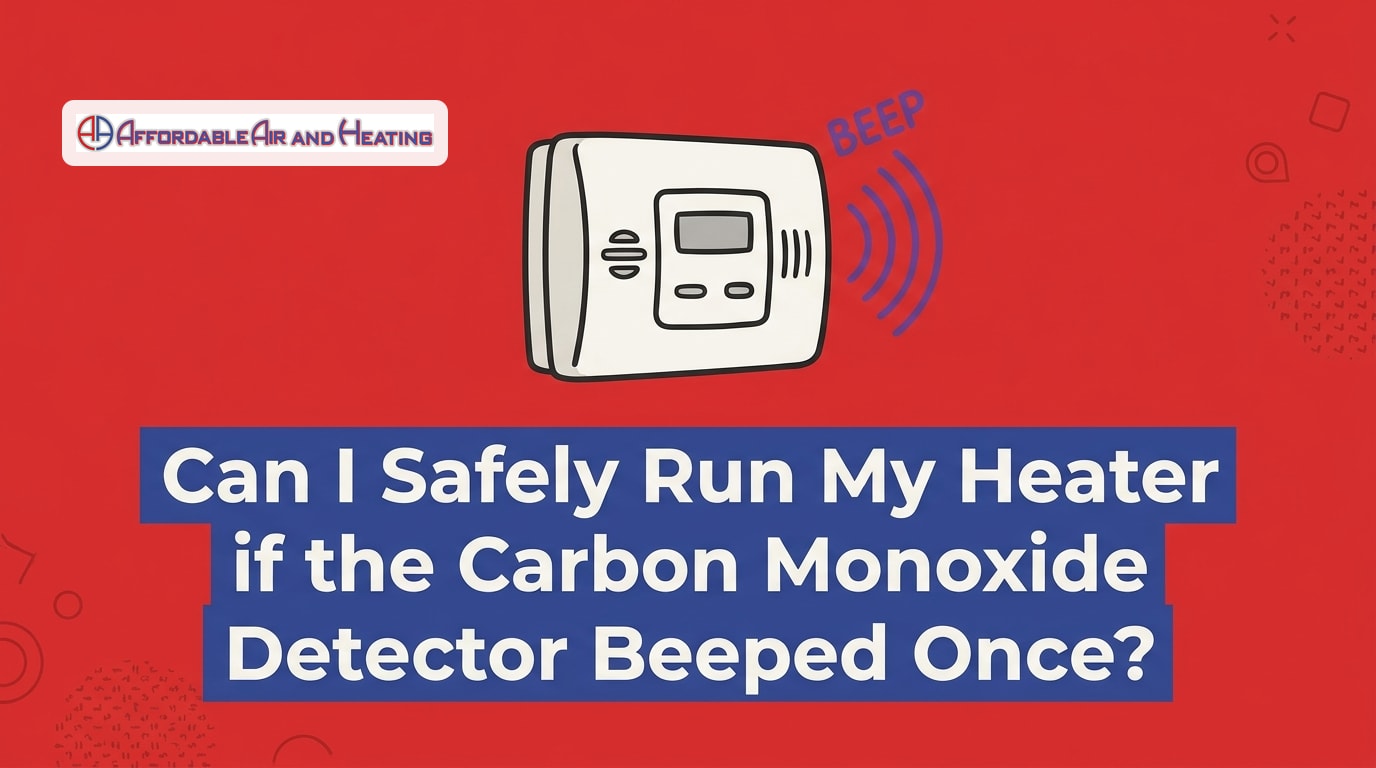


Hearing a Single CO Detector Chirp on a Cold Night: What It Means
Did your carbon monoxide detector just let out a sudden, piercing beep the exact moment your furnace kicked on? At Affordable Air and Heating, we frequently receive frantic calls from homeowners standing in the hallway asking themselves, "Can I safely run my heater if the carbon monoxide detector beeped once?" If this happens to you, you are facing a critical diagnostic fork in the road.
When dealing with potential exhaust issues, relying on our professional heating services is the fastest and most reliable way to ensure your home's indoor air quality and safety.
Hearing a sudden electronic chirp from your ceiling or wall unit is inherently stressful, especially when the temperature outside is dropping and you just want a warm, comfortable house. Your immediate instinct might be to assume it is just a dying battery, swap it out, and go back to sleep. However, our team consistently warns customers that when a single beep correlates perfectly with the ignition sequence of your gas furnace, it shifts from a simple maintenance nuisance to a potential safety warning.
The underlying issue: Carbon monoxide detectors use highly sensitive electrochemical sensors. These sensors are designed to trigger a full, continuous alarm when gas concentrations reach dangerous levels over a specific period. But they can also emit isolated chirps when they detect a sudden, brief anomaly in the air—or when the unit itself is failing.
Ignoring that single beep is never a safe option. Even if your home feels freezing, you cannot simply turn up the thermostat and hope the sound goes away. You need to immediately determine whether your device is asking for a new battery, or if your heating system is actively venting combustion gases into your living space. Understanding the difference is the first step in protecting your household while working with our technicians to safely restore your heat.
Decoding the Sound: Battery Warning vs. Active Threat
Not all alarms sound the same, and manufacturers specifically design carbon monoxide detectors to communicate different problems through distinct audio patterns. Knowing how to decode these sounds is vital for your safety.
In our years of servicing Lancaster CA high desert homes, our team has seen firsthand how rapidly the temperature drops once the sun goes down. When a cold night sets in, the temptation to ignore a single beep just to keep the house warm is incredibly strong. You might think, "It only beeped once, the air is probably fine." But understanding what the device is actually trying to tell you will help you make the right call.
Here is a breakdown of the typical sounds a carbon monoxide detector makes and what they indicate based on our field experience:
• One chirp every 30 to 60 seconds — Typical Cause: Low battery or end-of-life warning (detectors expire after 5-7 years). — Required Action: Replace the batteries immediately. If the chirping continues, replace the entire unit.
• Continuous 4-beep pattern (Beep-Beep-Beep-Beep, Pause) — Typical Cause: Active carbon monoxide emergency. Dangerous levels detected. — Required Action: Evacuate the home immediately, call 911, and do not re-enter until cleared.
• A single, isolated chirp when the heater turns on — Typical Cause: Potential micro-leak, draft issue, or a surge of exhaust gases during furnace startup. — Required Action: Turn off the heater, ventilate the area, and schedule professional diagnostics.
The startup phenomenon: The most confusing scenario we see for homeowners is the isolated chirp. If your detector is completely silent all day, but lets out one sharp beep exactly when the furnace burners ignite, it is highly unlikely to be a battery issue. Batteries do not suddenly lose voltage only when the heater runs. Instead, this correlation suggests that the initial draft of the furnace is pushing a small amount of combustion gas into the home before the flue fully pressurizes and vents it outside.
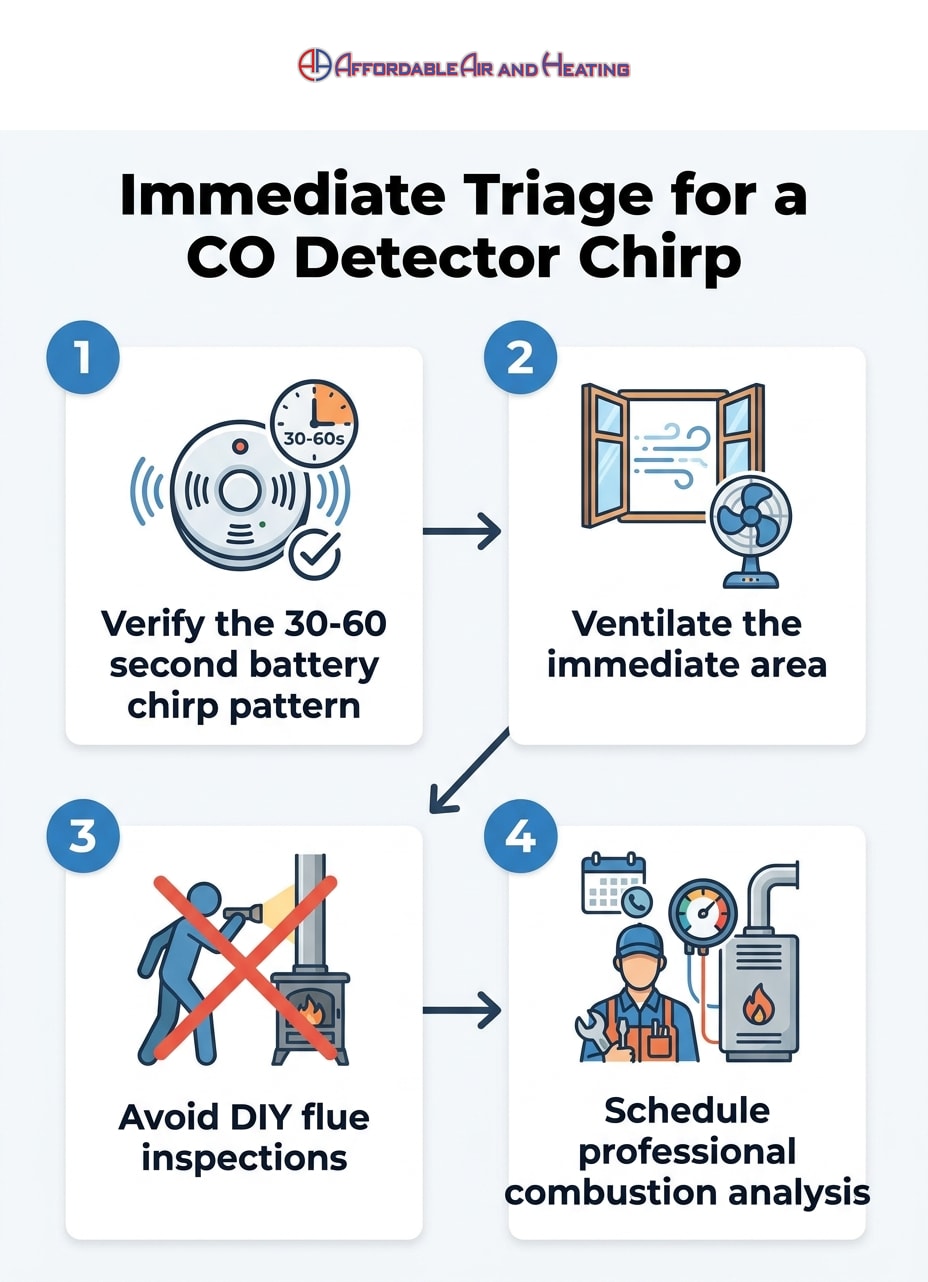
Immediate Triage: Safe Steps to Take Right Now
If you experience this isolated warning, taking the right steps immediately can prevent a minor mechanical issue from escalating into a serious health hazard. As the November early winter heating season begins, we tell all our local customers that these triage steps are essential for every household's pre-winter readiness.
1. Verify the chirp pattern: Stand near the detector for at least two full minutes. If it chirps exactly every 30 to 60 seconds, it is almost certainly a battery issue. Change the batteries. If it was a single beep that does not repeat, proceed to the next step.
2. Ventilate the immediate area: Open a few nearby windows to introduce fresh outdoor air into the home. This helps disperse any trace amounts of carbon monoxide that may have triggered the sensitive sensor during the furnace's initial startup sequence.
3. Do not attempt a DIY flue or heat exchanger inspection: Turn the furnace off at the thermostat. Do not open the furnace cabinet, tamper with the exhaust pipes, or try to visually inspect the internal components. Disturbing the venting system without proper training can dislodge rusted pipes and make a minor leak significantly worse.
4. Schedule a professional combustion analysis: Contact a licensed HVAC technician to perform a comprehensive diagnostic check. Only a professional with specialized digital tools can safely clear the heater for continued use.
The Heater Connection: Why Startup Exposes Hidden Risks
To understand why your detector might beep just once, it helps to understand the mechanics of how your gas furnace starts up. When your thermostat calls for heat, a sequence of events begins. The draft inducer motor turns on to push air up the flue, the igniter glows, and the gas valve opens.
During those first few seconds of ignition, the flue pipe is still cold. Cold air is heavy and can temporarily block the rising exhaust gases, causing a brief moment of "backdrafting" where a tiny puff of exhaust spills out of the furnace cabinet before the chimney effect takes over. Our team frequently finds that if a carbon monoxide detector is mounted very close to the furnace room, this initial puff can be just enough to trigger a single warning chirp.
More concerning, however, is the state of your heat exchanger. The heat exchanger is the metal shield that keeps the toxic combustion gases completely separate from the clean air being blown into your home's ductwork. Over years of expanding when hot and contracting when cold, this metal can develop stress fractures.
When our customers ask, "Can I safely run my heater if the carbon monoxide detector beeped once?", we explain that the answer is heavily tied to the integrity of that metal shield. When the blower fan turns on, it changes the air pressure inside the furnace. If there is a crack in the heat exchanger, that pressure change can force carbon monoxide directly into your breathing air. A single chirp is often the very first indicator of this structural failure, serving as a critical bridge to noticing other symptoms of a cracked heat exchanger.
Why DIY Furnace Inspections Fall Short for CO Leaks
When the house is cold, it is tempting to grab a flashlight, open the furnace panel, and try to find the problem yourself. However, when it comes to combustion gases, we always caution homeowners that DIY inspections are not just ineffective—they are actively dangerous.
Here is why relying on a visual check is never enough to guarantee your family's safety:
• Carbon monoxide is entirely invisible: It is a colorless, odorless, and tasteless gas. You cannot see a leak, you cannot smell it, and you cannot hear it escaping. By the time human senses detect a problem (usually through physical symptoms like headaches or nausea), the situation is already a severe emergency.
• Hairline cracks hide in the cold: The metal of a heat exchanger expands significantly when the furnace burners are running. A crack that opens up to a millimeter wide under intense heat will often shrink tightly closed when the furnace is off and the metal cools. A homeowner shining a flashlight on a cold heat exchanger will almost always miss these invisible stress fractures.
• Tampering worsens the problem: Our technicians know that the exhaust flue and venting systems in Lancaster CA high desert homes are precisely fitted. Nudging, pulling, or taping vent pipes without a license can break fragile seals, turning a micro-leak into a massive exhaust failure.
• Lack of measurement tools: You cannot fix what you cannot measure. Without knowing the exact concentration of gases in the airstream, there is no way to verify that a repair was successful or that the system is safe to operate.
Professional Combustion Analysis: The Only Definitive Clearance
If a visual inspection cannot prove your furnace is safe, how do you get your heat back on without worrying? At Affordable Air and Heating, the answer lies in professional combustion analysis.
A combustion analyzer is a highly calibrated, digital diagnostic tool that our HVAC technicians use to measure the exact chemical makeup of your furnace's exhaust and the ambient air in your ductwork. It detects carbon monoxide levels down to single parts per million (PPM). This level of precision allows us to identify micro-leaks long before they ever reach the threshold to trigger a continuous household alarm.
The diagnostic process: When an Affordable Air and Heating professional arrives, we don't just guess. We insert the probe of the combustion analyzer directly into the exhaust flue to measure how efficiently the fuel is burning. We also test the supply air coming out of your vents. If the analyzer detects any trace of carbon monoxide in the breathing air, it is definitive proof that the heat exchanger has failed.
Working with our dedicated local team means you benefit from honest, up-front diagnostic steps. We use these advanced combustion analyzers to provide transparent, data-backed proof of your system's health—ensuring you get accurate safety information without the fear of hidden fees or unnecessary upselling. If our analyzer reads zero PPM in your ductwork, you get the absolute peace of mind that your heater is safe to run. If we detect a leak, you know exactly why the system must be shut down.
Frequently Asked Questions About Carbon Monoxide and Heater Safety
What does 1 beep on a carbon monoxide detector mean?
A single beep every 30 to 60 seconds usually indicates a low battery or an end-of-life warning for the detector unit itself. This requires immediate battery replacement and close observation. If the single beep only occurs exactly when an appliance like a furnace turns on, it may indicate a brief surge of exhaust gases triggering the sensor.
Can I use my furnace if the carbon monoxide detector is beeping?
If the detector is sounding a continuous alarm, evacuate immediately and do not use the furnace under any circumstances. If it is a single chirp, verify the battery first; if the chirp persists or coincides directly with furnace use, shut the system down immediately and call a professional to inspect for a potential leak.
How do HVAC technicians check for carbon monoxide?
Technicians use calibrated digital combustion analyzers to measure precise parts per million (PPM) of gases in both the exhaust flue and the home's breathing air. They also perform thorough structural inspections of the heat exchanger, burners, and venting systems to ensure absolute integrity before clearing a unit for use.
Does a carbon monoxide detector beep when a heater turns on?
Under normal, safe operating conditions, it should not. If a detector beeps when the heater ignites, it may indicate a burst of carbon monoxide during startup, signaling a potentially dangerous draft issue, a blocked flue, or a failing heat exchanger that requires immediate professional attention.
What are the early signs of a furnace carbon monoxide leak?
Early physical signs of a furnace leak include soot accumulating around the furnace cabinet, a yellow or flickering burner flame instead of a crisp blue one, and excessive, unexplained moisture on your windows. Physical symptoms in the household, such as unexplained headaches, dizziness, or nausea that clear up when you leave the house, are also major warning signs.
Restore Your Heat Safely with Professional Diagnostics
Hearing a single chirp from your carbon monoxide detector is a critical warning that should never be brushed aside, especially during the freezing nights common to Lancaster CA high desert homes. Whether it is a simple battery issue or the early warning sign of a cracked heat exchanger, guessing is simply not worth the risk to your family's health.
Professional clearance is the only way to achieve definitive peace of mind. By relying on advanced diagnostic tools, our licensed technicians can pinpoint the exact cause of the alert and ensure your system is completely secure. If you suspect your heater is the reason behind that unsettling beep, contact us for emergency diagnostics today. As your trusted local experts, we will help you safely restore your heat so you can sleep comfortably, knowing your home is fully protected.