Why Your Smart Thermostat Might Be Damaging Your Older AC


The Unseen Conflict Between Modern Tech and Legacy Cooling
Your new smart thermostat looks great on the wall, but your air conditioner is suddenly acting erratic. You likely installed that sleek, digital device to cut down on energy bills and improve your comfort during the August extreme late-summer heat. It makes perfect sense to upgrade your controls. However, what you cannot see behind that glowing touchscreen is a hidden electrical conflict that might be silently damaging your cooling equipment.
The core issue is a technical mismatch. Modern smart thermostats require a continuous flow of electricity to keep their Wi-Fi connected and their screens illuminated. If your home's wiring wasn't built to provide that constant power, the new device will resort to a process called "power-stealing." It pulls the electricity it needs directly from the heating and cooling circuits. While the thermostat stays powered on, your aging air conditioner is forced to bear the brunt of the electrical confusion.
Ignoring this erratic behavior is a risky gamble. When a thermostat power-steals from a system that wasn't designed for it, the resulting electrical pulses can force your compressor into a destructive cycle. Before you risk a total system failure at the hottest time of the year, it is critical to have a professional evaluate your entire HVAC system to ensure your new controls and your older equipment are actually communicating correctly.
What Is a C-Wire and Why Do Smart Thermostats Demand It?
To understand why your smart thermostat is clashing with your older air conditioner, you have to look at the wiring hidden inside your walls. For decades, standard thermostats were incredibly simple devices. They relied on mechanical components, like mercury switches or basic analog relays, to turn your heating and cooling on and off. Because they did not have digital displays, background software, or Wi-Fi antennas, they required almost zero continuous electrical power to operate.
Modern smart thermostats are essentially miniature computers mounted to your wall. They need a steady, uninterrupted supply of 24-volt electricity to function. In a modern electrical setup, this continuous power is delivered through a dedicated wire known as the C-wire, or "common wire." The C-wire provides a safe, independent return path for the electrical current, ensuring the thermostat stays powered without interfering with the actual commands being sent to your air conditioner or furnace.
The problem arises because many older Lancaster CA residential homes were built long before smart home technology existed. These homes typically feature older 4-wire thermostat bundles behind the drywall. A standard 4-wire setup includes a wire for power (usually red), a wire for heating (white), a wire for cooling (yellow), and a wire for the indoor fan (green). Notice what is missing? There is no dedicated 5th wire to serve as the common power return.
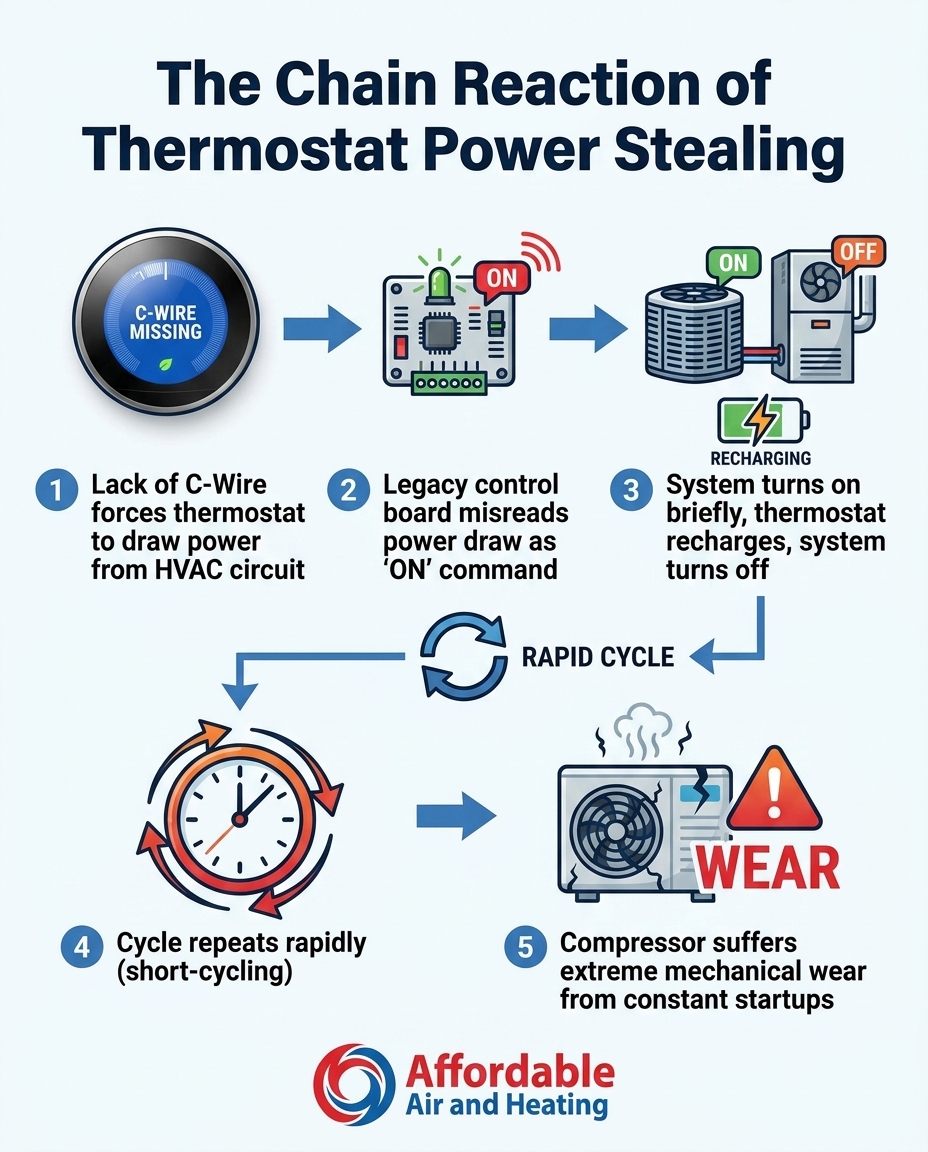
When you connect a power-hungry smart device to a 4-wire bundle, the device still demands its 24 volts of continuous power. Without the C-wire to deliver it safely, the thermostat has to find another way to stay awake. This missing wire is the root cause of countless emergency calls for air conditioning repair and service, as homeowners mistake a wiring mismatch for a failing cooling unit.
The Mechanics of Power Stealing and Short-Cycling
Here is the thing: a smart thermostat is programmed to survive even if a C-wire is missing. If it cannot get dedicated power, it initiates a workaround known as "power stealing" or "phantom drawing." The thermostat intentionally bleeds a small amount of electricity from the cooling or heating wires to charge its internal battery. It pulses the circuit just enough to stay powered on, but theoretically not enough to actually turn on the air conditioner.
The cause of the damage happens at the other end of those wires. The electrical pulses travel down to the furnace or air handler, where the main control board sits. Legacy HVAC control boards without dedicated C-wire terminals were never designed to interpret these tiny, rapid pulses of electricity. They operate on a simple binary system: they are either receiving power (turn on) or they are not (turn off). When the power-stealing thermostat pulses the cooling wire to grab a charge, the older control board feels that surge of electricity and assumes you just asked for cold air.
The solution requires stopping this miscommunication before it destroys your equipment. Because the legacy board misreads the pulse, it triggers the air conditioner to start up. A moment later, the thermostat finishes grabbing its quick charge and stops pulsing the wire. The control board suddenly loses the signal and shuts the air conditioner right back down. This rapid, unintended on-and-off switching is known as "short-cycling," and it is one of the most severe operational malfunctions an air conditioner can experience.
How Legacy Boards Misread Digital Signals
The technological gap between analog relays and digital power-stealing is vast. Older control boards use physical relays—magnetic switches that click closed when they receive 24 volts from the thermostat. When a smart thermostat steals power, it sends a partial voltage spike down the line.
The legacy board reacts to these phantom power draws by repeatedly trying to close its relays. You might even hear a rapid clicking sound coming from your indoor unit as the physical switches bounce open and closed in response to the digital pulses. This constant mechanical chatter not only wears out the relays on the control board but also sends chaotic, interrupted voltage to the outdoor compressor, which can result in vents blowing warm air instead of the reliable cooling you expect.
Why Short-Cycling is a Death Sentence for Older Compressors
To understand why short-cycling is so dangerous, you have to look at how an air conditioner consumes energy. The most intense mechanical stress on your cooling system occurs during the initial startup phase. When the outdoor compressor kicks on, it requires a massive surge of electricity—known as in-rush current—to overcome the resting pressure of the refrigerant and get the heavy internal motors spinning. Starting an air conditioner takes significantly more effort and energy than keeping it running smoothly for an hour.
When a power-stealing thermostat forces your system to short-cycle, it multiplies this startup stress exponentially. Instead of starting up three or four times an hour and running for long, efficient cycles, the compressor is forced to start, stop, and restart dozens of times an hour. The internal motors never get a chance to cool down. The electrical contactors burn and pit from the constant sparking. The starting capacitors are drained and overworked until they bulge and fail.
This added mechanical strain pushes already stressed equipment past its breaking point, especially in extreme climates. With Lancaster's triple-digit August heatwaves already maximizing the thermal load on older AC units, the equipment is fighting hard just to keep your house comfortable. Adding the violent stop-and-go stress of short-cycling during the August extreme late-summer heat acts as a direct catalyst for catastrophic failure. The compressor motor overheats, the internal windings melt, and the entire unit locks up permanently. While this specific issue destroys cooling equipment quickly, it's worth noting that power-stealing can also wreak havoc on the control boards of older heating systems when winter rolls around.
Spotting the Signs of a Thermostat Mismatch
Catching a power-stealing issue early is the only way to save your compressor from permanent damage. If you recently installed a smart thermostat in an older home, you need to monitor the system closely for the first few days. Because legacy HVAC control boards without dedicated C-wire terminals cannot communicate their distress to the thermostat screen, you have to rely on physical symptoms.
Watch for these common warning signs of a wiring mismatch:
• Rapid on-and-off cycling: The air conditioner turns on, runs for one to three minutes, shuts off, and immediately tries to start again.
• Low battery warnings: The smart thermostat constantly displays a "low battery" or "power loss" error on the screen, even if it is brand new.
• Wi-Fi disconnections: The thermostat frequently drops its connection to your home network because it does not have enough power to maintain the wireless radio.
• Blank screens: The digital display goes completely dark when the air conditioner kicks on, as the system voltage drops too low to support the screen.
• Failing to reach set temperatures: The system runs constantly in short bursts but never actually cools the house down to your desired temperature.
Prompt professional diagnosis is essential when these symptoms appear. One local homeowner reached out during the summer when their AC unit broke down after most places were closed. Our technician arrived promptly, identified the issue, and had the necessary part to fix the unit right away. Often, sudden breakdowns like this trace back to simple control or wiring issues that escalate because they go unnoticed. If you ignore short-cycling, it is not a matter of if the compressor will fail, but when. Accurate diagnostics protect both your comfort and your indoor air quality by ensuring the system runs long enough to properly dehumidify and filter the air.
Safe Solutions: Fixing the Wiring Without Risking Your System
Fixing a power-stealing issue requires stopping the electrical mismatch safely and permanently. You must provide the smart thermostat with the continuous 24-volt power it needs without using the heating or cooling wires as a crutch. For older Lancaster CA residential homes, achieving this requires professional electrical intervention.
There are generally two safe, professional solutions to resolve a missing C-wire. The first is installing a C-wire adapter (often called an add-a-wire kit) directly at the indoor control board. This small electronic module splices into the existing 4-wire bundle and safely splits one of the wires to carry both a signal and a common return path. The second, more robust solution is pulling a completely new 5-wire thermostat bundle through the walls, physically connecting a dedicated C-wire from the control board all the way to the backplate of the thermostat.
• C-Wire Adapter Kit — How It Works: A module installed at the furnace board multiplexes the existing wires to create a safe common return. — Best Application: Homes where pulling new wire through finished walls or tight spaces is impossible.
• Pulling New 5-Wire Bundle — How It Works: Physically routing a modern, fully equipped wire bundle from the equipment to the thermostat location. — Best Application: Homes with accessible crawlspaces or attics, providing the most reliable long-term connection.
We strongly advise against DIY wiring modifications. Modern HVAC control boards are highly sensitive. Crossing the wrong wires for even a fraction of a second can blow the low-voltage fuse, short out the entire main logic board, or fry the transformer. Furthermore, unauthorized electrical modifications can instantly void the manufacturer warranty on your cooling equipment.
Another customer recently called us when their AC unit needed troubleshooting. Our technicians came out the same day, diagnosed a faulty fan motor, and replaced it with a quick turnaround. We bring that same commitment to honest diagnostics when dealing with thermostat wiring. Affordable Air and Heating focuses on identifying simple electrical mismatches—like a missing C-wire—and fixing the root cause safely, saving homeowners from expensive, premature AC replacements when the unit itself still has plenty of life left.
Frequently Asked Questions About Smart Thermostats and Older ACs
Can a smart thermostat ruin your AC?
Yes, a smart thermostat can ruin an older AC if it is installed without a proper C-wire. Without this dedicated power wire, the thermostat steals electricity from the cooling circuit, which legacy HVAC control boards without dedicated C-wire terminals misinterpret as a command to turn on. This forces the air conditioner into a rapid on-and-off cycle that can quickly burn out the compressor motor.
What happens if you don't have a C wire?
If you don't have a C-wire, your smart thermostat will attempt to draw phantom power from the other connected wires to keep its screen and Wi-Fi active. This power-stealing method often leads to dropped network connections, dead thermostat batteries, and severe communication errors with your HVAC equipment. Over time, the erratic signals will cause significant mechanical wear on your heating and cooling systems.
Why is my AC short cycling with a new smart thermostat?
Your AC is short cycling because the new thermostat is pulsing the cooling wire to charge its internal battery, and your older control board thinks those pulses are commands to start the air conditioner. The system turns on, the thermostat grabs its power, the pulse stops, and the system shuts right back down. Fixing the wiring to include a common power return will stop this destructive cycle.
Do older AC units work with smart thermostats?
Older AC units can work perfectly with smart thermostats, provided the wiring between the two is updated to support modern digital requirements. The cooling equipment itself does not need to be "smart" to be controlled by a Wi-Fi thermostat. However, you must have a licensed professional install a C-wire adapter or pull a new 5-wire bundle to ensure the old analog control board can safely communicate with the new digital device.
How can I tell if my thermostat is power stealing?
You can usually tell a thermostat is power stealing if you notice your air conditioner turning on and off every few minutes, or if the thermostat screen goes blank exactly when the AC kicks on. Additionally, if you pull the thermostat off the wall and do not see a wire connected to the "C" terminal, the device is definitely utilizing power stealing to stay awake.
Protect Your Cooling System with Accurate Diagnostics
Upgrading your home's controls should make your life easier and your energy bills lower. A smart thermostat is designed to improve efficiency, not destroy your compressor by forcing it into a brutal short-cycling loop. If you have recently upgraded your thermostat and noticed your system behaving strangely, you cannot afford to wait and see if the problem resolves itself.
Having a licensed professional evaluate the wiring mismatch is the only way to protect your aging equipment from catastrophic mechanical failure. Especially during the August extreme late-summer heat, your air conditioner needs to run in smooth, uninterrupted cycles to keep your home comfortable. Reach out for a thorough diagnostic assessment to correct the electrical mismatch, stop the power stealing, and ensure your new smart technology works in perfect harmony with your legacy cooling system.