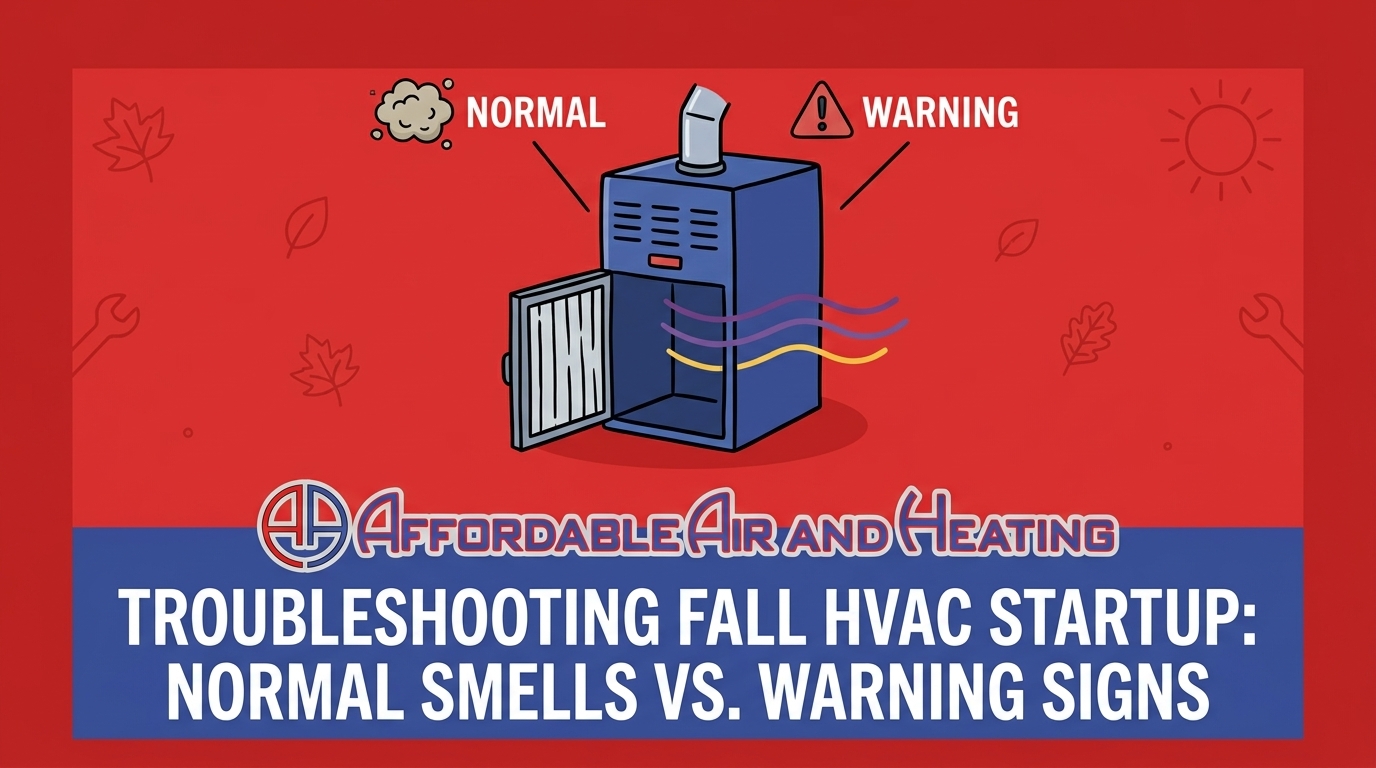
The Shock of the First Cold Night: Navigating Fall Heating Startup
Your thermostat registers a chilly 45 degrees, but when you switch the system to heat for the first time this season, a sharp, burning odor fills the hallway. Mastering home maintenance tips and troubleshooting begins with distinguishing between a harmless seasonal quirk and a serious mechanical hazard. At Affordable Air and Heating, our team typically sees a massive surge in service calls the morning after the first major temperature drop. The rapid shift from a warm fall afternoon to a near-freezing night puts immediate stress on a system that has been sitting dormant for months. Navigating an October heating-startup means understanding exactly how your equipment reacts to that sudden demand.
While air conditioning maintenance and cooling services are typically top-of-mind during the sweltering summer months, transitioning to professional HVAC services for your heating system requires equal vigilance. That strange smell from your furnace is not going to resolve itself without at least a basic understanding of what is happening inside the cabinet. Homeowners are often left at a critical decision point: knowing whether to ignore these initial signs as normal operational behavior or to call our team for professional intervention before a minor quirk becomes a major system failure.
The sudden shift in weather patterns exposes underlying wear and tear that accumulated during the cooling season. When a warm day abruptly turns into a freezing night, your heating system is forced to roar to life and rapidly raise the indoor temperature. This immediate thermal stress highlights every vulnerability in the system. By learning to identify the specific symptoms of a struggling heater, you can protect your home, ensure your family's comfort, and avoid the stress of an unexpected breakdown during the first major cold snap of the year.
How Summer Desert Conditions Set the Stage for Fall HVAC Issues
To understand why your heater is struggling in the fall, you have to look at what it endured over the summer. Extreme triple-digit heat forces the outdoor air conditioning unit and the indoor air handler to work overtime, placing massive mechanical stress on moving parts. In our years of servicing the Lancaster and Antelope Valley High Desert, we've seen firsthand how this heat is paired with heavy, blowing desert dust that infiltrates homes and HVAC systems alike. Over months of continuous operation, this fine particulate matter bypassed standard air filters and began coating the internal components of your ductwork and air handler.
The accumulation of blowing desert dust directly sets the stage for the symptoms you experience during your fall heating startup. When dust settles on the heat exchanger, it creates a physical barrier that the furnace must burn off when it ignites for the first time. Furthermore, investing in robust indoor air quality solutions during the summer can significantly mitigate this dust accumulation, preventing the severe buildup that leads to alarming smells and reduced efficiency in the fall.
The Hidden Toll of Blowing Dust on Blower Motors
The blower motor is the heart of your air distribution system, and it takes a severe beating from environmental dust. When fine desert sand and particulate matter coat the motor housing, it creates a dangerous insulating effect.
• Thermal insulation: Dust traps heat against the motor. Instead of dissipating thermal energy, the motor runs significantly hotter than its design specifications, accelerating component degradation.
• Bearing friction: Fine grit works its way into the sealed bearings of the motor. This increases friction, causing the motor to draw more electrical current just to spin the fan blade.
• Belt and pulley wear: For belt-driven systems, dust acts as an abrasive compound, slowly grinding away the rubber belts and scoring the metal pulleys.
This summer strain rarely causes a total failure in July. Instead, the weakened, dust-choked motor manages to limp across the finish line of summer, only to seize up or fail completely when asked to push heavy, cold air during the first freezing night of the fall.
Decoding the 'Burning Dust' Smell: What is Normal?
Every fall, one of the most frequent panicked calls our dispatchers receive involves a pungent burning smell spreading through the house during an October heating-startup. The science behind this odor is straightforward: the settled summer dust that coated your heat exchanger is now being subjected to intense heat. As the furnace burners ignite, that layer of organic particulate matter literally burns off the metal surface, sending a smoky, dusty scent through your supply vents.
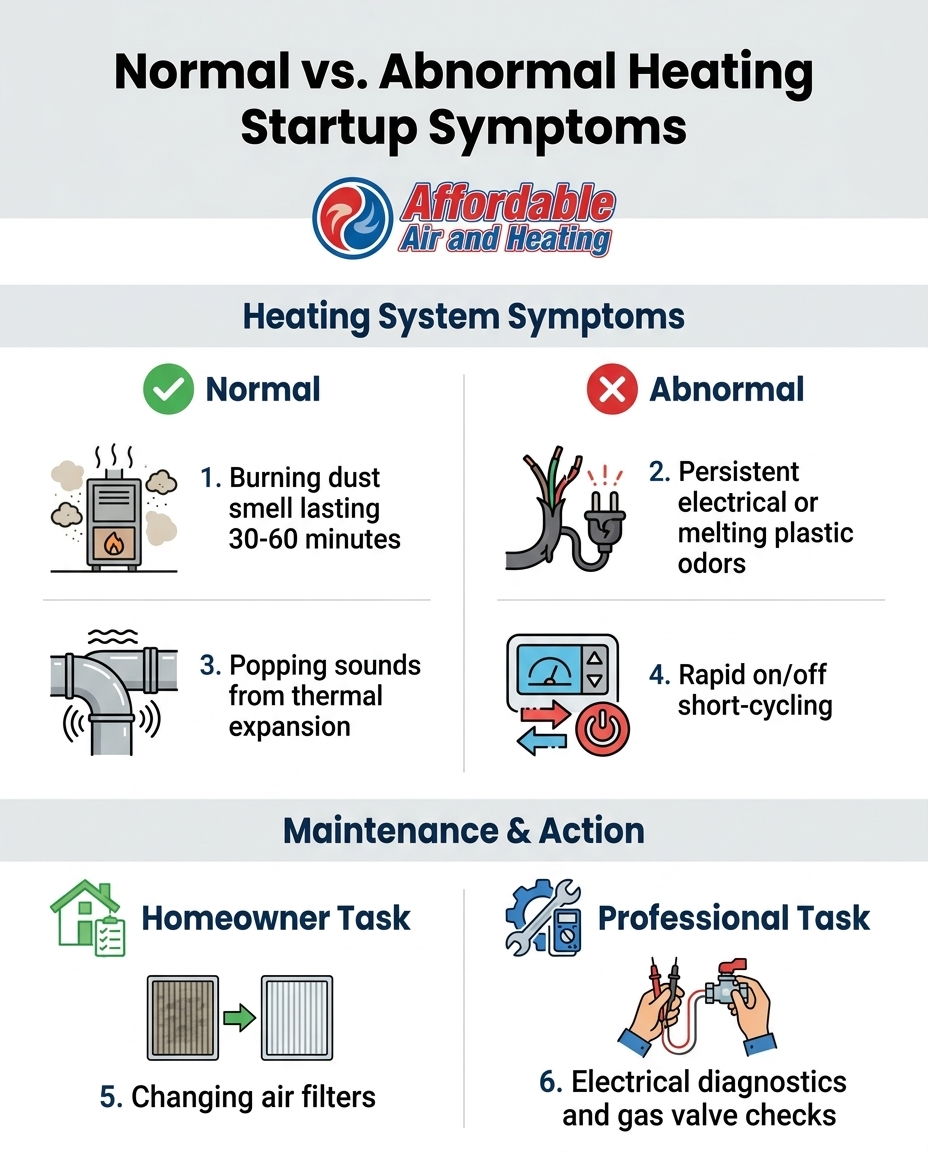
In a healthy system, this normal burning dust smell will dissipate relatively quickly. You can expect the odor to fade within 30 to 60 minutes of continuous operation. During this initial startup phase, it is entirely safe and highly recommended to ventilate your home. Open a few windows, turn on ceiling fans, and allow fresh air to circulate until the burn-off process is complete.
However, it is vital to contrast this normal dust burn-off with dangerous odors that require an immediate response. A musty, dusty smell is normal; the sharp tang of melting plastic, ozone, or electrical burning is not.
When to Turn Off the Unit Immediately
If the smell coming from your vents does not resemble burning dust, you must take immediate action to protect your home. Certain odors indicate a critical mechanical or electrical failure.
• Electrical burning or ozone: A smell resembling melting wire insulation, hot plastic, or a metallic "ozone" scent indicates an overheating electrical component, a failing circuit board, or a seized motor drawing too much amperage.
• Rotten eggs or sulfur: This is the universal warning sign of a natural gas leak. If you smell sulfur, shut the system down, leave the house immediately, and contact your utility provider.
• Visible smoke: While normal dust burn-off may create a slight haze, thick or dark smoke accompanied by unusual popping sounds means something inside the cabinet is actively burning.
If electrical or melting smells persist for more than a few minutes, shut down the heating system directly at the thermostat. Persistent, acrid smells warrant immediate professional diagnostics before the system is allowed to run again.
Short-Cycling vs. Normal Operational Noises
When you turn on the furnace, it is going to make noise. The key is understanding the difference between standard acoustic reactions and the mechanical distress signal known as short-cycling. The region's diurnal temperature variations—rapid drops from warm days to cold nights—cause significant thermal expansion and contraction in your metal ductwork. As the hot air hits the cold metal, the ducts expand, creating normal clicking, popping, and pinging sounds. These acoustic adjustments are harmless and expected.
Short-cycling, however, is a serious operational failure. Short-cycling occurs when the furnace rapidly turns on, fires up the burners, and then abruptly shuts off before the home ever reaches the temperature set on the thermostat. The system then waits a few minutes and repeats the process, endlessly looping through startup and shutdown phases without actually heating the house.
This rapid on-and-off behavior places immense mechanical strain on the system. The ignition sequence is the most stressful part of a furnace's operational cycle. When a system short-cycles, it multiplies that stress tenfold, leading to premature failure of the igniter, the blower motor, and the heat exchanger. Common causes of short-cycling include severely clogged air filters that choke off airflow, causing the system to overheat and trip its internal safety limit switch. A failing fan motor that cannot push enough air out of the cabinet will also trigger this protective shutdown.
• Occasional popping or pinging — Typical Cause: Thermal expansion of cold metal ductwork — Action Required: None (Normal operation)
• Rapid clicking at the thermostat — Typical Cause: Failing relay or weak thermostat batteries — Action Required: Replace batteries; monitor for changes
• System turns off after 2-3 minutes — Typical Cause: Short-cycling due to overheating or airflow restriction — Action Required: Check air filter immediately; call a professional if clean
• Loud grinding or metal-on-metal squealing — Typical Cause: Failing blower motor bearings — Action Required: Turn off system to prevent catastrophic motor failure
Why DIY Troubleshooting Ends Where the Cabinet Opens
In an era of endless online tutorials, it is tempting to try and fix a struggling furnace yourself. However, it is crucial to establish firm boundaries for safe homeowner maintenance. While changing air filters, replacing thermostat batteries, and keeping the outdoor unit clear of debris are excellent homeowner tasks, diagnosing internal electrical or gas components is highly dangerous.
Modern HVAC diagnostics require specialized tools, multi-meters, manometers, and rigorous safety training. The internal cabinet of your furnace contains high-voltage electrical connections, sensitive circuit boards, and pressurized natural gas lines. Mishandling any of these components can result in severe injury, fire, or catastrophic damage to the equipment. Knowing how to tell if your AC contractor is actually licensed and insured is the first step in protecting your investment before allowing anyone to open up your system.
A true professional brings comprehensive diagnostics to the table, replacing guesswork with precise measurements. Furthermore, a reputable technician treats your property with respect during these dirty maintenance tasks. You should expect your technician to utilize drop cloths and wear shoe covers on every service call, ensuring that the heavy desert dust from inside your ductwork doesn't end up tracked across your living room carpet.
The Risks of Internet DIY Fixes
Following generic online tutorials for specific mechanical failures is a gamble you cannot afford to take with your home's primary heating source.
• Voided warranties: Most major HVAC manufacturers explicitly state in their warranty documentation that repairs must be performed by a licensed professional. Attempting to bypass a safety switch or splice a wire yourself can instantly void your coverage.
• Misdiagnosed root causes: An internet video might tell you to replace a tripped limit switch, but it won't tell you why the switch tripped. If you replace the safety switch without fixing the underlying airflow restriction, the system will continue to overheat, potentially cracking the heat exchanger.
• Safety hazards: Natural gas valves require precise calibration. An improperly adjusted gas valve can lead to incomplete combustion, which produces deadly carbon monoxide gas that can back-draft into your living space.
Essential Pre-Winter Maintenance Tasks for Homeowners
Before the deep cold arrives, there are several actionable, safe maintenance steps you can take to prepare your system for an October heating-startup. Based on the hundreds of fall tune-ups our team performs across Lancaster each year, these proactive measures ensure that when you finally need the heat, the system has the best possible chance of operating efficiently.
1. Check and replace the air filter: This is the single most important task a homeowner can perform. A dirty, clogged filter is a leading cause of system inefficiency and short-cycling. Locate your filter housing, check the MERV rating, and ensure the directional airflow arrows point toward the furnace. If the filter is dark gray and coated in summer dust, replace it immediately.
2. Clear debris from the outdoor unit: Even though the furnace operates indoors, heat pump systems rely on the outdoor condenser. Clear away fallen leaves, overgrown brush, and accumulated summer dust from the perimeter of the outdoor unit to ensure proper airflow across the coils.
3. Inspect indoor vents and registers: Walk through every room in your home and verify that the supply and return vents are fully open. Ensure that heavy furniture, thick rugs, or long curtains are not blocking the airflow. Closing vents in unused rooms actually increases static pressure and makes the blower motor work harder.
4. Test the thermostat functionality early: Do not wait for a freezing night to test your heater. Pick a mild morning, switch the thermostat to "Heat," and raise the temperature a few degrees above the room ambient. Listen for the system to ignite, verify that warm air is blowing from the registers, and then turn it back down. Finding an issue at 10:00 AM gives you time to react; finding it at 10:00 PM leaves you in the cold.
Securing System Reliability Before the Deep Freeze
Transitioning from basic troubleshooting to proactive professional maintenance is the best way to secure your home's comfort. A professional pre-winter inspection is designed specifically to catch the summer wear and tear that goes unnoticed by the untrained eye. Technicians clean the flame sensor, inspect the heat exchanger for microscopic cracks, calibrate the thermostat, and test the amperage draw on the blower motor.
The value of this maintenance extends far beyond basic reliability. According to Department of Energy data, proper, consistent HVAC maintenance can reduce energy consumption by up to 15%. When your system is clean, lubricated, and properly calibrated, it doesn't have to burn as much fuel or draw as much electricity to heat your home. Homeowners may also find that qualifying high-efficiency upgrades or maintenance services can make them eligible for generic utility incentive programs or federal tax credits—we always recommend verifying current programs with your utility provider or a tax professional.
Prompt professional intervention prevents minor issues—like a struggling, dust-choked motor—from escalating into total, expensive breakdowns. If you hear a strange noise or smell an unusual odor, having a licensed expert evaluate the system immediately saves you money in the long run. We maintain comprehensive availability across all the areas we serve in the Antelope Valley, ensuring that our community has access to timely, thorough seasonal tune-ups before the Lancaster / Antelope Valley High Desert winter fully sets in.
Prepare Your Home for a Comfortable Fall
The transition into colder weather shouldn't be a source of anxiety. True peace of mind comes from knowing your heating system has been professionally inspected, cleaned, and calibrated to handle whatever the season brings. Distinguishing between a normal burning dust smell and a serious mechanical issue empowers you to make smart decisions for your home.
We encourage you to schedule your seasonal tune-up before the severe winter weather arrives and appointment times become scarce. Proactive care not only ensures your family's immediate comfort but significantly extends the overall lifespan of your expensive HVAC equipment. Take the time to prepare your home today, so you can enjoy a warm, reliable, and comfortable fall season.
Frequently Asked Questions
Why does my heater smell like burning dust when I turn it on?
This odor is caused by settled dust burning off the heat exchanger. Over the long summer months, fine particulate matter accumulates inside your furnace cabinet. When the burners ignite for the first time in the fall, this dust gets incinerated, sending a smoky smell through the vents. The smell is normal and should dissipate entirely within 30 to 60 minutes of continuous operation.
What causes a furnace to short cycle?
Short-cycling is frequently caused by a severe restriction in airflow that forces the system to overheat. When a dirty air filter blocks air from moving through the cabinet, the internal temperature spikes, triggering a safety limit switch that shuts the furnace down prematurely. Other common culprits include an oversized furnace, a failing blower motor, or a malfunctioning thermostat.
What should I check before turning on the furnace for winter?
Start by inspecting and replacing your indoor air filter to ensure maximum airflow. Next, walk through your home to verify that all supply and return vents are open and unobstructed by furniture or rugs. Finally, test the system early in the day by raising the thermostat a few degrees to confirm it ignites and blows warm air before the nighttime cold sets in.
How do you troubleshoot a furnace that won't turn on?
The first step is to verify that the thermostat is set to "Heat" and the temperature is set higher than the current room ambient. Next, check your home's electrical panel for a tripped breaker and ensure the physical power switch mounted on the side of the furnace is flipped to the "On" position. If the filter is clean and the power is on but the system remains unresponsive, you need to call a licensed professional.
When should I call a professional for heating issues?
You should contact an expert immediately if you smell electrical burning, melting plastic, or sulfur (natural gas) coming from your vents. Additionally, if the system is short-cycling rapidly, making loud grinding noises, or failing to reach the set temperature on the thermostat, professional diagnostics are required. Never attempt to repair internal gas or electrical components yourself.
How does blowing desert dust affect my HVAC system's efficiency?
Fine desert dust acts as a thermal insulator and a mechanical abrasive inside your system. When it coats the blower motor, it traps heat and causes the motor to draw more electricity to function. Furthermore, dust buildup on the heat exchanger restricts heat transfer, meaning the furnace has to burn more fuel for longer periods just to warm the air passing through the ducts.