Why We Measure Your Windows Before Recommending a Heating Capacity
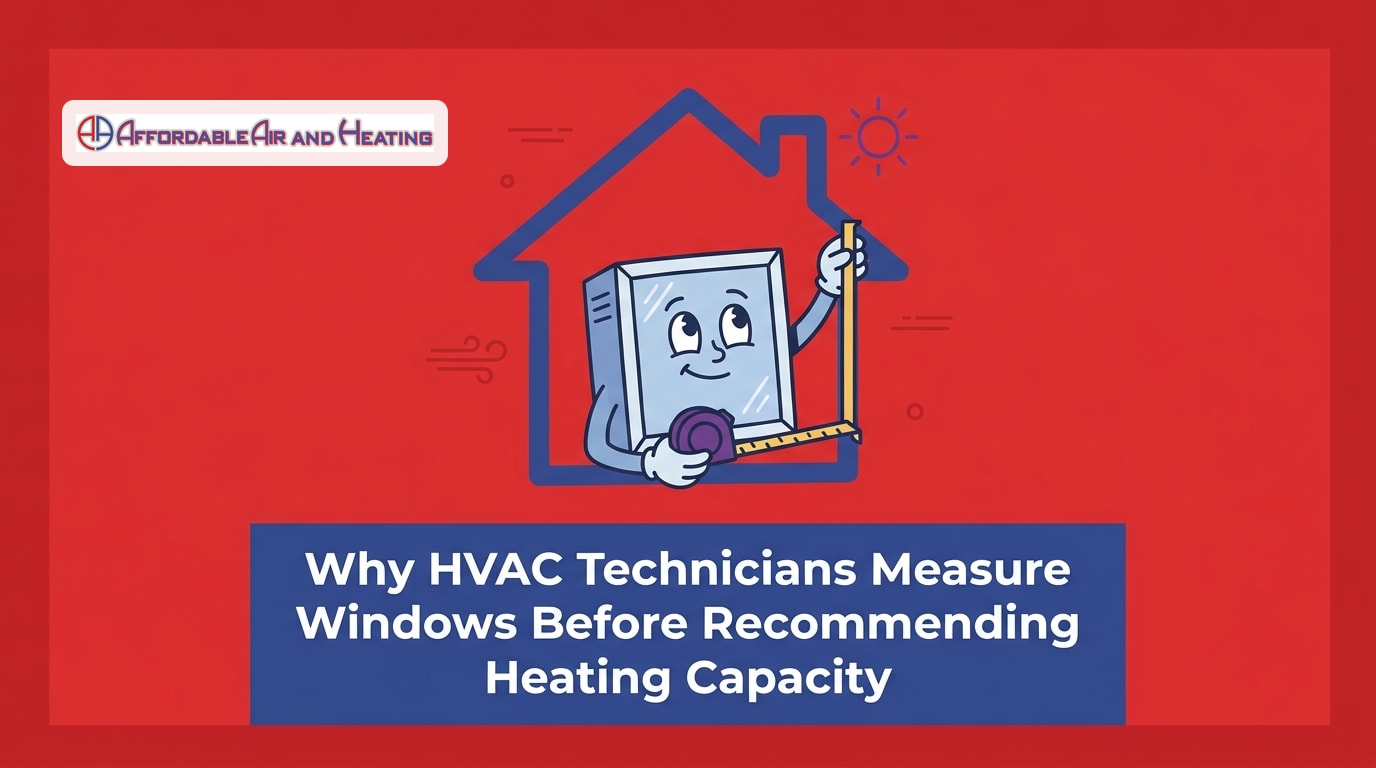


Why Is My HVAC Contractor Measuring My Windows?
At Affordable Air and Heating, we are frequently asked why our technicians pull out a tape measure instead of just looking at the old furnace's data plate. When it comes to measuring windows for heating capacity, you are actually looking at the foundation of an accurate, custom-fit system. As homeowners in Lancaster prepare for the late fall temperature drops this November 2026, you might wonder why our team meticulously logs your glass dimensions while other contractors simply jot down a few notes based on your home's square footage.
Many homeowners face the frustrating problem of receiving generic replacement quotes that completely ignore the severe heat loss occurring through glass. When a technician only checks the label on your broken furnace, they are assuming the previous installer got the sizing perfectly right decades ago. The critical decision point you face is whether to trust a contractor who simply matches the old unit's BTU rating, or one who performs proper, modern heat load diagnostics.
Windows are essentially giant thermal holes in your home's insulation envelope. Failing to account for their size, type, and direction means guessing at your home's true heating needs. For top-tier professional HVAC services, accurate diagnostics are everything. Our thorough contractors measure your windows because it is the only verifiable way to ensure your new heating system will keep you comfortable during the coldest nights of the year without wasting energy.
The Square Footage Myth vs. Proper Heat Load Diagnostics
In our decades of experience serving the Antelope Valley, we have found that the heating and cooling industry relied far too long on a simple, outdated "rule of thumb." A contractor would take the total square footage of your house, multiply it by a generic number, and use that result to pick a furnace size. While this method is fast, our team knows firsthand that it is incredibly inaccurate.
In many 1980s and 1990s tract homes across Lancaster, older furnaces were routinely oversized to compensate for drafty construction, poorly sealed ductwork, and single-pane glass. If a modern technician replaces your system "like for like" without running new calculations, they are simply perpetuating an old error. Up to 30% of a home's heating and cooling energy use is tied directly to window heat loss and gain. Ignoring that massive variable leads to poorly performing equipment.
Today, the industry standard we follow is the Manual J load calculation. This mathematical formula takes every aspect of your home's construction into account, replacing guesswork with hard science. When you are understanding furnace AFUE ratings and efficiency levels, you must also understand that even the most highly-rated 96% AFUE furnace will perform poorly if it is the wrong size for your home's specific thermal profile.
• Accuracy — Square Footage Guess (Rule of Thumb): Low. Assumes all homes are built exactly the same. — Manual J Load Calculation: High. Customized to your home's specific construction.
• Window Accounting — Square Footage Guess (Rule of Thumb): Completely ignored. — Manual J Load Calculation: Measures size, framing material, and glazing type.
• Directional Heat — Square Footage Guess (Rule of Thumb): Treats north and south-facing rooms identically. — Manual J Load Calculation: Calculates solar heat gain based on compass direction.
• Long-Term Result — Square Footage Guess (Rule of Thumb): Often leads to oversized, short-cycling equipment. — Manual J Load Calculation: Results in perfectly sized, highly efficient heating.
Especially during late fall and freezing winter nights, the flaws of the square footage myth become glaringly obvious. Rooms with large picture windows will feel like iceboxes, while interior rooms become stiflingly hot. Proper diagnostics eliminate these uncomfortable temperature imbalances.
The Mechanics of Heat Loss Through Glass
To understand why our technicians spend so much time evaluating your glass, you have to look at the mechanics of thermal boundaries. A thermal boundary is the barrier between the conditioned air inside your home and the unconditioned air outside. Your walls, filled with thick fiberglass or blown-in insulation, do an excellent job of slowing down heat transfer. Glass, however, is the weakest link in that boundary.
Even the most expensive, highly rated windows insulate far less effectively than a standard exterior wall. Heat naturally moves from warmer areas to colder areas. When the temperature drops in the Lancaster and Antelope Valley regions, the expensive heat generated by your furnace immediately starts trying to escape through your windows.
Here is how our calculation process breaks down:
1. Measuring Total Glass Area: We calculate the exact square footage of glass in every single room to determine the total surface area vulnerable to heat loss.
2. Evaluating Frame Materials: Standard aluminum frames—common in older local neighborhoods—conduct heat rapidly, pulling warmth out of your house, while vinyl or wood frames act as better insulators.
3. Checking Glazing Types: Single-pane glass offers almost no resistance to heat transfer, whereas double-pane glass with argon gas fills slows the process down significantly.
4. Mapping Orientation: The compass direction each window faces dictates how much passive solar heat the room receives during the day.
Understanding U-Factor in Heat Retention
When an Affordable Air and Heating professional inputs your window data into a load calculation program, one of the most critical metrics is the U-factor. The U-factor measures the rate of heat transfer through a window. Unlike insulation, where a higher R-value is better, a lower U-factor means the window is better at keeping heat inside your home.
A home with standard 1970s single-pane windows might have a very high U-factor around 1.0 to 1.2, meaning the furnace has to work overtime to replace the heat constantly bleeding through the glass. Upgrading to modern double-pane windows can drastically lower that U-factor below 0.30 in a Manual J calculation, which often means we can install a smaller, more efficient heating system for you.
Solar Heat Gain Coefficient (SHGC)
The Solar Heat Gain Coefficient (SHGC) measures how much solar radiation passes through your windows and becomes heat inside your home. During the winter months, sunlight acts as a passive heater.
A room with massive, south-facing windows will absorb a significant amount of solar heat during daylight hours. Because of this natural boost, that specific room requires less supplemental heating capacity from your furnace. Conversely, a north-facing room with the exact same square footage will receive almost no direct sunlight, meaning it requires more BTUs from the HVAC system to stay warm. This is exactly why measuring windows and noting their orientation is non-negotiable for our team when sizing equipment.

Why Severe Temperature Swings Demand Exact Thermal Boundaries
Generic heating rules might survive in mild, highly predictable climates, but they fail miserably in environments with extreme weather patterns. The high desert climate requires a much more rigorous approach to HVAC sizing.
In the Lancaster and Antelope Valley areas, our technicians see firsthand how severe diurnal temperature swings impact residential comfort. It is not uncommon in late fall to experience a pleasant 65-degree sunny afternoon followed by a rapid, plunging drop to 30 degrees as soon as the sun goes down. This sudden shift puts an immense amount of stress on a home's thermal envelope.
The physics of heat transfer dictate that heat moves faster when the temperature difference between inside and outside is larger. When the outdoor temperature plummets to freezing at night, the rate of heat loss through your windows accelerates dramatically. If a contractor sized your heating system using a generic square-footage multiplier meant for a mild coastal city, your furnace will simply not be able to keep up with the rapid heat loss through the glass.
Precise window measurements protect homeowners from being left in the cold during these sudden temperature drops. By calculating exactly how much heat will escape through your specific windows at freezing temperatures, our professionals ensure your new system has the exact capacity needed to maintain a comfortable indoor climate, no matter how cold the high desert night gets.
The Hidden Dangers of Oversized Heating Equipment
When contractors skip the tape measure and guess at your home's heat load, they almost always err on the side of caution by installing a system that is too large. While having "extra power" might sound like a good thing, oversized heating equipment is actually one of the most destructive forces for your home comfort and your wallet.
We routinely find oversized 100,000 BTU furnaces crammed into local homes that truly only required 60,000 BTUs. Skipping precise load calculations is the root cause of this oversized equipment. At Affordable Air and Heating, we believe in honest, upfront diagnostics because taking the time to measure your home correctly prevents premature system failure and guarantees long-term reliability.
The Short-Cycling Dilemma
The most immediate symptom of an oversized furnace is a phenomenon called short-cycling. When a heating system is too large for the space, it blasts a massive amount of hot air into the home very quickly. The thermostat, usually located in a central hallway, registers that the target temperature has been reached and shuts the system down after only a few minutes.
Think of it like driving a car in heavy stop-and-go traffic versus cruising smoothly on the highway. Starting and stopping every five minutes puts incredible wear and tear on the system's moving parts. The blower motor burns out faster, and the heat exchanger undergoes rapid, constant thermal expansion and contraction, which can lead to dangerous stress cracks over time. A properly sized system, calculated using exact window measurements, will run in longer, gentler cycles that protect the equipment.
Compromised Indoor Comfort and Air Quality
Short-cycling doesn't just damage the furnace; it ruins your comfort. Because the system shuts off so quickly, the warm air never has time to reach the rooms furthest from the thermostat. You end up with a hallway that feels like a sauna and bedrooms that feel like iceboxes.
Furthermore, your HVAC system is responsible for filtering the air in your home. If the blower is only running for five minutes at a time, the air is not circulating through the filter long enough to remove dust, allergens, and pet dander. This lack of continuous air circulation severely degrades your indoor air quality. Investing in advanced indoor air quality solutions is only effective if your heating system is sized correctly and runs long enough to actually pull air through the filtration media.
What a Proper Manual J Calculation Looks Like
If you have never seen a comprehensive heat load calculation performed, you might not know what to expect when an Affordable Air and Heating professional arrives at your home. A true diagnostic visit is not a five-minute glance at the utility closet. It is a meticulous inspection of your home's entire thermal envelope.
Positioning the physical act of measuring windows during a quote as proof of honest, thorough diagnostics helps you separate true professionals from contractors who take shortcuts. A reliable technician will evaluate a wide range of variables to ensure your new system is perfectly matched to your home.
A thorough Manual J load calculation includes checking:
• Window Dimensions and Glazing: Measuring the exact square footage of all glass, noting whether it is single or double-pane, and checking for low-E coatings.
• Window Frame Materials: Identifying whether the frames are heat-conducting aluminum or insulating vinyl/wood.
• Attic and Wall Insulation: Checking the specific R-value (such as R-13 in walls or R-38 in attics) to see how well the house retains heat.
• Ceiling Heights and Room Volume: Heating a room with standard 8-foot ceilings requires far less energy than heating a room with 12-foot vaulted ceilings, even if the square footage is identical.
• Ductwork Condition: Inspecting the duct system for leaks, poor insulation, or sizing restrictions that could bottleneck airflow.
This meticulous process is the absolute only way to accurately size modern, high-efficiency equipment, including advanced heat pump systems that require precise airflow and load matching to operate at peak performance.
Frequently Asked Questions About HVAC Sizing and Heat Loss
Why does my HVAC contractor need to measure my windows?
Your contractor needs to measure your windows to calculate the exact amount of heat your home loses during the winter. Glass is a poor insulator compared to solid walls, and windows account for a massive portion of a home's thermal transfer. By measuring the windows, noting their direction for solar heat gain, and performing a Manual J calculation, our team ensures we do not install an oversized, short-cycling furnace.
How do you calculate heating capacity for a room with windows?
Heating capacity for a specific room is calculated by evaluating the room's total volume, the insulation in the surrounding walls, and the specific U-factor of the windows. A technician uses software to determine how many BTUs of heat will escape through that specific glass area at freezing temperatures. They also factor in the window's compass direction to account for any passive solar heat the room might receive during the day.
Do windows affect HVAC sizing?
Yes, windows drastically affect HVAC sizing. Because glass transfers heat much faster than insulated walls, a home with many large windows will require a larger heating capacity than a home of the exact same square footage with very few windows. Ignoring window size and type is the most common reason contractors accidentally install incorrectly sized equipment.
What is a Manual J calculation?
A Manual J calculation is the industry-standard mathematical protocol used to determine exactly how much heating and cooling a home needs. Instead of guessing based on square footage, a Manual J accounts for insulation levels, window sizes, ceiling heights, local climate data, and home orientation. It provides the exact BTU requirements needed to keep the home comfortable in extreme weather.
How much heat is lost through windows in winter?
Windows can account for 25% to 30% of a residential home's total heating and cooling energy use. The exact amount of heat lost depends heavily on the U-factor of the glass, whether the windows are single or double-pane, and the quality of the weatherstripping around the frames. Upgrading from single-pane to double-pane windows can significantly reduce this heat loss.
What happens if my furnace is oversized?
If your furnace is oversized, the system will short-cycle, meaning it turns on and blasts heat rapidly before shutting off just a few minutes later. This leads to severe temperature imbalances, with some rooms feeling too hot and others remaining freezing cold. Short-cycling also causes higher utility bills, poor indoor air quality due to lack of filtration time, and premature wear on critical components like the heat exchanger.
Secure a Reliable, Custom-Fit Heating Solution Before Winter
When you see an Affordable Air and Heating contractor measuring your windows during an estimate, you are witnessing a clear sign of professionalism, accuracy, and care. A clear explanation of how window size, type, and direction impact heat loss proves that measuring windows is the mark of a reliable, custom-fit heating installation rather than an unnecessary delay.
Exact measurements are the only way to prevent the long-term headaches, uneven temperatures, and high utility bills associated with oversized equipment. If you are preparing your home for the colder months, do not settle for a contractor who guesses your comfort needs based on outdated rules of thumb. Keep in mind that federal tax credits or local utility incentive programs may apply to qualifying high-efficiency installations, making it an excellent time to upgrade (we recommend checking with your utility provider or a tax professional for current program details).
Schedule a comprehensive estimate with our team and secure a professional heating system installation before the freezing weather sets in, ensuring your home remains perfectly warm all season long while perfectly measuring windows for heating capacity.