What Happens If You Ignore a Flashing Light on Your Furnace Board


That Blinking Light Is More Than a Simple Glitch
Here at Affordable Air and Heating, we get dozens of calls on that first chilly September night in the high desert when homeowners turn on the heat, only to find the system short-cycles and shuts down. When you look through the small viewport on the lower panel of your unit, you notice a red LED blinking in the darkness. In that moment of frustration, you might be wondering exactly what happens if you ignore a flashing light on your furnace board and simply flip the breaker to force the system back on.
The short answer is that ignoring this specific warning compromises the safety and functionality of your entire HVAC system. That blinking light is not an arbitrary power indicator or a minor electronic glitch. It is a deliberate, coded communication from the system's internal control board telling you that a critical safety parameter has been breached.
Many homeowners assume that a furnace operates like a simple space heater—you give it power, and it produces heat. In reality, modern heating equipment relies on a complex network of sensors and switches designed to prevent catastrophic failures, fires, and dangerous gas leaks. When one of these sensors detects an unsafe condition, the control board cuts the ignition sequence and flashes a specific code to tell you exactly what went wrong.
The False Comfort of a Hard Reset
The most common reaction to a malfunctioning furnace is to head straight for the electrical panel. Flipping the breaker off and back on will often clear the error code from the control board's memory. The furnace might even fire up and run for a few minutes, providing a false sense of security. However, our technicians will tell you this action does absolutely nothing to resolve the mechanical or airflow issue that triggered the safety shutdown in the first place.
By constantly resetting the system, you are forcing the equipment to operate under the very conditions it was desperately trying to avoid. Whether the heat exchanger is overheating or dangerous exhaust gases are failing to vent properly, ignoring the control board's warning allows a minor, repairable issue to escalate into severe permanent damage.
Decoding the Control Board: What Your Furnace Is Trying to Tell You
To understand why that light is flashing, it helps to understand how modern furnace control boards utilize LED sequences to indicate specific operational faults. In our years of serving homeowners across Lancaster CA and the Antelope Valley, we know how heavily our community relies on heating equipment when the sun goes down, and knowing the difference between normal operation and a fault code is the first step in protecting your home.
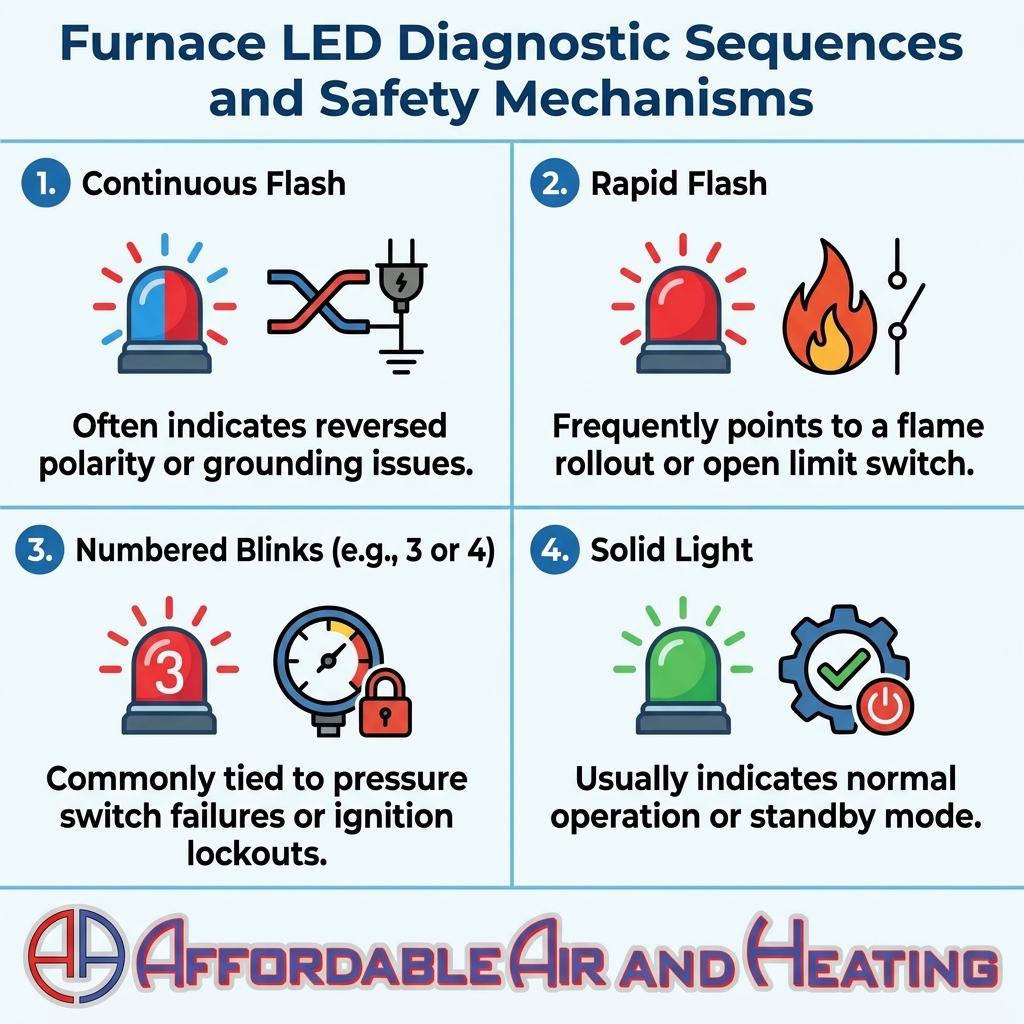
In most systems, a solid, non-blinking light indicates that the furnace has power and is either in standby mode or operating normally. The moment that light begins to blink, flash rapidly, or pulse in a specific numbered sequence, the system has entered a fault state or a lockout mode. These sequences are not random; they correspond directly to built-in safety mechanisms that monitor every phase of the heating cycle. If you are consistently seeing fault codes, it is time to call for professional heating repair services rather than attempting to bypass the system.
The Role of Safety Switches
Your furnace control board acts as the brain of the operation, but the safety switches act as the nervous system. The board relies on these switches to confirm that it is safe to introduce gas and spark an ignition.
• Limit Switches: These sensors monitor the internal temperature of the furnace. If the blower motor fails or a severely clogged air filter restricts airflow, the heat generated by the burners has nowhere to go. The internal temperature spikes rapidly. The limit switch detects this dangerous overheating and immediately shuts off the gas valve to prevent a fire or a cracked heat exchanger.
• Pressure Switches: Before the furnace ignites, a draft inducer motor turns on to push toxic exhaust gases (like carbon monoxide) out through the flue pipe. The pressure switch verifies that this draft is strong enough to safely vent the exhaust. If a bird's nest blocks the flue, or if the inducer motor fails, the pressure switch remains open, and the control board will refuse to light the burners.
• Flame Sensors: Once the gas valve opens and ignition occurs, the flame sensor must detect a steady flame within seconds. If the sensor is dirty or failing, it won't sense the fire, and the control board will shut the gas off immediately to prevent raw gas from flooding your home.
When any of these switches trip, the control board translates that specific failure into a unique blinking pattern, actively preventing the system from running under unsafe conditions.
The Hidden Danger of the 'Breaker Reset' Habit
Our technicians often see the results of homeowners getting desperate for overnight heat during rapid temperature drops in the high desert, which frequently leads to the dangerous habit of repeatedly resetting the furnace breaker. When you wake up freezing on the first chilly September night, the temptation to just make the machine work is incredibly strong. However, the mechanical reality of this habit is deeply concerning.
A breaker reset temporarily clears the error memory from the control board. It tells the furnace to forget that it just experienced a dangerous overheating event or a venting failure and commands it to try again. The furnace complies, firing up the burners and attempting to heat the home. Because the root cause—such as a failing blower motor or a blocked vent—has not been fixed, the system will inevitably reach that dangerous threshold again and shut down.
The Anatomy of a Forced Reset
Every time you force the system to run through a compromised cycle, you subject the internal components to extreme stress. For example, if the limit switch is tripping due to overheating, forcing the furnace to run repeatedly causes the metal heat exchanger to expand and contract under excessive temperatures. Over time, this metal fatigue leads to stress fractures.
Overriding these safety mechanisms can lead to severe overheating, risking permanent damage to critical components. What might have started as a simple need for a new air filter or a minor sensor cleaning can quickly turn into the need for a complete system replacement. Furthermore, DIY electrical resets are never a substitute for a proper mechanical diagnosis. The safety switches are there to protect your property and your family; treating them as an annoyance to be bypassed is a severe safety hazard.
Common Diagnostic LED Sequences and Their Meanings
While every manufacturer has a slightly different diagnostic code index (usually located on the inside of the blower compartment door), our team typically sees common patterns across major brands that help identify what the control board is communicating. Understanding these sequences satisfies the immediate need to know what is wrong, even though executing the repair requires a licensed professional.
1. Continuous Flash: A steady, continuous blinking light often points to an electrical issue rather than a mechanical failure. This frequently indicates reversed polarity or a grounding issue in the electrical supply to the furnace. It means the control board is not receiving clean, properly oriented power.
2. Rapid Flashing Sequences: Fast, erratic flashing frequently indicates a critical safety breach, such as a flame rollout or an open limit switch. A flame rollout occurs when the burner flames spill backward out of the combustion chamber, usually due to a blocked flue or a cracked heat exchanger. This is an immediate fire hazard.
3. Numbered Blink Codes: Most specific faults are communicated through a series of slow blinks followed by a pause (e.g., 3 blinks, pause, 3 blinks). For instance, 3 blinks commonly tie to pressure switch failures, indicating that the system cannot safely vent exhaust gases. A sequence of 4 blinks often points to an ignition lockout, meaning the system tried to light the burners multiple times and failed.
While knowing the code is helpful for understanding the severity of the problem, fixing it safely is another matter entirely. Our team cannot stress enough that ignoring a code pointing to safety risks like a cracked heat exchanger can have devastating consequences for indoor air quality. Always rely on a licensed technician to ensure safety protocols are met.
Understanding Hard Lockouts: When the Furnace Shuts Down for Your Safety
When a furnace experiences a fault, it typically enters a "soft lockout." During a soft lockout, the system shuts down temporarily, waits for a predetermined period (often an hour), and then attempts to run again. If the underlying issue is still present and the system fails repeatedly, the control board escalates the situation to a "hard lockout."
A hard lockout is the control board's final defense mechanism after detecting repeated failures. During a hard lockout, the furnace will completely shut down and refuse to attempt another ignition cycle to prevent fire or gas hazards. The system essentially grounds itself, recognizing that whatever is wrong is too dangerous to ignore.
Just last season, our Affordable Air and Heating technicians responded to a homeowner in the region who experienced this firsthand during a particularly cold week under a freeze warning. Their heat stopped working entirely, and when our team assessed the system, we identified a bad relay that had caused repeated failures. Because the early warning signs were bypassed, the issue escalated into a total failure, ultimately requiring a complete HVAC system replacement to restore reliable heat.
The Consequences of Bypassing Lockouts
We see the consequences of ignoring board issues far too often. A bad relay, a failing draft inducer, or a coated flame sensor are all relatively straightforward issues for our technicians to resolve if caught early. However, when these issues are ignored, they escalate into total system failures right when you need heat the most. Homeowners in Lancaster CA and Antelope Valley know that losing heat in the middle of the night is more than an inconvenience. A hard lockout cannot (and should not) be bypassed by the homeowner; it requires a professional to clear the code and repair the mechanical root cause safely.
Why Bypassing Safety Switches Requires Professional Intervention
It is crucial to reinforce that step-by-step DIY repairs on control boards or safety switches are highly dangerous and go strictly against ASHRAE safety standards for residential heating equipment. The internet is full of tutorials on how to jump a pressure switch or bypass a limit switch to get a furnace running. Doing so removes the only barrier between a malfunctioning combustion appliance and a house fire.
When you schedule a diagnostic visit, you are paying for the expertise required to test and verify the entire combustion process safely. Affordable Air and Heating brings professional, reliable diagnostic expertise to fix the root cause safely, contrasting sharply with the severe risks of DIY resets.
What a Professional Diagnosis Actually Checks
• Electrical Limits: Technicians use multimeters to check the exact voltage and continuity across all safety switches, ensuring they are opening and closing at the correct temperature and pressure thresholds.
• Airflow Verification: Professionals measure the static pressure of the ductwork and the temperature rise across the heat exchanger to ensure the system is moving enough air to prevent overheating.
• Gas Pressure and Combustion: Technicians verify that the gas valve is delivering the precise amount of fuel required for clean, safe combustion, preventing raw gas buildup or excessive carbon monoxide production.
For our customers, the real value lies in the peace of mind that comes from knowing the root cause has been permanently resolved. Rather than just temporarily clearing a code and hoping for the best, a professional repair ensures your home in Lancaster CA and Antelope Valley remains safe and warm. The moment a persistent code appears, prompt evaluation by our team is the safest choice.
Addressing Warning Signs Before Peak Winter Demand
Addressing an ignored code is a vital part of pre-season preparation before the severe winter nights hit the high desert. In our experience, early fall is the most critical time to tackle short-cycling and diagnostic codes. When you turn the system on for the first time on a chilly September night, any flashing lights or unusual behaviors are early warning signs that the system is not prepared for the heavy workload of January and February.
Our technicians frequently see how ignoring a seemingly minor fault code in September can easily lead to a catastrophic breakdown during peak winter demand. A blower motor that is drawing too much amperage might only trip the limit switch occasionally during the mild fall weather. However, when the system is forced to run for hours at a time during a winter freeze, that struggling motor will fail completely, leaving you without heat during the worst possible weather.
The Value of Proactive Care
Proactive fall diagnostics allow our team to uncover underlying issues before they necessitate a complete, sudden system replacement. A thorough inspection of the control board and safety switches ensures that the furnace operates efficiently and safely. Note that if a major repair or replacement is needed, addressing it early allows time to explore financing options for unexpected replacements without freezing in the meantime. Making a calculated decision with our team in October is always better than making a panicked decision during a January blizzard.
Frequently Asked Questions About Furnace Error Codes
Why is the red light blinking on my furnace?
The blinking red light is a diagnostic code generated by your furnace's control board indicating a specific operational fault or safety issue. Instead of a simple power indicator, the board uses specific flash patterns (like rapid blinking or a set number of flashes) to communicate which safety switch has tripped. This could be anything from a dirty flame sensor to a blocked exhaust flue, and it serves as a warning that the system cannot operate safely.
Can I reset my furnace if the light is blinking?
While flipping the breaker or pressing the reset button will temporarily clear the code and restart the system, it is highly discouraged if you haven't fixed the underlying problem. Resetting forces the furnace to operate with compromised safety limits, which can lead to severe overheating or dangerous gas venting issues. A reset should only be performed after a qualified technician has diagnosed and repaired the mechanical fault.
Is a blinking furnace light dangerous?
The light itself is not dangerous; it is a vital safety feature designed to protect your home from danger. However, the underlying issue causing the light to blink can be very dangerous, potentially involving carbon monoxide leaks, flame rollouts, or extreme overheating. Ignoring the light or repeatedly bypassing the safety shutdown puts your property and family at significant risk.
What does a continuous flashing light on a furnace mean?
A continuous, steady flashing light usually points to an electrical supply issue rather than a mechanical breakdown within the furnace itself. The most common causes are reversed electrical polarity or a poor ground connection to the unit. Because this involves the main electrical supply, it requires immediate attention from a professional to ensure the control board isn't damaged by improper voltage.
How long does a furnace hard lockout last?
A hard lockout is an indefinite safety shutdown initiated by the control board after multiple consecutive failed ignition attempts or safety trips. Unlike a soft lockout, which may reset itself after an hour, a hard lockout requires manual intervention to clear. It is designed to completely disable the furnace until a professional technician can resolve the dangerous condition that triggered it.
Ensure Safe, Reliable Heat for Your Home
Understanding that the flashing light on your furnace board is a specific diagnostic code empowers you to make safe, informed decisions about your home comfort. By recognizing that these LED sequences are actively protecting your home from overheating and venting failures, you can avoid the dangerous habit of repeatedly resetting the breaker. Homeowners in Lancaster CA and Antelope Valley need dependable heating when the temperatures drop, and a professional diagnosis is the only way to ensure the furnace operates safely and efficiently all season long. Stop resetting the breaker, get the underlying mechanical issue resolved, and ensure your home stays warm by trusting Affordable Air and Heating to accurately decode and fix your system.