When Your Heat Pump Stops Cooling in the Antelope Valley's Brutal Summer Heat
If you're wondering why is my heat pump not cooling in extreme Antelope Valley heat, you're not alone — and the answer usually comes down to one of these common causes:
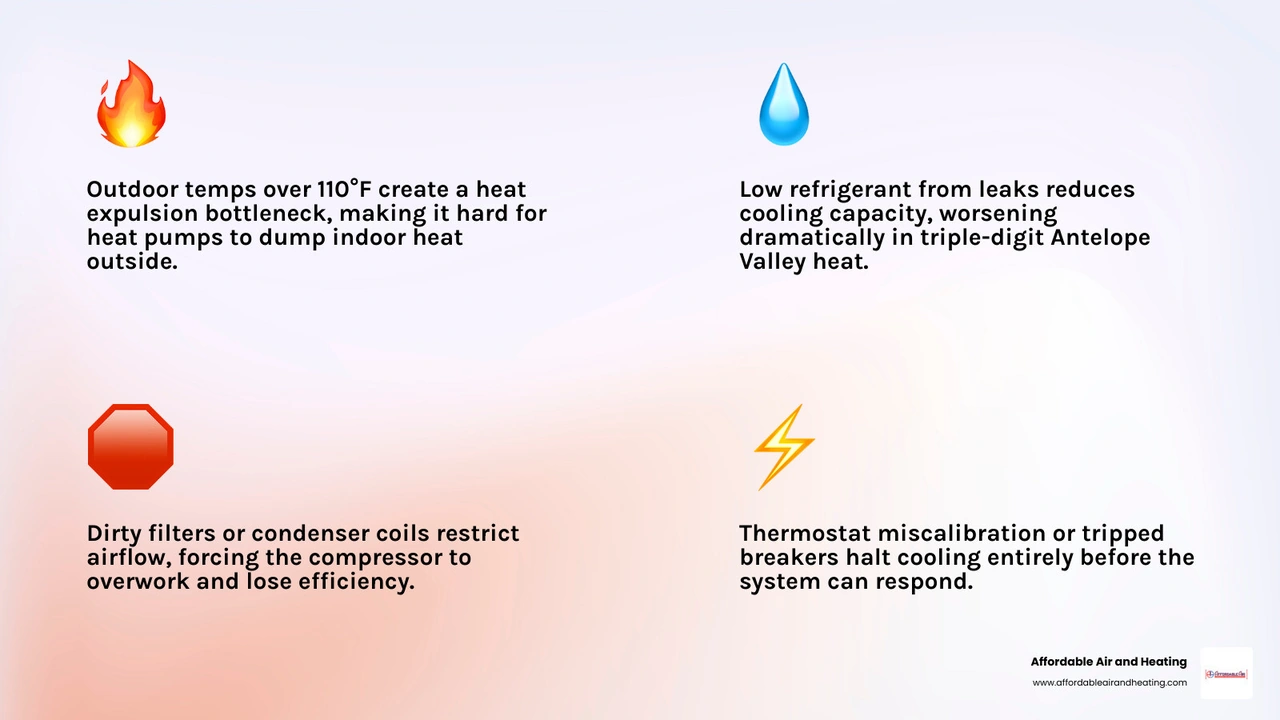
- Compressor overload – When outdoor temps push past 110°F, your compressor struggles to expel heat and may shut down entirely
- Low refrigerant – Leaks reduce cooling capacity, and the problem gets worse as temperatures climb
- Dirty air filters or condenser coils – Restricted airflow forces your system to work harder and cool less
- Thermostat or electrical issues – A miscalibrated thermostat or tripped breaker can stop cooling before it even starts
- Undersized system – A heat pump not properly sized for the Antelope Valley's extreme climate will never keep up on the hottest days
The Antelope Valley is no ordinary desert. Palmdale and Lancaster regularly hit 110°F or higher during peak summer months, and that level of heat puts every component of your heat pump under serious stress. Heat pumps cool your home by pulling heat from indoor air and pushing it outside — but when the outside air is already scorching, that process becomes much harder and much less efficient.
One homeowner found that their cool airflow dropped off completely during back-to-back triple-digit days. When a technician inspected the system, the culprit was a compressor that had overheated and shut itself down as a safety measure. It's a scenario that plays out across the high desert every summer.
Understanding what's going wrong is the first step toward fixing it — and in most cases, the problem is diagnosable and solvable.
Why Is My Heat Pump Not Cooling in Extreme Antelope Valley Heat?
To understand why is my heat pump not cooling in extreme Antelope Valley heat, we have to look at the physics of how these systems work. Unlike a furnace that creates heat, a heat pump simply moves it. In the summer, it acts like an air conditioner, absorbing heat from inside your home and dumping it into the outdoor air.
However, heat naturally wants to move from a hot area to a cold area. When it’s 113°F in Lancaster or Palmdale, your heat pump is trying to force heat into an environment that is already much hotter than the refrigerant inside the coils. This creates a "heat expulsion" bottleneck.
As we move through May 2026, we are seeing more systems hit their "thermal threshold." Most standard heat pumps are designed to operate efficiently up to about 95°F to 100°F. Once the mercury hits that 110-degree mark, the efficiency of the unit can drop by 20% to 40%. The compressor has to work twice as hard to compress the refrigerant enough to shed heat into the blistering desert air. This leads to:
- Compressor Strain: The heart of your system runs hotter and longer.
- Thermal Overload: Many modern units have safety switches that kill power to the compressor if it reaches a dangerous internal temperature.
- Continuous Running: You might notice your unit never turns off, yet the indoor temperature continues to rise.
If your system is currently struggling, our Heat Pump Services in Antelope Acres can help diagnose whether your unit is simply overwhelmed or if there is a mechanical failure.
Common Culprits Behind Cooling Failures in the High Desert
While the weather is a major factor, it’s often a combination of the heat and a secondary mechanical issue that causes a total cooling failure. In the high desert, dust and wind are just as much of an enemy as the sun.
Airflow Restrictions
Airflow is the lifeblood of your HVAC system. If air can’t move freely through your indoor and outdoor units, heat exchange cannot happen. We often find that Solving Heat Pump Airflow Issues is the quickest way to get a home back to a comfortable temperature. In our area, a dirty air filter can reduce airflow by up to 50%, which is a recipe for disaster when it’s 105°F outside.
Dirty Condenser Coils
Your outdoor unit (the condenser) is responsible for releasing heat. Because the Antelope Valley is prone to dust storms and high winds, the fins on your outdoor unit can become "carpeted" in dirt and debris. This layer acts like a thermal blanket, trapping heat inside the unit and preventing it from cooling down.
Refrigerant Leaks
Refrigerant is the medium that carries heat out of your home. If your levels are low—even by a little—the system loses its ability to absorb indoor heat. Signs of low refrigerant include a unit that runs constantly, higher-than-normal utility bills, and air that feels "cool" but not "cold." If you suspect a leak, you need professional Heat Pump Repair Antelope Acres to find and seal the breach before recharging the system.
Troubleshooting Why My Heat Pump Is Not Cooling in Extreme Antelope Valley Heat
Before you panic, there are a few simple things we recommend checking. Sometimes the solution is as simple as a flipped switch.
- Check the Thermostat: Ensure it is set to "Cool" and the fan is on "Auto." Sometimes a power flicker can reset a smart thermostat to a default "Heat" mode. Also, check the batteries; a weak battery can cause the thermostat to send erratic signals to the unit.
- Inspect the Breakers: Heat pumps have two power sources—one for the indoor air handler and one for the outdoor compressor. If the outdoor unit has tripped its breaker, the indoor fan will still blow air, but it won't be cold.
- Clear the Outdoor Unit: Visit our Antelope Acres Location page for tips, but generally, you should ensure there are at least two feet of clear space around your outdoor unit. Tumbleweeds, overgrown brush, or even a misplaced patio chair can block the air needed to shed heat.
- The Power Switch: Most outdoor units have a "disconnect box" nearby. Ensure the handle hasn't been bumped or the fuse hasn't blown.
If you’ve checked these and the air is still warm, you may be facing more complex Heat Pump Issues Canyon Country homeowners often experience during heatwaves.
Signs of Component Failure When Your Heat Pump Is Not Cooling in Extreme Antelope Valley Heat
When troubleshooting doesn't work, it’s time to look for signs of failed parts. Extreme heat accelerates wear and tear on electrical components.
- Capacitor Failure: This is the most common repair we see in the summer. The capacitor is like a big battery that gives the motor the "kick" it needs to start. High heat causes these to bulge and fail. If you hear a humming sound from the outdoor unit but the fan isn't spinning, it’s likely a bad capacitor.
- Reversing Valve Malfunction: This part tells the refrigerant which way to flow. If it gets stuck, your heat pump might accidentally stay in "Heat" mode even when you want cooling.
- Fan Motor Burnout: The outdoor fan motor works overtime to pull air through the coils. If it burns out, the compressor will overheat within minutes.
- Frozen Coils: It sounds counterintuitive, but your heat pump can actually freeze over in 110-degree heat. This usually happens due to a refrigerant leak or a severely clogged filter. If you see ice, turn the system off immediately and read our guide on Heat Pump Freezes Over What to Do to prevent permanent compressor damage.
For these technical repairs, it’s vital to call for HVAC Repair Antelope Acres rather than attempting a DIY fix, as handling refrigerant and high-voltage electricity requires specialized tools and training.
Long-Term Solutions for Reliable Desert Cooling
If your heat pump is older than 10 years and consistently fails every time the temperature tops 100°F, it might be time to look at long-term solutions. Not all heat pumps are created equal, and some are specifically designed for high-ambient environments.
| Feature | Standard Heat Pump | High-Ambient/Desert Model |
|---|---|---|
| Cooling Limit | Struggles above 100°F | Rated for 115°F - 125°F+ |
| Compressor | Single-stage (On/Off) | Variable-speed (Inverter) |
| Efficiency | Drops sharply in heat | Maintains SEER2 ratings better |
| Lifespan | 10-12 years in desert | 15+ years with maintenance |
Upgrading to a properly sized, high-efficiency unit via HVAC Replacement Antelope Acres can drastically reduce your summer stress. Beyond the unit itself, you should also Optimize Heat Pump Performance by:
- Adding Attic Insulation: If your attic is 140°F, your AC has to fight that heat through the ceiling.
- Duct Sealing: In many Antelope Valley homes, up to 30% of cooled air is lost in the attic through leaky ducts.
- System Sizing: A unit that is too small will run forever and never cool. A unit that is too large will "short cycle," which wears out the compressor. Our team specializes in precision Heat Pump Installation Antelope Acres to ensure your unit is a perfect match for your square footage.
Preventive Maintenance: Your Best Defense Against the Heat
We always say that an ounce of prevention is worth a pound of cure—especially when that "cure" involves sitting in a 95-degree living room waiting for a technician. In a desert climate, bi-annual tune-ups are not a luxury; they are a necessity.
During a professional Heat Pump Maintenance Antelope Acres visit, we do more than just look at the unit. We perform a multi-point inspection designed to Ensure Efficient Heat Pump Performance all summer long.
- Chemical Coil Cleaning: We wash away the baked-on desert dust that a garden hose can't reach.
- Drain Line Clearing: We clear the condensate drain to prevent water leaks and mold growth.
- Electrical Tightening: Heat causes wires to expand and contract, which can loosen connections and lead to electrical fires or component failure.
- Refrigerant Check: We ensure your levels are exact, which keeps the compressor running cool.
Choosing a local HVAC Company Antelope Acres means you're working with people who understand the specific challenges of our "High Desert" environment—from the wind-blown sand in Saugus to the extreme temperature swings in Rosamond.
Frequently Asked Questions about Desert Heat Pump Performance
Why is my heat pump blowing warm air when it is 110 degrees outside?
When it is 110°F outside, the temperature of the air being pulled across your outdoor coils can be even higher if the unit is in direct sun. If the compressor overheats, it will shut off, but the indoor fan will keep running. This results in the fan simply circulating the warm air from inside your home. It could also indicate a failed capacitor or a stuck reversing valve.
Can a heat pump effectively cool a home in the Antelope Valley summer?
Yes, but it must be properly sized and maintained. Modern high-efficiency heat pumps are more than capable of handling triple-digit heat. However, older models or units that haven't been serviced will struggle significantly once the temperature exceeds 105°F.
How often should I change my air filters during a 2026 heatwave?
In a standard climate, every 3 months is fine. In the Antelope Valley during a heatwave, you should check your filter every 30 days. The combination of high winds and the AC running 12-18 hours a day means filters clog much faster. A clean filter is the easiest way to prevent a system breakdown.
Conclusion
Dealing with a heat pump not cooling in extreme Antelope Valley heat is a stressful experience, but it doesn't have to be a permanent one. Whether it’s a simple filter change, a capacitor replacement, or a full system upgrade, understanding the unique demands of our desert climate is the key to staying comfortable.
At Affordable Air and Heating, we’ve been family-owned since 1996, serving our neighbors in Palmdale, Lancaster, Santa Clarita, and beyond. We pride ourselves on offering energy-efficient solutions and flexible financing to ensure every family in the valley can afford a cool home.
Don't wait for the next 115-degree day to find out your system can't keep up. If you need a reliable Heat Pump Service Antelope Acres, give us a call today. We’ll help you beat the heat and keep your home the oasis it’s meant to be.