When to Call a Technician for an AC That Won't Shut Off
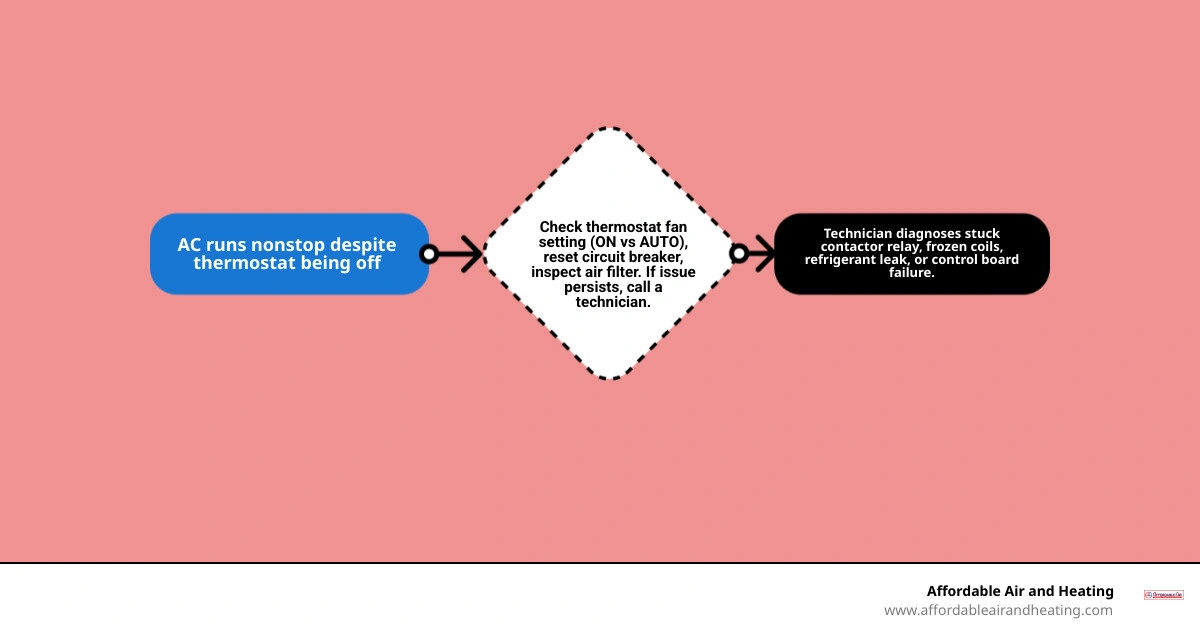
Knowing when to call a technician for an AC that will not shut off could save you from a sky-high electric bill — or a burned-out compressor. If your AC is running nonstop right now, here are the situations that mean it's time to stop troubleshooting and pick up the phone:
Call an HVAC technician immediately if:
- The outdoor unit keeps running even after you disconnect or turn off the thermostat
- The indoor fan shuts off but the outdoor condenser unit stays on
- You notice ice forming on the outdoor unit or refrigerant lines
- The AC is running constantly but no longer cooling your home
- You smell burning or hear unusual electrical sounds from the unit
- The circuit breaker trips when you try to shut the system down
Try these DIY steps first if:
- The fan is running but set to ON instead of AUTO on the thermostat
- A simple circuit breaker reset restores normal cycling
- A clogged air filter is the only visible issue
Here in the Antelope Valley, summer temperatures regularly push past 100°F, and an AC that refuses to shut off isn't just annoying — it's a system under serious stress. A constantly running unit can add significantly to your monthly electric bill, and left unchecked, it can lead to compressor damage that turns a simple repair into a full replacement. Some homeowners describe it as a "zombie air conditioner" — a system that ignores every command you give it and just keeps running. The cause is almost always one of a handful of specific failures, ranging from a simple thermostat setting to a physically welded electrical relay inside your outdoor unit.
I'm Vito, and in this guide I'll walk you through exactly how to identify what's wrong and when it's time to call a professional.
Basic when to call a technician for an ac that will not shut off vocab:
- Is It Normal for AC to Run Nonstop When Temperatures Exceed 100 Degrees
- Undersized AC Unit Signs and Problems in a Hot Desert Climate
- AC Running Constantly in Desert Heat
Why Won't My AC Shut Off Even When the Thermostat Is Turned Off?
It is incredibly frustrating when you walk over to your thermostat, switch it to "OFF," and yet you still hear the low rumble of your outdoor unit or the continuous rush of air from your vents. When a system completely ignores a direct shut-off command, it means the electrical path that delivers power to your system is staying closed when it should be open.
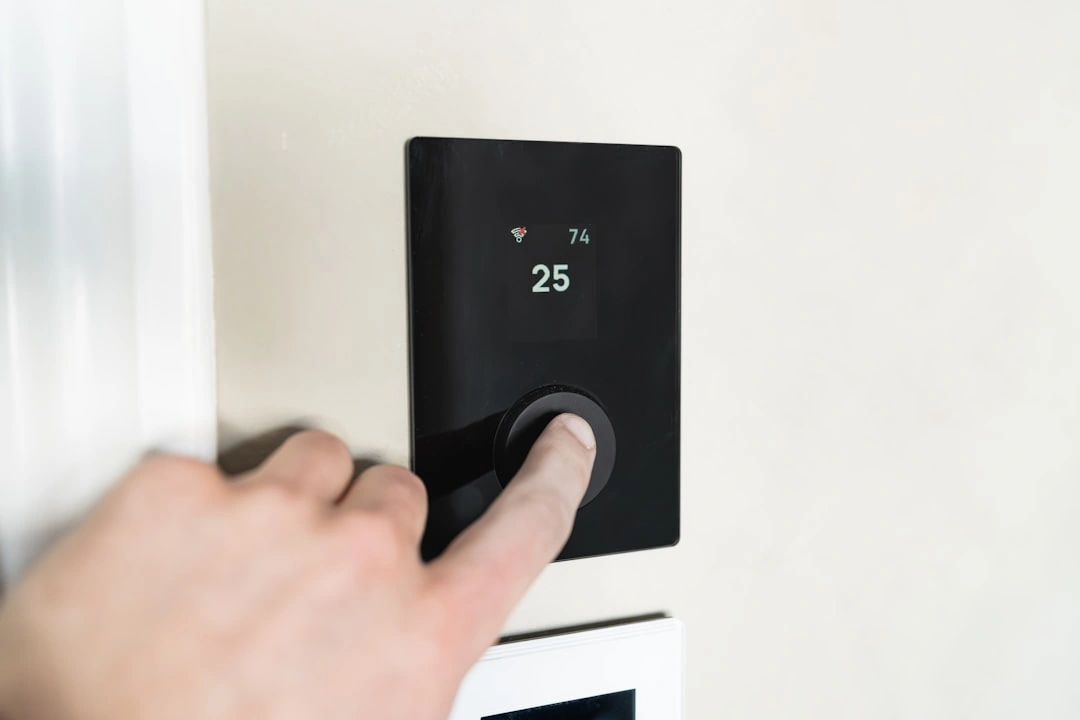
To understand why this happens, we have to look at how your cooling system communicates. Your thermostat acts as the brain, sending low-voltage control signals (typically 24 volts) to the indoor air handler and the outdoor condenser. When these signals are interrupted or stuck, the system suffers from a communication breakdown.
If your thermostat is completely off but the air conditioner is still chugging along, the root cause is usually a physical component downstream that has seized, an electrical short circuit, or a control board glitch. Before you panic, checking the basic settings can rule out simple human error. If the settings are correct, you are likely dealing with a hardware issue that requires professional diagnostic tools.
To help narrow down the problem, read through our comprehensive guide on Thermostat Not Responding to AC Settings: What to Check.
Thermostat Settings vs. Mechanical Failure
Sometimes, the issue isn't a broken component but an overlooked setting. The first thing we always tell homeowners in Lancaster, CA, or Palmdale, CA, to check is the fan setting.
Your thermostat has a setting for the fan, usually labeled ON and AUTO:
- ON: This setting tells the indoor blower fan to run 24/7, completely independent of whether the system is actively cooling. If you have your thermostat set to "OFF" or if the target temperature has been met, but the fan is set to "ON," the indoor fan will never stop blowing.
- AUTO: This setting ensures the fan only runs when the compressor is actively cooling your home. Once the set temperature is reached, the entire system shuts down.
If switching the fan to AUTO doesn't stop the air, or if the outdoor unit continues to run while the indoor fan is off, you are looking at a mechanical or electrical failure.
Another common culprit is a faulty temperature sensor or thermistor. Inside your thermostat or on your indoor unit's control board, these sensors measure the temperature of the air. If the sensor fails or goes out of calibration, it may think your home is 90°F when it is actually a comfortable 72°F. Because it "thinks" the house is hot, it will keep sending a cooling signal indefinitely.
To help you rule out other basic issues before making a service call, take a look at our step-by-step checklist on AC Troubleshooting Before Calling a Pro. Also, keep in mind the "3-minute rule" built into most modern systems. This is a safety delay designed to prevent the compressor from restarting too quickly and suffering damage from rapid cycling. If you just turned the system off, wait at least three to five minutes to see if it shuts down naturally.
Low-Voltage Wiring and Control Board Issues
If your thermostat settings are correct and you've even tried physically removing the thermostat faceplate from the wall, but the system still won't shut off, you are likely dealing with a low-voltage wiring short or a control board failure.
Your thermostat is connected to your indoor unit by a bundle of thin, low-voltage wires. The yellow wire (typically labeled 'Y') carries the signal that tells your outdoor compressor to turn on. If a rodent in your attic or crawlspace has chewed through the wire insulation, or if the wires have rubbed together over time, the yellow wire can make direct, permanent contact with the red power wire ('R'). This creates a permanent short circuit, sending a constant 24V cooling signal to your system even if the thermostat is completely disconnected from the wall!
Similarly, modern HVAC units rely on electronic control boards to coordinate operations. A control board glitch, a stuck solid-state relay on the board, or damage from a desert lightning storm can lock the cooling circuit in the "closed" position. When this happens, the control board continues to distribute high-voltage power to your blower motor or compressor. In some cases, performing a complete system power reset at your breaker box can clear these temporary logic errors, but persistent wiring shorts will immediately cause the system to start running again as soon as the power is restored.
When to Call a Technician for an AC That Will Not Shut Off
While checking your thermostat settings and air filters are perfectly safe DIY tasks, there is a strict safety boundary when it comes to the electrical and mechanical components of your air conditioner. Central air conditioners run on high-voltage electricity (typically 240 volts), which can be extremely dangerous.
Attempting to open electrical panels, test live capacitors, or handle internal wiring without professional training can result in severe electrical shock, system short circuits, or even house fires. Furthermore, handling refrigerant requires specialized EPA certification by federal law.
If your basic troubleshooting does not solve the problem, it is time to look at the Signs You Need AC Repair and call in a professional. If you reside in the Antelope Valley and find yourself dealing with an unstoppable system during a triple-digit heatwave, you can reach out for Emergency Heat and Air Repair Lancaster to get your home back to a safe temperature quickly.
Stuck Contactor Relays: When to Call a Technician for an AC That Will Not Shut Off
The single most common mechanical reason an outdoor AC unit refuses to shut off is a stuck contactor relay.
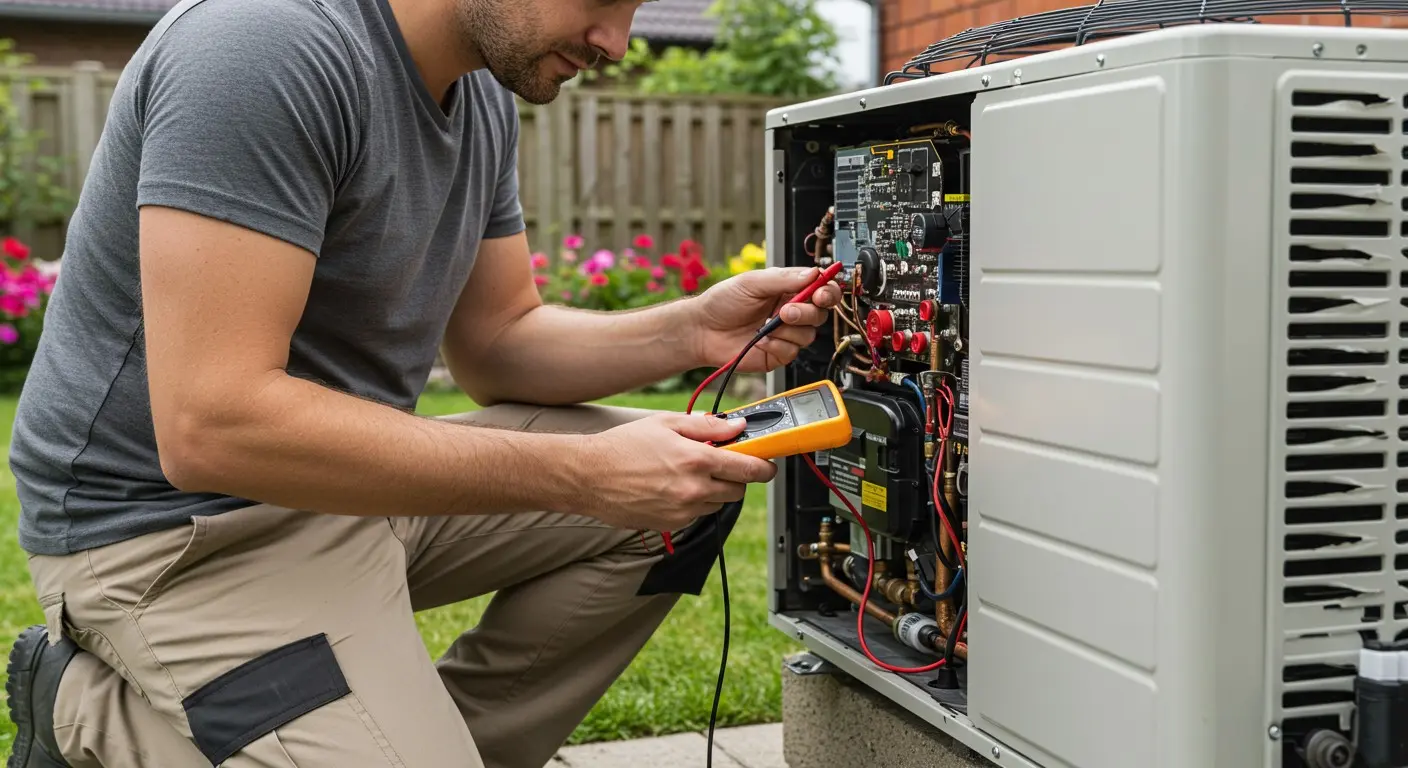
The contactor is a heavy-duty electrical switch located in your outdoor condenser unit. Think of it as a gatekeeper. When your thermostat calls for cooling, it sends a 24V signal to an electromagnetic coil inside the contactor. This magnetic force pulls down a set of metal contacts, closing the circuit and allowing 240V of electricity to flow directly to your compressor and condenser fan motor.
Over time, as the contactor opens and closes thousands of times, a small electrical spark (called arcing) occurs between the metal contacts. This constant sparking can create pits in the metal and, eventually, generate enough heat to physically weld the contacts together.

When the contacts weld shut:
- The electrical pathway remains permanently closed.
- High-voltage power continues to flow directly to the compressor and outdoor fan.
- The outdoor unit will run continuously, even if you turn off the thermostat, unplug it from the wall, or turn off the indoor unit.
If your indoor blower fan shuts off but you can still hear your outdoor unit humming and running outside, you almost certainly have a stuck or welded contactor. This is a clear indicator of when to call a technician for an ac that will not shut off, as replacing a contactor requires opening the high-voltage electrical cabinet of your outdoor unit and safely discharging capacitors.
Frozen Evaporator Coils and Refrigerant Leaks: When to Call a Technician for an AC That Will Not Shut Off
Another major reason your air conditioner might run continuously is a lack of cooling capacity, often caused by frozen evaporator coils or a refrigerant leak.
Your air conditioner is designed to run in cycles, typically lasting 15 to 20 minutes, to lower your home's temperature to the thermostat's setpoint. However, if your indoor evaporator coils are encased in a solid block of ice, or if your system is low on refrigerant, the AC loses its ability to absorb heat from your indoor air.
When this happens, the system will blow lukewarm or warm air. Because the indoor temperature never drops to meet the thermostat's setting, your thermostat will keep calling for cooling indefinitely. The system will run 24 hours a day, desperately trying to cool a home it simply does not have the capacity to cool.
This issue is often triggered by a severely restricted air filter or a leak in the refrigerant lines. If you suspect your system is running constantly because it isn't cooling, check out our guide on AC Not Cooling but Running: What to Check First. Finding and repairing a refrigerant leak requires specialized equipment, leak-detection dyes, and EPA certification to safely handle and top off the system's refrigerant.
Immediate Steps to Take When Your AC Won't Stop Running
If your air conditioner is running constantly and refusing to shut off, you need to take immediate action to protect your equipment from severe damage and keep your utility bills from skyrocketing.
Below is a quick-reference table to help you decide whether to perform a DIY check or shut down the system and call us:
| Symptom / Scenario | Immediate Action | Who Should Handle It? |
|---|---|---|
| Blower fan runs constantly, but blows cool air only when compressor is on. | Check thermostat fan setting (switch from ON to AUTO). | Homeowner (DIY) |
| AC runs constantly on a 105°F day, but maintains indoor temp within 15-20°F of outdoors. | Close blinds, limit door openings, set thermostat to a realistic 78°F. | Homeowner (DIY) |
| Blower fan runs continuously and air filter is completely caked in dust. | Turn off system, replace air filter, check for ice. | Homeowner (DIY) |
| Outdoor unit runs continuously even when thermostat is turned OFF or removed. | Shut off power at the outdoor disconnect or main breaker. | Call a Technician |
| AC runs 24/7, blows warm air, and outdoor refrigerant lines are covered in ice. | Shut off cooling, run fan only to thaw ice, call for service. | Call a Technician |
| System hums loudly, trips the breaker repeatedly, or smells like burning plastic. | Leave breaker OFF immediately. Do not attempt to turn back on. | Call a Technician |
If your system requires professional intervention, the first step is always to safely cut power to the unit. You can do this by locating the red emergency toggle switch (often located near your furnace or indoor air handler), pulling the disconnect block out of the outdoor disconnect box next to your condenser, or flipping the dedicated double-pole circuit breaker in your home's main electrical panel to the "OFF" position.
Once you have safely powered down the system, you can contact us to schedule a diagnostic visit. If you want to know what our professional service calls look like, read our guide on AC Service: What to Expect.
Frequently Asked Questions About Unstoppable Air Conditioners
Is it safe to keep running an AC that won't shut off?
No, it is highly recommended that you do not leave an unstoppable AC running indefinitely. Running an air conditioner 24/7 without cycling places an immense amount of mechanical stress on the compressor—the most expensive component in your system. This can lead to premature compressor burnout, motor failure, or complete system damage.
Additionally, if the constant running is caused by a electrical short or a stuck contactor, leaving it energized poses a safety risk to your home's electrical system. If your system is cycling rapidly or acting erratically, you can read more about AC Keeps Turning On and Off: What Is Wrong to understand how cycling issues damage your equipment.
Can a dirty air filter cause my AC to run continuously?
Yes! A dirty, clogged air filter restricts the volume of air flowing across your indoor evaporator coil. Without enough warm indoor air passing over the cold coil, the moisture on the coil will quickly freeze, turning your indoor unit into a block of ice.
Once frozen, the ice acts as an insulator, preventing the system from absorbing any heat from your home. The air blowing out of your vents will turn warm, and because the thermostat's target temperature is never met, the system will run continuously. We recommend checking your air filters every 30 to 90 days, especially during the dusty, windy summer months in places like Quartz Hill, CA, and Rosamond, CA. Always choose a filter with an appropriate MERV rating (typically between MERV 8 and MERV 13 for residential systems) to ensure optimal airflow.
How do I perform a hard reset on my AC unit?
Performing a hard reset can sometimes clear minor electrical or control board glitches:
- Go to your thermostat and turn the cooling system to "OFF."
- Walk over to your main electrical panel and locate the circuit breaker labeled for your AC or HVAC system.
- Flip the breaker completely to the "OFF" position.
- Leave the breaker off for a full 30 minutes. This allows the internal electrical capacitors to fully discharge and resets the control board's internal logic timers.
- After 30 minutes, flip the breaker back to the "ON" position.
- Wait 5 minutes, then go back to your thermostat and set it to "COOL" with a target temperature a few degrees below the room temperature. If the system resumes normal cycling, a temporary logic error was likely the cause. If it immediately runs and refuses to shut off again, you have a hardware issue.
Conclusion
An air conditioner that refuses to shut off is more than just a minor annoyance—it is an active threat to your home's comfort, your wallet, and the lifespan of your cooling system. Whether the culprit is a welded outdoor contactor, a shorted low-voltage wire, or frozen evaporator coils, acting quickly is the key to preventing a costly system replacement.
Here in the dry, intense desert climate of the Antelope Valley—from Palmdale and Lancaster down to Santa Clarita, Valencia, and Stevenson Ranch—our air conditioners work incredibly hard. When your system starts acting like a "zombie" and won't take a break, let our family-owned team help you restore peace and quiet to your home.
To help you decide on the best financial path forward for an aging system, read our guide on How to Decide if AC Repair Is Worth the Money in a Hot Climate. When you are ready to get your system running efficiently again, reach out to us directly through our Affordable Air and Heating Air Conditioning Services page or Contact Us to schedule a professional diagnostic visit today!