How a Mini Split Heats and Cools a Garage or Home Addition in the Antelope Valley
How a mini split heats and cools a garage or home addition in the Antelope Valley comes down to one core idea: it moves heat instead of creating it, and it does so without any ductwork.
Here is a quick answer:
How a Mini Split Heats and Cools a Garage or Home Addition
| Mode | What Happens |
|---|---|
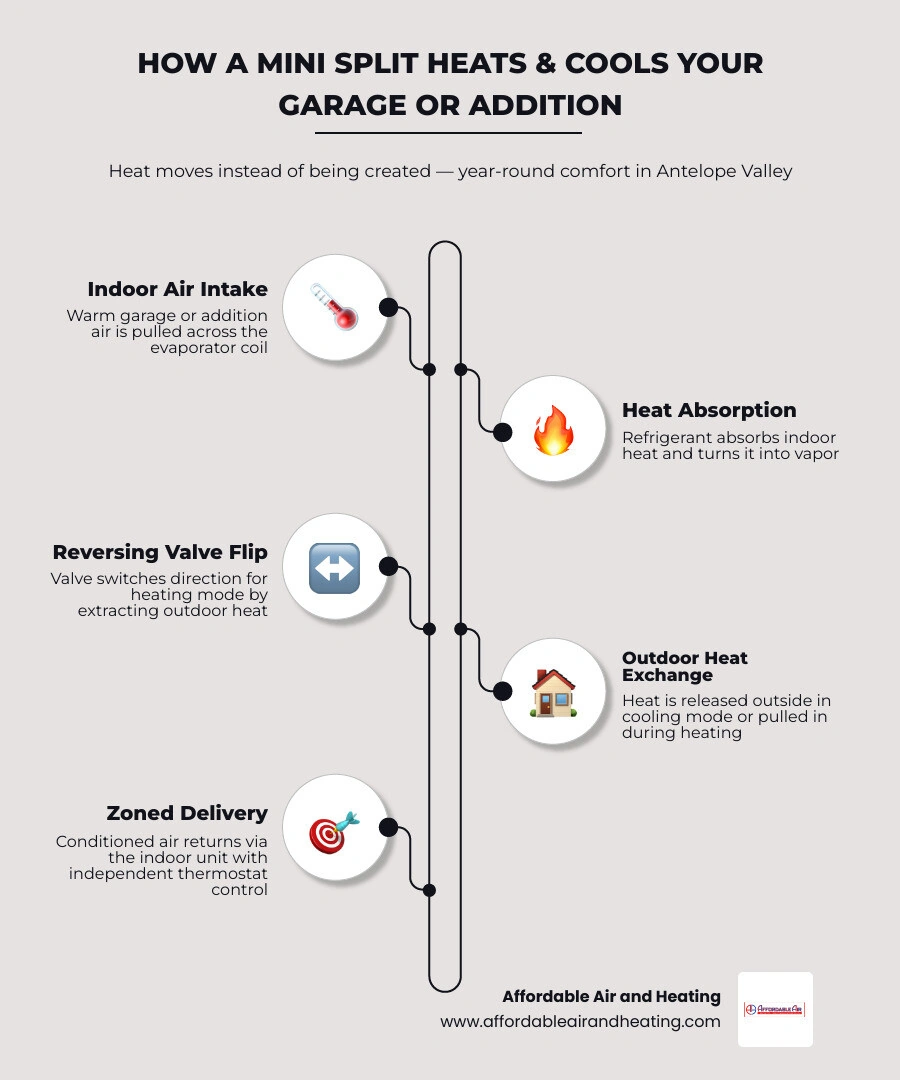
| Cooling | The indoor unit pulls warm air across cold refrigerant coils, absorbs the heat, and blows cooled air back into the room |
| Heating | A reversing valve flips the cycle — the system pulls heat from outdoor air and pumps it inside |
| No ducts needed | Refrigerant lines run through a small hole in the wall connecting the indoor and outdoor units |
| Zoned control | Each indoor unit has its own thermostat, so your garage or addition stays at its own temperature |
If you live in the Antelope Valley, you already know the problem. Summers in Lancaster and Palmdale push well past 100°F, and winters bring cold nights that central heating often fails to reach — especially in a detached garage, converted room, or new home addition. These spaces usually have no existing ductwork, which makes extending a central system expensive and often impractical.
A ductless mini split solves this directly. It gives you full heating and cooling in any space that needs it, without tearing into walls to run ducts. It is quiet, energy-efficient, and built to handle the kind of extreme temperature swings that are common across the High Desert.
Why a Mini Split Is Ideal for Garages and Additions in the Antelope Valley
Garages and additions are often the hardest rooms in the house to keep comfortable. They heat up fast, cool down fast, and usually seem determined to ignore whatever the main thermostat wants. In the Antelope Valley, that problem gets amplified by desert heat, dry air, strong afternoon sun, and chilly nights.
That is why a mini split is such a practical fit for spaces like:
- Converted garages
- Home offices
- Guest rooms
- Sunrooms
- Garage gyms
- Workshops
- Bonus rooms
- New additions without ducts
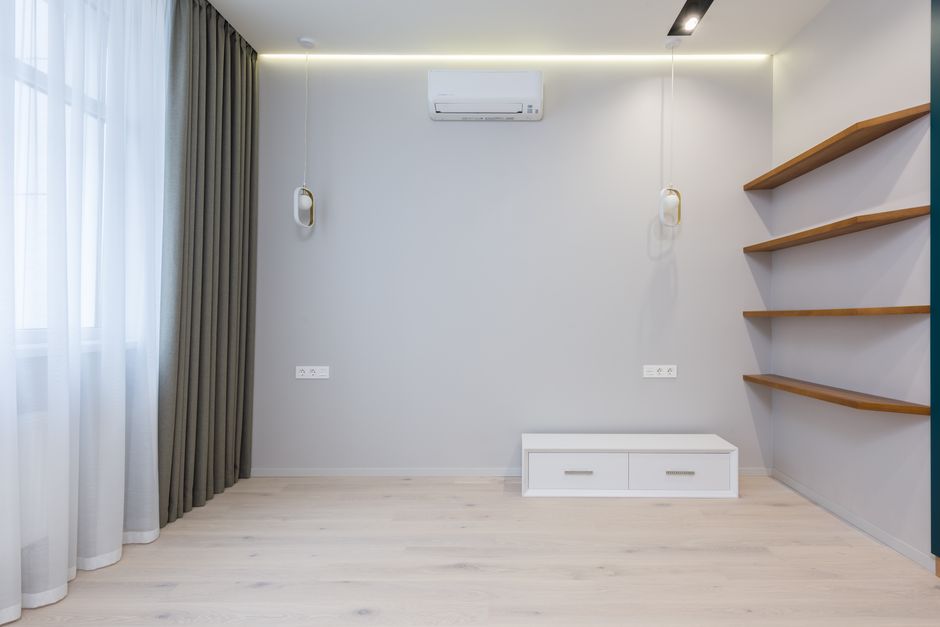
Instead of trying to push conditioned air through long duct runs, a mini split delivers heating and cooling directly into the room where you need it. That means fewer hot spots, better comfort, and less wasted energy. It is also much quieter than many homeowners expect, with indoor units commonly operating in a range as low as about 20 to 49 decibels.
What makes a ductless system better for a garage or addition than extending ducts
For most garages and additions, extending central ductwork sounds simpler than it really is. In reality, it can create several problems:
- Existing equipment may not be sized for the added space
- Long duct runs can reduce airflow
- Poorly insulated ducts can waste energy
- The new room may have different heating and cooling needs than the rest of the house
Traditional ducted systems can lose 20% to 30% of cooling energy through duct leaks and poor insulation. A mini split avoids that issue because there are no ducts to lose air in the first place. It sends conditioned air straight into the room.
That direct delivery is a big reason mini splits are often 20% to 30% more efficient than ducted systems, and in some cases up to 40% more efficient than older central equipment. For a garage that is used only in the evening, or a home office that is occupied only during the day, that kind of targeted conditioning makes a lot of sense.
Mini splits are also retrofit-friendly. They usually need only a small wall opening for the line set, drain, and wiring, rather than major remodeling. If you want a deeper look at the comfort and efficiency advantages, here are the benefits of mini splits.
How a mini split heats and cools a garage or home addition in the Antelope Valley for year-round comfort
The short version is this: a mini split is usually a heat pump. In summer, it removes heat from inside your garage or addition and releases it outdoors. In winter, it reverses the process and pulls heat from outdoor air to warm the space inside.
That may sound like magic, but it is really refrigeration science with better manners.
Key parts that make this work include:
- An inverter-driven compressor that adjusts output instead of constantly turning fully on and off
- A reversing valve that switches between cooling and heating modes
- Refrigerant that carries heat between the indoor and outdoor units
- Indoor fan control that helps maintain steady airflow and comfort
This matters in Lancaster, Palmdale, Quartz Hill, and nearby areas because the weather swings are real. A room can be baking in the afternoon and cold after sunset. Mini splits handle those shifts well because they modulate their output instead of overshooting the temperature and then stopping. For more local insight, see ductless AC solutions in Lancaster.
How a Mini Split System Works Without Ductwork
A mini split system has two main sections:
- An outdoor unit
- One or more indoor air handlers
These are connected by a compact conduit that typically contains:
- Refrigerant lines
- Power wiring
- Communication wiring
- A condensate drain
Installation usually requires only a small hole through the wall, often around three inches, which is one reason these systems work so well in finished additions and garage conversions.
The indoor unit recirculates air from the room. It does not pull in outside air for normal heating and cooling. That is an important point because many homeowners picture it working like a window unit. It does not. It is a closed-loop system that moves heat using refrigerant.
How cooling mode removes heat from a garage or addition
In cooling mode, the system follows a simple sequence:
- The indoor unit pulls warm room air across a cold evaporator coil.
- Refrigerant inside the coil absorbs heat from that air.
- Moisture in the air condenses on the coil and drains away through the condensate line.
- The now-cooled air is blown back into the room.
- The absorbed heat travels through the refrigerant lines to the outdoor unit, where it is released outside.
So when your garage gym feels like an oven in July, the mini split is not "making cold." It is removing heat from the space and carrying it outdoors. If you want a plain-English explanation of refrigerant’s role, see do ductless mini splits use coolant.
How a mini split heats and cools a garage or home addition in the Antelope Valley during winter
In heating mode, the reversing valve changes the direction of refrigerant flow. That allows the system to collect heat from the outdoor air and move it indoors.
Even when outdoor air feels cold to us, there is still heat energy in it. A heat pump is designed to capture that energy efficiently. Modern inverter systems do this more steadily than older on-off equipment, which helps avoid the familiar blast-of-hot-air-then-nothing pattern many homeowners dislike.
For an addition used as a bedroom, office, or guest space, that steady output is a big comfort upgrade. Instead of dramatic swings, the room stays more consistent.
How zoned controls work in single-zone and multi-zone setups
Zoning is one of the biggest advantages of mini splits.
A single-zone system connects one outdoor unit to one indoor unit. This works well for:
- One garage conversion
- One new room addition
- One detached workshop
- One problem room
A multi-zone system connects one outdoor unit to multiple indoor units. Each indoor unit gets its own control, setpoint, and operating schedule. That means you can keep:
- A garage at one temperature
- A home office at another
- A guest room at another
No family thermostat arguments required.
Many systems include handheld remotes, wall controls, or Wi-Fi options for app-based scheduling. If you want to understand zone planning in more detail, read optimize your home with mini split zones.
How to Choose the Right Setup for Your Space
The right mini split setup starts with proper sizing and layout. Bigger is not always better. An oversized unit can short cycle and control humidity and temperature less effectively. An undersized unit may struggle during peak summer heat.
We recommend looking at the full load on the room, including:
- Square footage
- Ceiling height
- Insulation levels
- Number and size of windows
- West- or south-facing sun exposure
- Garage door quality and sealing
- Occupancy
- Electronics, appliances, or gym equipment
- Whether the space is attached or detached
A professional Manual J load calculation is the best way to size the equipment correctly.
Single-zone vs. multi-zone mini splits
| Setup | Best For | Main Advantage |
|---|---|---|
| Single-zone | One garage or one addition | Simple, dedicated comfort for one space |
| Multi-zone | Several rooms with different needs | Independent control in multiple areas |
Best unit placement for even airflow and fewer hot spots
Placement matters more than many people realize. A perfectly good unit in the wrong spot can still leave the room uneven.
Good indoor placement usually aims for:
- Clear airflow across the room
- Minimal obstruction from shelves or tall furniture
- Enough clearance around the unit
- Positioning that accounts for window heat gain and room layout
For example, if a garage addition gets hammered by late-afternoon sun, we may plan placement to improve air distribution across that hotter side of the room. In open additions, we also look at where people spend time, not just where the wall space happens to be.
Outdoor placement matters too. The condenser should have:
- Proper clearance for airflow
- Stable mounting
- Protection from debris buildup
- Reasonable shade when possible
- Access for service
For more placement guidance, see optimize your ductless AC placement.
Installation steps that matter in hot, dry climates like Lancaster
In the Antelope Valley, professional installation is especially important because systems have to perform through extreme summer heat, dust, and wide day-night temperature changes.
The most important installation steps include:
- Performing a room-by-room load calculation
- Selecting the right indoor and outdoor unit combination
- Mounting the indoor unit securely and level
- Routing the line set with proper protection and support
- Providing the correct condensate drain slope
- Completing electrical connections safely
- Pressure testing and evacuating the refrigerant lines
- Checking for leaks
- Starting up and commissioning the system
- Verifying airflow, temperature split, controls, and system performance
- Completing permit and code requirements where needed
Skipping the vacuum test, rushing line-set work, or ignoring drainage details can lead to reduced performance and early problems. For a look at professional installation standards, visit mini split installation in Newhall, CA.
Efficiency, Performance, and Long-Term Reliability
Mini splits are popular for garages and additions because they combine flexibility with high efficiency.
Several things drive that performance:
- No duct losses
- Inverter technology that matches output to demand
- Zoned operation so you only condition occupied spaces
- Stable temperature control with less stop-and-start cycling
This is especially useful in the High Desert, where a room addition may need cooling in the afternoon and heating overnight on the same day.
Why mini splits are so efficient for additions and converted garages
A big efficiency advantage is the elimination of duct losses. In a traditional ducted system, 20% to 30% of energy can be lost through leaks and poorly insulated ducts. Mini splits avoid that entirely.
They also shine at partial-load operation. Most rooms do not need maximum heating or cooling every minute of the day. Because inverter systems can ramp up and down, they use less electricity than equipment that constantly cycles on and off at full blast.
For additions and converted garages, that means:
- Less wasted energy
- More stable temperatures
- Better comfort in occupied rooms
- No need to cool or heat unused parts of the house just to make one room comfortable
For more ways to improve performance, read maximize mini split efficiency.
How long mini splits last and what affects lifespan
With proper installation and maintenance, mini split systems typically last 15 to 20 years.
What helps them last longer:
- Correct sizing
- Professional installation
- Clean filters and coils
- Healthy condensate drainage
- Sound electrical connections
- Prompt repair of small issues before they become large ones
- Reasonable protection from dust and debris
In the Antelope Valley, desert dust is one of the biggest wear factors. A unit that runs with clogged filters or dirty coils has to work harder, which can reduce efficiency and strain components over time.
Common mini split problems and how homeowners can prevent them
Like any HVAC system, mini splits can develop issues. The good news is that many common problems are preventable.
Typical issues include:
- Dirty air filters restricting airflow
- Clogged condensate drains causing water leaks
- Refrigerant leaks reducing heating or cooling performance
- Sensor or communication faults
- Ice buildup from airflow or refrigerant problems
- Loose electrical connections
- Unusual noises from debris, vibration, or worn parts
Warning signs to watch for:
- Weak airflow
- The room is not reaching the set temperature
- Water dripping from the indoor unit
- Ice on the indoor or outdoor unit
- New buzzing, rattling, or clicking sounds
- Error codes on the display
- Short cycling
- Musty or unusual smells
A little prevention goes a long way: clean filters regularly, keep outdoor units clear, and schedule professional service before peak seasons. If strange sounds show up, this guide on troubleshooting mini split noises can help you understand what may be happening.
How to Maintain a Mini Split So It Runs Efficiently Year-Round
Mini split maintenance is not complicated, but it does need to be consistent. Think of it like changing the oil in a car. Ignore it long enough, and the system will eventually complain.
Homeowner maintenance tasks usually include:
- Cleaning washable filters regularly
- Keeping supply and return airflow unobstructed
- Checking for visible dust buildup
- Watching for water leaks
- Keeping the outdoor unit free of debris
- Monitoring performance changes and odd noises
Monthly and seasonal maintenance for Antelope Valley conditions
Because our local climate is dusty and dry, filters often need attention more often than homeowners expect.
A good routine looks like this:
Monthly
- Inspect and clean indoor filters as needed
- Make sure airflow around the indoor head is not blocked
- Look for signs of drainage issues
- Check the outdoor unit for dust, leaves, or debris
Before summer
- Confirm the system cools properly before the hottest weather hits
- Clear debris around the condenser
- Make sure remotes or controls are working correctly
- Schedule professional service if performance seems off
Before winter
- Test heating mode
- Confirm the system switches modes normally
- Check for unusual startup noises
- Make sure the space is still well sealed and insulated
For more practical care tips, see mini split maintenance tips in Palmdale and ductless AC maintenance best practices.
When to call for professional repair or maintenance
Some issues should not wait for "maybe next weekend."
Call for professional service if you notice:
- Water leaking indoors
- Weak or inconsistent airflow
- Poor cooling during hot weather
- Poor heating on cold nights
- Repeated error codes
- Ice formation
- Burning or musty odors
- Short cycling
- Loud new noises
Professional maintenance typically includes inspection of refrigerant levels, electrical components, coil condition, blower operation, condensate drainage, and control performance. If you need ongoing care or service, visit mini split maintenance in Palmdale, CA or mini split repair in Lancaster, CA.
Frequently Asked Questions About How a Mini Split Heats and Cools a Garage or Home Addition in the Antelope Valley
Can a mini split heat and cool an uninsulated garage?
It can, but insulation makes a huge difference. An uninsulated garage gains heat fast in summer and loses heat fast in winter, so the system has to work harder. Proper sizing becomes even more important, along with sealing gaps around doors and reducing ceiling heat gain.
If you are turning a garage into a gym, office, or hobby space, improving insulation and weather sealing usually pays off in comfort and performance.
Are mini splits quiet enough for a home office, gym, or guest room?
Yes. Indoor mini split units are very quiet, often operating between about 20 and 49 decibels depending on model and fan speed. That is one reason they work so well in home offices, bedrooms, and guest spaces. The outdoor unit makes more noise than the indoor unit, but it is still much quieter than many homeowners expect.
Does a mini split work better for one room or multiple spaces?
Both, depending on the design. A single-zone system is ideal for one room, such as a garage conversion or home addition. A multi-zone system is better when you want separate temperature control in multiple rooms, such as an office, guest room, and detached bonus space.
The key is thoughtful design. The right number of indoor heads, correct BTU sizing, and smart placement matter more than just picking a system off a shelf and hoping for the best.
Conclusion
If you have been wondering how a mini split heats and cools a garage or home addition in the Antelope Valley, the answer is simple: it uses heat pump technology, inverter efficiency, and zoned control to deliver year-round comfort without ductwork.
For many homeowners in Lancaster, Palmdale, Quartz Hill, Rosamond, Santa Clarita, and surrounding areas we serve, that makes mini splits one of the smartest ways to condition a garage conversion, workshop, office, or new addition. They are efficient, quiet, flexible, and well suited to our local climate.
At Affordable Air and Heating, we have been helping local homeowners with HVAC installation, repair, and maintenance since 1996. As a family-owned company, we focus on affordable comfort solutions, energy efficiency, and flexible financing options that make upgrades easier to plan.
If you are ready to improve comfort in a garage or addition, learn more about our mini split services.