When Summer Heat Exposes the Truth About Your AC's Age
Does AC efficiency drop as it ages in extreme heat? Yes — and it drops faster than most homeowners expect. Research from the Florida Solar Energy Center tracked 56 homes over several years and found that cooling system performance degrades by roughly 5% per year on average. In high-heat climates, that number can climb even higher.
For homeowners in the Antelope Valley, where summer temperatures regularly push past 105°F, an aging AC isn't just less comfortable — it's working harder for worse results, every single day.
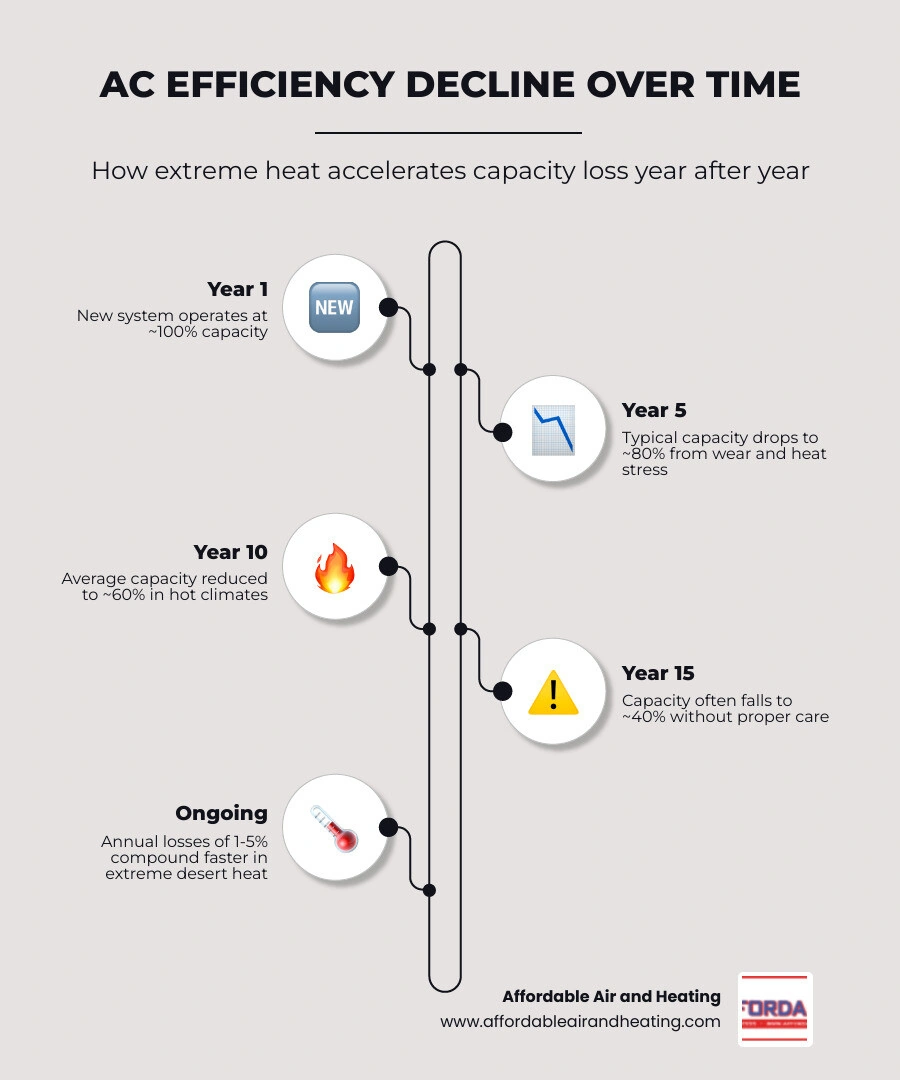
Here's a quick summary of what the research shows:
| System Age | Estimated Capacity Remaining |
|---|---|
| New (Year 1) | ~100% |
| 5 years | ~80% |
| 10 years | ~60% |
| 15 years | ~40% |
- Degradation starts from day one — even well-maintained systems lose 1-2% efficiency per year
- Poorly maintained systems can lose up to 5% or more per year
- Extreme outdoor heat amplifies every existing weakness in an aging system
- Most residential AC systems are replaced between 13 and 16 years of age
In the sections below, we break down exactly why this happens, what accelerates it, and what you can do about it.
Simple does ac efficiency drop as it ages in extreme heat word guide:
- ac bill spikes in summer
- why is my electric bill so high in an antelope valley summer
- best thermostat settings to save money during an antelope valley summer
Does AC Efficiency Drop as It Ages in Extreme Heat?
When we talk about whether does ac efficiency drop as it ages in extreme heat, we have to look at how real-world conditions differ from laboratory testing. Air conditioners are engineered and rated under standardized conditions. However, when an outdoor unit sits under the baking sun in Palmdale or Lancaster, CA, the actual operating conditions are far more punishing.
An AC unit's seasonal energy efficiency ratio (SEER) measures its cooling output divided by its electrical energy input over a typical cooling season. When a system is brand new, it runs close to its factory SEER rating. But as the years tick by, a combination of mechanical wear, environmental exposure, and electrical degradation chips away at that number.
Empirical studies have completely changed how we view this decline. While older computer simulations estimated a modest 2% to 3% annual efficiency drop for completely unmaintained systems, a landmark field study monitoring residential homes discovered a median degradation rate of 5.2% per year. In high-use, extreme-heat environments, systems can lose up to 20% of their actual cooling capacity within just five years, 40% after ten years, and a staggering 60% by year fifteen.
This means a 3-ton system that kept your home perfectly chilled when installed may only perform like a 1.8-ton system a decade later. To understand why this drop is so dramatic, we have to look closely at the physical toll our local desert environment takes on these systems. Learn more about these environmental factors in our guide on Does Extreme Heat and Desert Dust Shorten AC Life Expectancy.
How Extreme Desert Temperatures Accelerate Component Wear
The climate in the Antelope Valley is notoriously tough on outdoor mechanical equipment. During our peak summer months, ambient temperatures frequently exceed 100°F, and the thermal load on an air conditioner's outdoor condenser unit is immense.
In a moderate climate, an air conditioner might only run for 600 to 900 hours per year. In our hot desert climate, that number easily skyrockets to 2,500 to 3,500 operating hours annually. This extended run time means that an AC system in Santa Clarita or Quartz Hill accumulates the equivalent of 15 years of standard wear and tear in just 5 to 6 years.
Furthermore, the physical laws of heat transfer work against your AC as the outdoor air gets hotter. To cool your home, the outdoor coil must reject heat into the surrounding air. When the ambient temperature is 110°F, the temperature of the condenser coils can climb past 150°F. This extreme heat shrinks the temperature differential needed for efficient heat rejection, forcing the compressor to work much harder to pump refrigerant.
Under these intense conditions, high-side refrigerant pressures can exceed 500 PSI, compared to just 350 PSI on a mild day. This massive pressure difference puts extreme stress on the compressor motor windings, which can reach internal temperatures above 225°F. At the same time, the vital electrical capacitors housed in the outdoor unit are subjected to temperatures well beyond their designed limits, often exceeding 170°F in direct sunlight. This thermal stress causes these components to weaken and eventually fail, leading to sudden breakdowns during the hottest weeks of the year. For a deeper dive into these local climate challenges, read about How the Antelope Valley Desert Climate Affects Your AC System.
Why Does AC Efficiency Drop as It Ages in Extreme Heat for Older Systems?
Older air conditioning systems face a double whammy: they suffer from the natural compounding effects of age, and they rely on outdated technology that struggles to cope with modern extreme weather.
One of the most significant issues with systems manufactured over a decade ago is their reliance on R-22 refrigerant. Because R-22 has been phased out due to environmental regulations, maintaining these older units has become increasingly difficult. When an older system develops a minor refrigerant leak, the drop in pressure causes a severe drop in cooling efficiency. A refrigerant undercharge of just 20% can cause a 24% decrease in sensible cooling capacity, forcing the system to run almost continuously to meet your thermostat settings.
Additionally, older systems suffer from cumulative electrical and mechanical wear:
- Mechanical Friction: Over time, the bearings in the compressor and fan motors lose their lubrication. This increased friction requires more electrical current (amperage) to spin the motors, directly raising your utility bills.
- Electrical Contact Degradation: Years of cycling on and off cause electrical contacts (contactors) to pit and corrode. This resistance causes voltage drops, forcing components to draw more current and generate more destructive internal heat.
- Outdated Compressors: Older systems typically use single-stage compressors that can only run at 100% capacity. Unlike modern variable-speed systems, they cannot scale back their energy use on milder days, accelerating overall wear.
To see how these factors combine to limit the lifespan of your unit, check out our analysis of the Average Lifespan of a Central Air Conditioner in a Hot Desert Climate.
Key Drivers of Performance Degradation in Aging Air Conditioners
To combat efficiency loss, we must first understand the primary physical culprits behind it. While age is inevitable, the speed at which a system degrades is largely determined by three main mechanical issues: coil fouling, refrigerant loss, and airflow restriction.
- Coil Fouling: The indoor evaporator coil and outdoor condenser coil rely on clean aluminum fins to transfer heat. In dusty desert areas like Rosamond and Antelope Acres, windblown dust and pollen quickly coat these fins. A tiny, almost invisible layer of dust acts as an insulator. If an outdoor coil is just 10% blocked by dirt and debris, the compressor is forced to work up to 20% harder to reject heat.
- Refrigerant Leaks: All cooling systems naturally vibrate during operation. Over time, these micro-vibrations can cause tiny copper joints to rub together, creating microscopic pinhole leaks. As refrigerant slowly escapes, the system's pressure balance is disrupted. This not only slashes cooling capacity but also prevents the returning refrigerant from properly cooling the compressor motor, leading to premature motor burnout.
- Airflow Restriction: A clogged air filter or a blower motor coated in dust restricts the volume of air passing over the indoor coil. When airflow drops below the recommended 400 CFM (cubic feet per minute) per ton, the indoor coil runs much colder than designed. This can cause the refrigerant to turn to liquid before reaching the compressor, risking catastrophic compressor failure, or cause the entire indoor coil to freeze into a solid block of ice.
Addressing these issues early is key to keeping your system running smoothly. You can read about how keeping up with repairs maintains system health in our article on AC Efficiency with Timely Repair.
The Impact of System Sizing and SEER Ratings on Aging
How quickly an air conditioner loses its efficiency over time is also heavily influenced by its original design, size, and efficiency rating.
Interestingly, research shows that larger systems actually degrade faster than smaller ones. For every additional ton of cooling capacity, the annual rate of performance degradation increases by roughly 3%. This is because larger systems cycle on and off more frequently when meeting the home's cooling load (a phenomenon known as short-cycling), which accelerates mechanical wear on the compressor clutch and electrical relays.
On the other hand, systems with higher SEER ratings tend to be much more resilient to aging. A system rated at SEER 20 degrades about 1% less per year than an older SEER 10 system of equivalent size. High-efficiency units utilize larger evaporator and condenser coils, which provide more surface area for heat transfer and are less sensitive to minor amounts of dirt buildup. They also feature advanced Thermostatic Expansion Valves (TXVs) that can dynamically adjust refrigerant flow, allowing them to maintain peak performance even when the system is slightly undercharged.
Below is a comparison showing how system size and efficiency ratings influence the rate of performance loss over time:
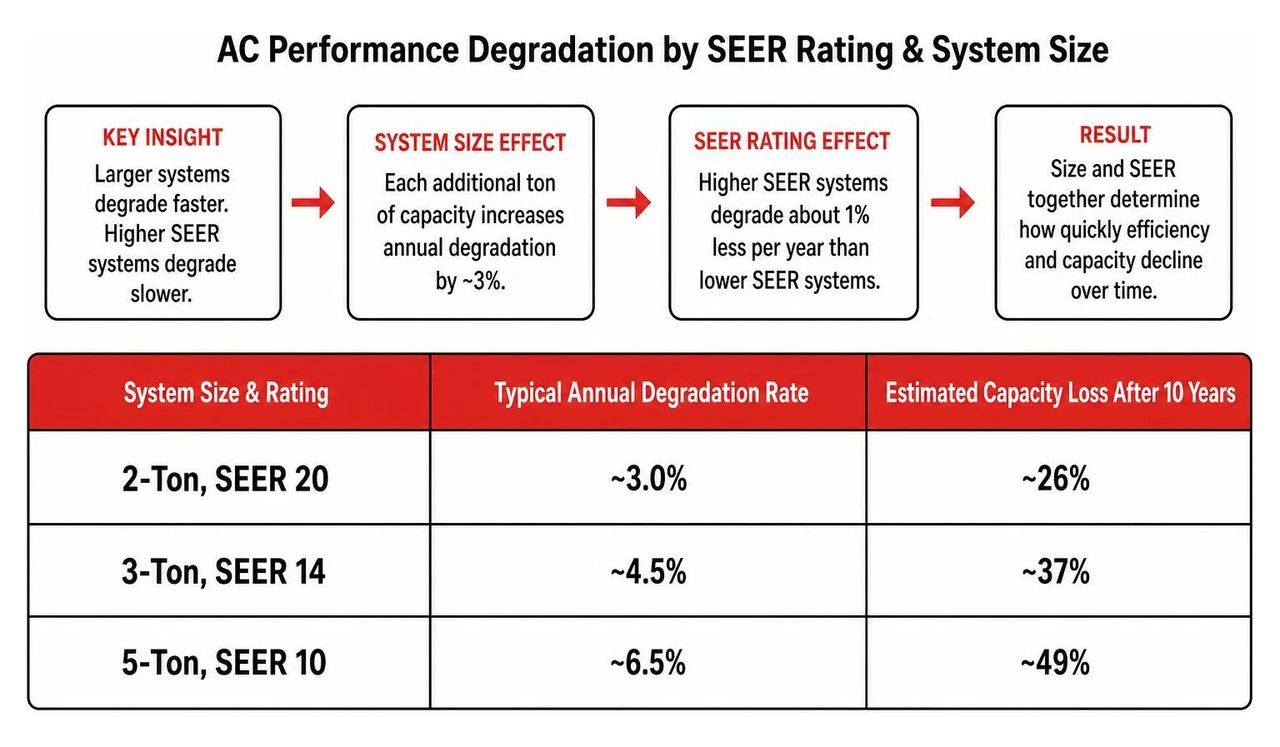
| System Size & Rating | Typical Annual Degradation Rate | Estimated Capacity Loss After 10 Years |
|---|---|---|
| 2-Ton, SEER 20 | ~3.0% | ~26% |
| 3-Ton, SEER 14 | ~4.5% | ~37% |
| 5-Ton, SEER 10 | ~6.5% | ~49% |
How Home Insulation and Ductwork Interact with an Aging AC
An air conditioner does not operate in a vacuum; it is part of a larger thermal system that includes your home’s ductwork, insulation, and overall airtightness.
When your home has poor attic insulation or leaky ductwork, the burden on an aging AC system increases dramatically. In hot inland climates like Castaic and Canyon Country, attic temperatures can easily soar past 130°F. If your ductwork has small cracks or unsealed joints, it can pull this superheated attic air directly into your cooling stream, or leak cold air out before it ever reaches your living spaces.
This constant influx of heat forces your already-degraded AC unit to run for hours on end without a break. Because the system is operating continuously under high thermal loads, the compressor oil thins out, reducing lubrication and accelerating internal mechanical wear. This creates a destructive feedback loop: poor home insulation makes the AC run constantly, which accelerates system aging, which further reduces its efficiency, leading to even higher energy bills. You can find out more about this relationship in our article How Poor Insulation Makes Your AC Run Constantly in Hot Inland Climates.
Mitigating Efficiency Loss and Extending System Lifespan
While some degree of efficiency loss is natural as an air conditioner ages, you do not have to sit back and watch your utility bills climb. The single most effective way to slow down and even reverse performance degradation is through consistent, professional preventative maintenance.
Regular maintenance acts like a tune-up for your car. By thoroughly cleaning the outdoor condenser coils, we remove the insulating layer of desert dust, instantly lowering compressor operating temperatures and pressures. Checking and adjusting the refrigerant charge ensures the system operates at peak thermodynamic efficiency, while lubricating moving parts reduces mechanical friction and energy draw.
Homeowners can also take simple steps to protect their systems, such as replacing air filters every 30 to 90 days and ensuring there is at least a two-foot clearance around the outdoor condenser unit to allow for unrestricted airflow. Discover the full benefits of keeping your system clean in our guide on the Benefits of Regular AC Maintenance.
How To Prevent the Question: Does AC Efficiency Drop as It Ages in Extreme Heat?
To stay ahead of system decline, modern technology offers excellent tools for tracking real-time performance. Smart thermostats and home energy monitors can help you detect early signs of AC degradation long before a complete breakdown occurs during a summer heatwave.
By comparing your daily energy consumption (kWh) against the outdoor temperature, you can spot unusual trends. For example, if your system is using 20% more energy to cool your home on a 95°F day this summer compared to a day with the exact same temperature two years ago, it is a clear sign that efficiency is dropping.
Additionally, pay attention to these physical warning signs:
- Extended Run Times: The system runs continuously without ever reaching your thermostat setpoint.
- Weak Airflow: Warm or weak air blowing from your supply registers.
- Frequent Cycling: The AC turns on and off rapidly, indicating electrical or airflow issues.
- Unusual Noises: Squealing, grinding, or loud humming from the outdoor compressor.
For practical tips on keeping your system running efficiently for as long as possible, explore our Boost Your AC's Lifespan guide and check out our AC System Lifespan Optimization Tips.
Frequently Asked Questions About Aging AC Performance
We hear many of the same questions from homeowners in Santa Clarita, Lancaster, and Palmdale who are struggling to keep their homes cool during the summer. Here are the facts behind some of the most common cooling concerns.
What is the typical annual rate of AC efficiency loss?
As established by empirical research from the Florida Solar Energy Center, a residential air conditioning system operating in a high-use climate loses an average of 5% of its original cooling capacity and efficiency every year if it does not receive regular professional maintenance. Even with meticulous care, systems will still experience a natural decline of about 1% to 2% per year due to unavoidable mechanical wear and component aging.
Does running my AC at lower thermostat settings shorten its lifespan?
Yes. Setting your thermostat to extremely low temperatures (like 68°F or 70°F) when it is over 100°F outside forces your system to run continuously at maximum capacity. This prolonged high-load operation thins out the compressor's lubricating oil and keeps internal motor temperatures dangerously high. Research shows that lower interior temperature preferences directly correlate with shorter system lifespans; in fact, for every degree you regularly set your thermostat below 82°F during the cooling season, you reduce your system's overall life expectancy by approximately six months.
When should I replace my aging AC instead of repairing it?
Deciding whether to repair or replace an older system can be challenging, but two helpful industry guidelines can make the choice clearer:
- The 50% Rule: If a single repair bill costs more than 50% of the overall value of the system, or if the unit is over 15 years old and requiring increasingly frequent repairs, replacement is generally the more economical choice.
- The $5,000 Rule: Multiply the age of your system by the cost of the estimated repair. If the total is greater than $5,000, it is usually wiser to invest that money into a new, high-efficiency system.
For example, if a 12-year-old system needs a repair that costs $500, multiplying those numbers gives you $6,000. Under this rule, replacing the system is the smarter long-term financial decision.
To help you make an informed choice, read our detailed guide on When to Consider AC Replacement. You can also learn how upgrading to a modern system pays off over time in our article on How Energy Savings from a New AC Offset Replacement in California.
Conclusion
Understanding how and why does ac efficiency drop as it ages in extreme heat is the first step toward regaining control over your home comfort and utility bills. In the harsh desert climate of the Antelope Valley, letting an aging, inefficient air conditioner run without attention is a recipe for high energy bills and sudden summer breakdowns.
Since 1996, our family-owned team at Affordable Air and Heating has been helping homeowners across Palmdale, Lancaster, Santa Clarita, Acton, and the surrounding areas stay cool and comfortable. We specialize in providing affordable, energy-efficient cooling solutions, routine preventative maintenance, and flexible financing options to fit any budget.
Don't wait for the next major heatwave to find out if your older AC can handle the pressure. Schedule professional cooling services today with our friendly team, and let us help you keep your home cool and comfortable all summer long!