What Is a Central Air Conditioning System?
Understanding how a central air conditioner works step by step can make a real difference when you're dealing with triple-digit summer temperatures in the Antelope Valley. When your home isn't cooling down fast enough — or your energy bills keep climbing — knowing what's actually happening inside your system helps you make smarter decisions.
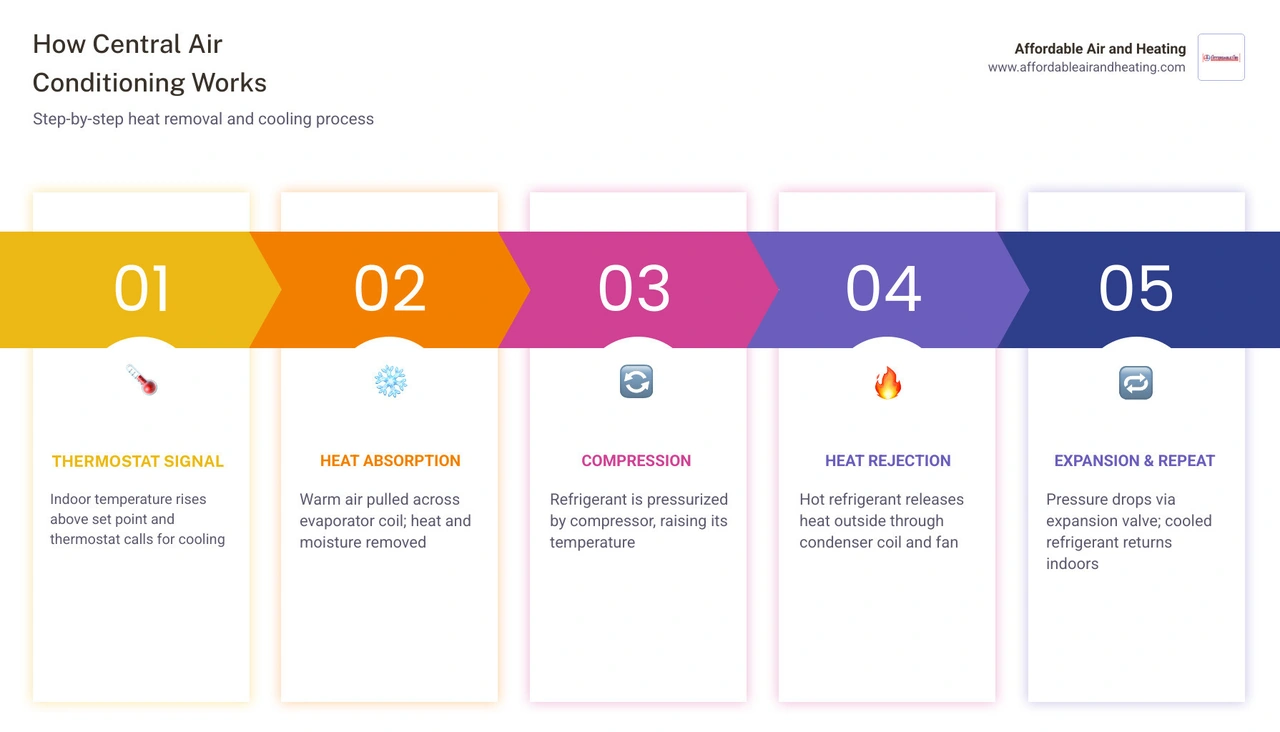
Here's a quick look at how central AC cools your home:
- Thermostat signals the system to start when indoor temperature rises above your set point
- Warm indoor air is pulled through return vents and across the air filter
- The evaporator coil absorbs heat from the air, cooling it down and removing moisture
- The refrigerant carries that heat through copper lines to the outdoor unit
- The compressor pressurizes the refrigerant, raising its temperature further
- The condenser coil releases the heat outside through the outdoor fan
- The expansion valve drops the pressure, cooling the refrigerant so the cycle repeats
- Cooled, dehumidified air is pushed back through supply ducts into your living spaces
Central air conditioning doesn't create cold air — it removes heat from your home and releases it outside. That distinction matters because it explains every component, every step, and every maintenance task involved in keeping your system running well.
First developed in the early 1900s and refined through the 1960s into the whole-home systems we use today, central AC has become the most common cooling solution for homes across the United States. In a climate like the Antelope Valley's, where summer heat is relentless and efficient cooling isn't optional, understanding your system is the first step toward getting the most out of it.
A central air conditioning system is a whole-home cooling system that removes heat and humidity from indoor air, then distributes cooled air through ductwork to different rooms.
Unlike a window unit or portable AC that cools one area at a time, central AC is designed to condition the entire home from one central system. It usually works with a thermostat, an indoor air handler or furnace blower, an evaporator coil, an outdoor condenser unit, refrigerant lines, and ducts.
In simple terms:
- The indoor side absorbs heat from your home.
- The outdoor side releases that heat outside.
- The duct system moves air where it needs to go.
- The thermostat acts like the bossy little manager telling everyone when to start and stop.
Central AC is different from ductless mini-splits, too. Ductless systems also use refrigerant to move heat, but they do not rely on a whole-home duct network. Instead, they serve individual rooms or zones with wall-mounted indoor units. Central air, by contrast, is usually the best fit when a home already has ductwork or when whole-house comfort is the goal.

Split Systems vs. Packaged Systems
Most central air conditioners fall into two main categories: split systems and packaged systems.
| Feature | Split System | Packaged System |
|---|---|---|
| Main layout | Indoor and outdoor equipment are separate | Most major components are housed in one cabinet |
| Indoor equipment | Evaporator coil and blower or air handler | Usually no separate indoor cooling cabinet |
| Outdoor equipment | Compressor, condenser coil, and outdoor fan | Compressor, condenser, evaporator, and blower may all be together |
| Common placement | Outdoor unit on a slab, indoor coil near furnace or air handler | Often placed on a roof or outdoor slab |
| Best fit | Homes with indoor mechanical space and ductwork | Homes with limited indoor space or certain layout needs |
| Installation considerations | Requires refrigerant lines between indoor and outdoor units | Requires duct connections to the packaged cabinet |
A split system is the most common design for residential central AC. The “split” simply means part of the system is inside and part is outside. The indoor unit handles airflow and heat absorption, while the outdoor unit handles compression and heat release.
A packaged system combines the main cooling components into one outdoor cabinet. These systems can be helpful when indoor space is limited, though the right choice always depends on the home layout, duct design, and cooling needs.
If you are comparing system designs for a replacement or new installation, our guide to understanding the basics of AC installation is a helpful next step.
Main Components of a Central AC Unit
A central air conditioner is not one magic box. It is a team of components working together in a loop. When one part struggles, the whole system can lose efficiency, comfort, or cooling power.
For a deeper component breakdown, see our guide on the main components of a home air conditioning system.
Indoor Components and the Thermostat
The indoor side of your central AC usually includes the thermostat, return vents, air filter, blower fan, air handler or furnace blower compartment, evaporator coil, condensate drain, and sometimes an expansion valve or metering device.
Here is what each part does:
- Thermostat: Measures indoor temperature and tells the AC when to turn on or off. Smart thermostats can also adjust temperatures around your schedule, helping reduce wasted cooling when no one is home.
- Return vents: Pull warm indoor air back into the system.
- Air filter: Captures dust, lint, and airborne particles before air reaches sensitive equipment.
- Blower fan: Moves air across the evaporator coil and through the duct system.
- Evaporator coil: The cold indoor coil where refrigerant absorbs heat from the air.
- Expansion valve or metering device: Reduces refrigerant pressure before it enters the evaporator coil, making it cold enough to absorb heat.
- Condensate drain: Carries away moisture removed from the air.
The thermostat is the control center. When the room temperature rises above the set point, the thermostat sends a signal to begin cooling. It may also control fan operation, staging, schedules, and humidity-related features depending on the system.
The expansion valve is especially important because it controls how refrigerant enters the evaporator coil. If you want the technical version, we explain it further in how the thermostatic expansion valve works in a cooling system.
Outdoor Components and Ductwork
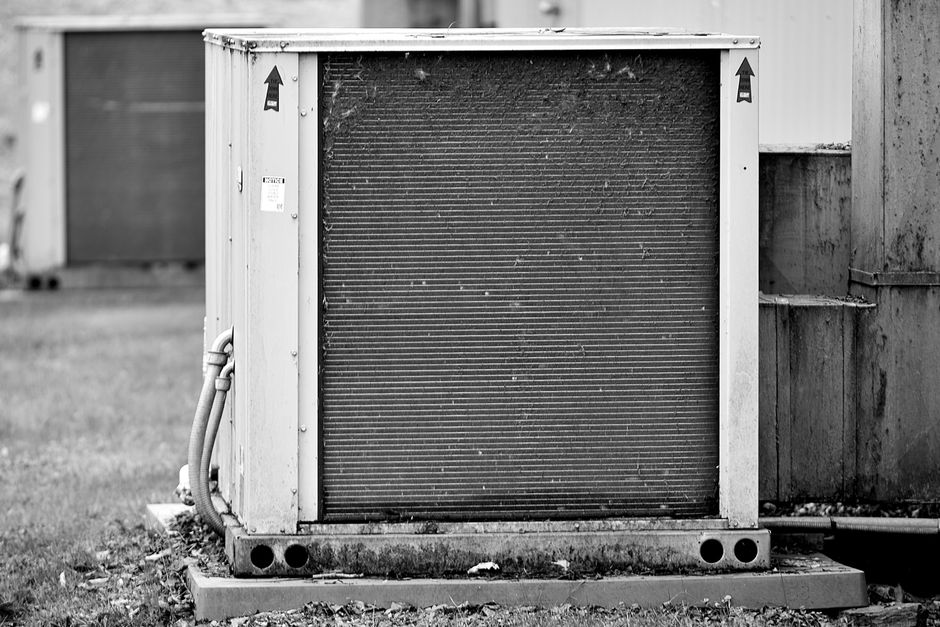
The outdoor unit is often called the condenser unit. It contains several major parts:
- Compressor: Pressurizes refrigerant and moves it through the system. This is often considered the heart of the AC.
- Condenser coil: Releases heat from the refrigerant into the outdoor air.
- Outdoor fan: Pulls air across the condenser coil to help remove heat.
- Contactor, capacitor, and electrical components: Help start and control the outdoor equipment.
- Refrigerant lines: Copper lines that carry refrigerant between the indoor and outdoor sections.
Ductwork is just as important as the equipment itself. Supply ducts deliver cooled air to rooms, while return ducts bring warm air back to be cooled again. If ducts are leaking, poorly insulated, or incorrectly sized, comfort problems can show up even when the AC equipment is working.
Leaky ducts can waste up to 30 percent of cooling energy. In the Antelope Valley, that is a big deal. When outdoor temperatures are extreme, losing cooled air into an attic or crawlspace is like trying to chill your living room with the front door cracked open. Technically possible? Maybe. Smart? Not so much.
How Does a Central Air Conditioner Work Step by Step?
Now let’s walk through the full cooling process. The key idea is heat transfer. Refrigerant changes between liquid and gas states as it absorbs heat indoors and releases heat outdoors.
The Refrigeration Cycle: How Does a Central Air Conditioner Work Step by Step?
Here is the central AC process in more detail:
The thermostat calls for cooling
When indoor temperature rises above your thermostat setting, the thermostat sends a low-voltage signal to the system. This starts the indoor blower and outdoor unit. If the outdoor unit does not start, an electrical part such as the contactor may be involved. We explain warning signs in AC contactor failure symptoms and what causes it.
Warm air returns to the system
The blower pulls warm indoor air through return vents. That air passes through the filter, which helps protect the blower, coil, and indoor air quality.
Air passes over the evaporator coil
Inside the evaporator coil, cold low-pressure refrigerant absorbs heat from the warm air. As the refrigerant absorbs heat, it evaporates from a liquid into a gas. This is where indoor cooling actually happens.
Cooled air moves through supply ducts
After heat is removed, the blower pushes cooled air into the supply ducts and out through registers in bedrooms, living areas, hallways, and other spaces.
Warm refrigerant gas travels outside
The refrigerant, now carrying heat from inside your home, travels through the copper suction line to the outdoor unit.
The compressor raises pressure and temperature
The compressor squeezes the refrigerant gas, increasing its pressure and temperature. This step makes the refrigerant hot enough to release heat outdoors, even on a warm day.
The condenser coil releases heat
The hot refrigerant moves through the condenser coil. The outdoor fan pulls air across the coil, allowing heat to move from the refrigerant into the outside air.
The refrigerant condenses back into a liquid
As heat leaves the refrigerant, it changes from a gas back into a high-pressure liquid.
The expansion valve drops the pressure
The refrigerant passes through the expansion valve or metering device. Its pressure drops, its temperature falls, and it becomes ready to absorb heat again at the indoor evaporator coil.
The cycle repeats until the thermostat is satisfied
The system continues this loop until indoor temperature reaches the thermostat setting. Then the thermostat shuts the cooling call off.
That is the answer to how does a central air conditioner work step by step: it repeatedly absorbs heat indoors, carries that heat through refrigerant, releases it outdoors, and circulates cooled air through the home.
Dehumidification: How Does a Central Air Conditioner Work Step by Step to Remove Moisture?
Central AC also dehumidifies your home. This matters because dry air often feels cooler than humid air at the same temperature.
As warm indoor air passes over the cold evaporator coil, moisture in the air condenses on the coil surface. It is similar to the way a cold glass “sweats” on a hot day. That water drips into a drain pan and exits through the condensate drain line.
This process helps:
- Improve comfort
- Reduce sticky indoor air
- Support better indoor air quality
- Help prevent moisture-related problems
- Allow many homeowners to feel comfortable at a slightly higher thermostat setting
However, dehumidification depends on proper system operation. If an AC is oversized, it may cool the home too quickly and shut off before it removes enough moisture. If airflow is poor, coils may get too cold and freeze. If the drain line clogs, water can back up where it should not.
Compressor Types and System Efficiency
The compressor has a major impact on comfort, efficiency, humidity control, and noise. Modern central AC systems may use single-stage, two-stage, or variable-speed compressor technology.
Efficiency is often measured with SEER or SEER2 ratings. SEER stands for Seasonal Energy Efficiency Ratio. SEER2 is the updated testing standard designed to better reflect real-world system conditions, including duct-related static pressure. Higher ratings generally mean better cooling efficiency.
Modern central air conditioners can reach SEER ratings as high as 26, though the best choice for a specific home depends on sizing, installation quality, duct condition, and usage patterns.
Single-Stage, Two-Stage, and Variable-Speed Compressors
Here is how the main compressor types differ:
| Compressor Type | How It Runs | Comfort Impact | Efficiency Notes |
|---|---|---|---|
| Single-stage | Either fully on or fully off | More temperature swings | Simple and common |
| Two-stage | Runs at a lower stage or full capacity | Better comfort and longer cycles | Often improves humidity control |
| Variable-speed | Adjusts output in small increments | Most even temperatures | Can run longer at lower speeds for efficiency |
A single-stage compressor runs at 100 percent capacity whenever it is on. If your thermostat is set to 72 degrees, the system may wait until the home rises above that setting, then run at full blast until it cools down. This works, but it can create noticeable temperature swings.
A two-stage compressor can run at a lower capacity for milder cooling needs and a higher capacity when more cooling is needed. Many two-stage systems operate around a lower setting for steady comfort, then ramp up during hotter conditions.
A variable-speed compressor can adjust output more precisely. Instead of cycling on and off aggressively, it can run longer at lower speeds. That often means quieter operation, more even temperatures, and better moisture removal.
In hot, dry Antelope Valley communities like Palmdale, Lancaster, Quartz Hill, Rosamond, and Acton, proper sizing and airflow are just as important as compressor type. A high-efficiency system still needs the right installation to perform well.
Choosing and Upgrading Your Central AC System
When choosing or upgrading central AC, homeowners should consider:
- Home size and layout
- Insulation levels
- Window type and sun exposure
- Duct condition and duct location
- Local climate and cooling demand
- Desired comfort features
- SEER2 efficiency rating
- Compressor type
- Thermostat compatibility
- Indoor air quality needs
- Existing electrical and mechanical setup
One of the most important steps is correct sizing. AC size is measured in BTUs or tons. One ton equals 12,000 BTUs of cooling capacity. Bigger is not automatically better. An oversized unit may short-cycle, reduce dehumidification, and wear out faster. An undersized unit may run constantly and still struggle to cool the home.
That is why professional load calculations matter. We recommend learning more through our AC sizing guide for optimal comfort and our guide to BTUs and what size AC you need.
If you are planning a replacement, installation quality is just as important as equipment selection. Useful resources include:
- AC installation steps and tips
- Selecting the perfect AC installation
- Choosing the right AC installation
- A guide to AC installation
The Importance of Proper Maintenance and Installation
A central AC system is a long-term comfort investment. With proper maintenance and care, a good high-efficiency air conditioning system can often provide 15 to 20 years of cooling. Without maintenance, the same system can lose efficiency, struggle with airflow, develop preventable failures, and wear down sooner.
Installation quality matters from day one. Refrigerant charge, airflow, duct sealing, electrical connections, equipment matching, thermostat placement, and condensate drainage all affect performance. A system can be excellent on paper and still perform poorly if it is not installed correctly.
For more detail, read why proper AC installation matters and professional AC installation matters.
Homeowner Maintenance Checklist
Homeowners can do several simple things to help keep central AC running efficiently:
Replace or clean air filters regularly
Check filters monthly during heavy cooling seasons. Many standard filters should be replaced every 1 to 3 months, depending on dust, pets, usage, and filter type.
Keep outdoor equipment clear
Keep leaves, weeds, grass clippings, and stored items away from the outdoor unit. Good airflow helps the condenser release heat.
Do not block supply or return vents
Furniture, rugs, curtains, and boxes can restrict airflow and create hot spots.
Use the thermostat wisely
Setting the thermostat much lower does not cool the home faster. It only makes the system run longer. A smart thermostat can help adjust settings when you are away.
Listen for unusual sounds
Grinding, buzzing, rattling, or repeated clicking can signal a problem.
Watch for weak airflow
Weak airflow may point to a dirty filter, duct issue, blower problem, or frozen coil.
Check the area around the indoor unit
Water around the air handler or furnace area may indicate a condensate drain issue.
Look for uneven cooling
Rooms that stay too warm may have duct leakage, poor insulation, blocked vents, or airflow imbalance.
For more practical tips, visit our guides on benefits of regular AC maintenance, importance of seasonal AC maintenance, and essential AC maintenance tips.
Professional HVAC Maintenance and Installation
Professional maintenance goes beyond changing filters. During a proper AC tune-up, HVAC technicians may inspect and service items such as:
- Refrigerant charge
- Electrical connections
- Capacitors and contactors
- Condenser and evaporator coils
- Blower motor and wheel
- Thermostat operation
- Temperature split
- Condensate drain
- Airflow levels
- Duct performance
- Safety controls
This matters because air conditioning can use more than 2,000 kilowatt-hours of electricity per year in an average-sized home. Small inefficiencies add up quickly when the system runs often.
Professional installation is equally important. A quality installation should include proper system selection, duct evaluation, correct refrigerant line setup, safe electrical connections, thermostat placement away from heat sources, and full startup testing. Our article on the process of a professional AC installation explains what homeowners should expect.
Frequently Asked Questions About Central AC Systems
Does a central air conditioner pull air from the outside?
In most standard central AC systems, no. The system recirculates indoor air.
The outdoor unit does not bring outdoor air into your home. Instead, it releases heat outside. Indoor air is pulled through return ducts, cooled at the evaporator coil, and sent back through supply ducts.
That said, some homes may have ventilation equipment that brings in controlled outdoor air for indoor air quality. But the central AC cooling process itself is mainly recirculation and heat transfer.
How long does a central air conditioning system typically last?
With proper installation and maintenance, many central AC systems can last 15 to 20 years. Actual lifespan depends on:
- How often the system runs
- Maintenance consistency
- Installation quality
- Duct condition
- Outdoor exposure
- Refrigerant charge and airflow
- System sizing
- Local heat demand
In Antelope Valley areas such as Palmdale, Lancaster, Quartz Hill, Santa Clarita, Valencia, Saugus, Castaic, and nearby communities, summer heat can put heavy demand on cooling equipment. Seasonal maintenance helps reduce strain and supports longer system life.
Why is my central air conditioner running but not cooling?
If your AC is running but not cooling well, possible causes include:
- Dirty air filter
- Dirty evaporator or condenser coil
- Low refrigerant due to a leak
- Failing capacitor
- Contactor issue
- Compressor problem
- Frozen evaporator coil
- Blocked return or supply vents
- Leaky or disconnected ductwork
- Thermostat problem
- Undersized or aging system
Start with the simple checks: thermostat setting, air filter, open vents, and outdoor unit clearance. If the system still does not cool, turn it off and schedule service. Running an AC with a frozen coil, failing compressor, or refrigerant issue can lead to more serious damage.
Conclusion
Central air conditioning works by moving heat, not by creating cold air. The thermostat starts the process, warm air moves across the evaporator coil, refrigerant absorbs indoor heat, the compressor raises refrigerant pressure, the condenser releases heat outside, and the cycle repeats until your home is comfortable.
When you understand how does a central air conditioner work step by step, it becomes easier to spot problems, ask better questions, and make informed decisions about maintenance, repairs, installation, and upgrades.
At Affordable Air and Heating, we have served Antelope Valley homeowners since 1996 with HVAC installation, repair, maintenance, and indoor air quality solutions. As a family-owned company, we focus on affordable comfort, energy-efficient options, and flexible financing for homeowners throughout Palmdale, Lancaster, Acton, Quartz Hill, Rosamond, Santa Clarita, Valencia, Canyon Country, Newhall, Saugus, Stevenson Ranch, Castaic, Lake Hughes, Antelope Acres, Ana Verde, and nearby communities.
If your system is struggling to keep up, making odd noises, or due for seasonal service, we are here to help. Learn more about our air conditioning services and let us help keep your home cool, efficient, and comfortable.